Nathan Bedford Forrest Quotes
We have but one flag, one country; let us stand together. We may differ in color, but not in sentiment. Many things have been said about me which are wrong, and which white and black persons here, who stood by me through the war, can contradict.
"General Forrest. His Address to the Colored People Yesterday." Memphis Daily Appeal, 6 July 1875, p. 1.


_0_thumbnail_47x47.jpg)


The “mystic chords of memory” which is one of the most famous Lincoln phrases. As great as this address was, it did not succeed in its purpose of maintaining the Union and preventing secession.

The statement was made just before Kenyan Independence was official. His statement was surprising to many people who perceived him as a racist and anti-white. There was a fear that whites would no longer be welcome in Kenya after independence, but Kenyatta’s leadership maintained a pluralistic society.


Lindbergh, a great aviator, was a Fascist who was a great admirer and supporter of Hitler and Mussolini.

Having endured centuries of near slavery and discrimination, 70,000 Irish people signed this petition urging American-Irish immigrants to understand the similar plight of African-Americans and to join together with abolitionists. Irish immigrants were nevertheless reluctant to join the abolition movement because the movement was often tied to anti-Catholicism and many feared that the emancipation of Blacks would increase competition for the low-paying jobs immigrants held.

The then Vice President was accosted on the train by southerners who believed that he was on his way to his home state of Tennessee to persuade the legislature not to secede from the union. Amid cries to hang him and after he was punched by one of the mob, ex-Senator Wigfall—the man who had received the surrender sword at Sumter, who was also on the train, persuaded the crowd to hear Johnson out. Johnson thus began his speech which was potentially for his life, but never wavered from his view that secession was a mistake. Most of the crowd calmed down and as the train pulled out, they let him go though there were still a few shouts for “hanging.” There was no secret service protection for the President or vice President at the outbreak of the Civil War. Pinkerton had organized some informal protection for the President and thwarted some plots, but it was the Vice President who was attacked first. And there was not sufficient protection to prevent Lincoln’s assassination.


At the time racism and discrimination in the United States was not only rampant but legal. But change in many substrata of America was detectable and many intellectuals--writers, artists, scientists, educators, theologians, entertainers, groups who would later be called “elites” began to make themselves heard on the subject. Falkner was one whose novels had always taken an anti racist view point and now were overtly calling for political and social change.

After the Civil War and Reconstruction, the American nation was still bitterly divided intelelctually, socially, emotionally and poliotically. In an effort to bring more unity to America, most of the power stucture and the influentials of the nation began to avoid those issues that would divide North and South and try and promote a narrative that both sides might be able to live with. And this is what Zeitz describes in this quotation. America went through a period of Revisionist History that even in the 21st century was held by many people. It wasn't until the middle of the 20th century that the real history and narrative of the Civil War and Reconstrution emerged from the few academics who had all along criticized the fabricated narritive that did unify the country at the cost of historical accuracy and truth. Many scholars point out that the price that America paid for this unity was the Jim Crow era and a century of legalized racism. Much of the nation was built on the labor of Negro slaves and the victims of the slavery era, also bore the brunt of American unity and reconcilliation.


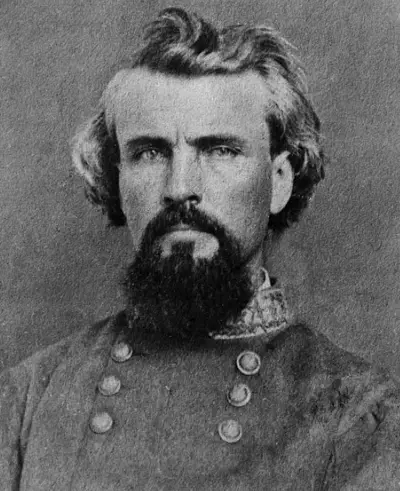
Nathan Bedford Forrest was a prominent Confederate Army general during the American Civil War and the first Grand Wizard of the Ku Klux Klan from 1867 to 1869. Before the war, Forrest amassed substantial wealth as a cotton plantation owner, horse and cattle trader, real estate broker, and slave trader. In June 1861, he enlisted in the Confederate Army and became one of the few soldiers during the war to enlist as a private and be promoted to general without any prior military training. An expert cavalry leader, Forrest was given command of a corps and established new doctrines for mobile forces, earning the nickname "The Wizard of the Saddle". His methods influenced future generations of military strategists, although the Confederate high command is seen by some commentators to have underappreciated his talents. Although scholars generally acknowledge Forrest's skills and acumen as a cavalry leader and military strategist, he has remained a controversial figure in Southern racial history for his main role in the massacre of several hundred Union soldiers at Fort Pillow, a majority of them black, coupled with his role following the war as a leader of the Klan.
