Albert Gallatin Quotes
I know and see every day the extent of geographical feeling, and the necessity of feeling if we mean to preserve and invigorate the Union.
The North and the South had major differences on the issue of Spanish Florida and whether or not the U. S. should expand by force. Northerners were generally opposed while the South had an opposite view.
Albert Gallatin, 1761-1849, U. S. Congressman & U. S. Senator (PA, Anti-Federalist), U. S. Secretary of the Treasury, Ambassador to Great Britain, Ambassador to France, Letter to Secretary of State James Monroe, May 8, 1813
Sourced by: Eigen's Political and Historical Quotations


The “mystic chords of memory” which is one of the most famous Lincoln phrases. As great as this address was, it did not succeed in its purpose of maintaining the Union and preventing secession.


The words are those of President Andrew Jackson. See {604550}. After occupying New Orleans, General Butler infuriated the Confederate Sympathizers with this act. Jackson was the hero of the Battle of New Orleans and an unapologetic slave owner. The Southerners had erected a magnificent statue of their hero Jackson on horseback in a major section of the city. Butler, then ordered that the Jackson quotation be chiseled in the stone base. The townspeople were furious that this Union General would make up words and attribute them to Jackson; however, when they finally realized that Jackson had actually said those words they felt even more humiliated. There are still a few Southernors who consider this terrible insult to the Confederacy, and of course that is just what Butler intended.

The then Vice President was accosted on the train by southerners who believed that he was on his way to his home state of Tennessee to persuade the legislature not to secede from the union. Amid cries to hang him and after he was punched by one of the mob, ex-Senator Wigfall—the man who had received the surrender sword at Sumter, who was also on the train, persuaded the crowd to hear Johnson out. Johnson thus began his speech which was potentially for his life, but never wavered from his view that secession was a mistake. Most of the crowd calmed down and as the train pulled out, they let him go though there were still a few shouts for “hanging.” There was no secret service protection for the President or vice President at the outbreak of the Civil War. Pinkerton had organized some informal protection for the President and thwarted some plots, but it was the Vice President who was attacked first. And there was not sufficient protection to prevent Lincoln’s assassination.


“Sectionalism” really referred to the North / South animosity which carried over from the Civil War. The South would hardly ever elect a Republican as it was the Republican Lincoln Government that ended slavery and put down their rebellion in the Civil War. There was a language difference that was much greater than modern times and the South was way behind most of the rest of the country in terms of education and standard of living. Every time the Federal Government would try and enforce the Constitution with respect to race, the sectional friction would break out again. The sectional issues carried into the 21st century but had gotten much better.


Bragg and other Southerner leaders had an unusual concept of equality. Ever since the original Constitution, Northerner’s votes counted for themselves only while a single Southerner’s vote counted for all his slaves as well. So the individual Southerner always had more political power than his Northern counterpart. However, this notion of equality reached it’s acme when it came to the new territories. The Southern argument was that Southerners could not equally prosper in the new territories of Kansas and Nebraska if they could not bring their slaves to work the land. The thought that Southerners were equally able to personally work the new lands or pay labor seems to never have occurred to them. If Northerners could prosper that way then Southerners should be equally able to do so also. However, many Southern whites simply could not conceive of a “gentleman” working in the fields. Therefore they would not be equally able to prosper in the new territories.

War had broken out in Europe and Jefferson enumerated a series of actions so that the United States would remain neutral. He was concerned that individual Americans would partake in foreign wars and then be captures of have to be ransomed or would give offence to some other nation who would assume that the American was acting with government approval and was allied with an enemy. The issue of American mercenaries fighting in foreign conflicts has been controversial ever since.
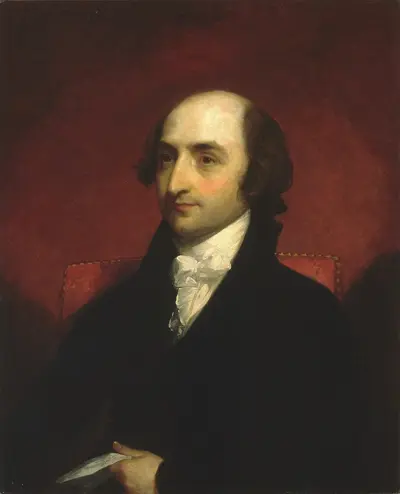
Abraham Alfonse Albert Gallatin, born de Gallatin was an American politician, diplomat, ethnologist and linguist. Biographer Nicholas Dungan states he was "America's Swiss Founding Father." He is known for being the founder of New York University and for serving in the Democratic-Republican Party at various federal elective and appointed positions across four decades. He represented Pennsylvania in the Senate and the House of Representatives before becoming the longest-tenured United States Secretary of the Treasury and serving as a high-ranking diplomat.
