Eleanor Roosevelt Quotes
We are such a large country that it is sometimes hard for us to realize that we are one nation, and that the interests of one part of the country, though they may be at variance with other parts, must react on each other and are therefore of interest to all men and women everywhere in the United States.
Eleanor Roosevelt, 1884-1962, First Lady (Franklin Delano Roosevelt), U. S. Delegate to the United Nations, Column, My Day, August 14,1936
Sourced by: Eigen's Political and Historical Quotations


At the time sectionalism was extensive in America. Most Iowa and Northern families still remembered a relative who had been “killed by the rebels” in the Civil War. The South still resented the rest of the country. The East and Midwest had much better educated than the rest of the country. Most important, there was very little contact between Americans of different sections. Until the great Eisenhower initiative of a National Highway System sectionalism was common. Presidents were constantly trying to develop a national American spirit.


The North and the South had major differences on the issue of Spanish Florida and whether or not the U. S. should expand by force. Northerners were generally opposed while the South had an opposite view.

The Southern authorities were particularly angry with people form the North coming South to demonstrate over unconstitutional and immoral segregation laws. Northerners were considered as having no business with Southern desegregation. Mrs. Peabody, and the wives of a number of wives of Christian Bishops, black and white, went to a restaurant in St. Augustine and requested service which was contrary to the segregation laws of Florida at the time. The women were arrested. The act of civil disobedience in integrating the restaurant was one act of a planned desegregation strategy worked out with Martin Luther King’s SCLC organization. The mature age of the women and their prominent husbands brought a great deal of newspaper coverage which is just what the demonstrators wanted. The photo is of Mrs. Peabody getting arrested. See {637404} and {637406} for more on this incident.


War had broken out in Europe and Jefferson enumerated a series of actions so that the United States would remain neutral. He was concerned that individual Americans would partake in foreign wars and then be captures of have to be ransomed or would give offence to some other nation who would assume that the American was acting with government approval and was allied with an enemy. The issue of American mercenaries fighting in foreign conflicts has been controversial ever since.

Ingersoll was considered to be the greatest orator and political thinker of his day, but his overt atheistic views curtailed his elected political career.

President Benjamin Harrison and Congress proclaimed that October 31, 1892 be a national celebration of the 400th Anniversary of Columbus landing in America. Bellamy represented a juvenile weekly publication and was named chairman of the committee to conduct the celebration. A first draft of the pledge was written by James B. Upham, a staff member of the publication. The words "under God" were added in 1952 by an Act of Congress. The original had “to my flag.” The pledge was first used publicly at the Chicago World’s Fair on October 21, 1892. It was not endorsed by Congress until 1942. It is officially recognized as law in 36 United State Code 172.
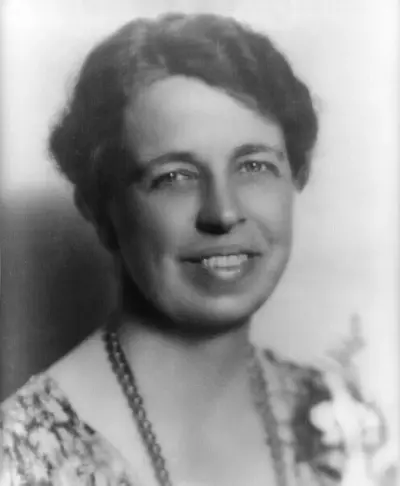
Anna Eleanor Roosevelt was an American political figure, diplomat and activist. She served as the First Lady of the United States from March 4, 1933, to April 12, 1945, during her husband President Franklin D. Roosevelt's four terms in office, making her the longest-serving First Lady of the United States. Roosevelt served as United States Delegate to the United Nations General Assembly from 1945 to 1952. President Harry S. Truman later called her the "First Lady of the World" in tribute to her human rights achievements.
