Andrew Johnson Quotes
You cannot found a monarchy on this Continent.
Publicly warning Louis Napoleon against his adventure in Mexico:
Andrew Johnson, 1808-1875, 17th President of the United States (War Democrat), Speech, Nashville, TN, June 10, 1864
Sourced by: Eigen's Political and Historical Quotations

The Congress was reacting against the prospect of France supporting a monarchy in Mexico.

This was the first contact between the colonists and the French government. The French agent was very non committal and the parties were just feeling each other out. Franklin made it perfectly clear that the colonists would not trade the English King for a French one and become part of the French empire.


Although friendly to America, Canning was a monarchist and did not share America's enthusiasm for democracy and concern about Spanish Princes in Mexico and Brazil.

Commenting on the concept of democracy and it's lack of Biblical justification:

When ambassador to Great Britain, he was very supportive of the British Fascists, and was an admirer of Adolf Hitler. Once war with Germany was commenced, Kennedy predicted that England would lose the war and became a fascist puppet state controlled by Germany. He opposed Lend Lease and the other efforts of the Roosevelt administration to assist England to fight off the Germans. Ironically his oldest son died in a dangerous volunteermission fighting Germany in the War. Kennedy's earlier pro-German views ended his political career and was an embarassment to his sons when they entered politics.
This Cahier was the consensus of the Clergy of Blois in 1789. There were cahiers of several provinces of France—some by the clergy, some by the nobles. What is fascinating is the emergence of many of the pre-revolutionary French concepts. The example of the American revolution and its principles was known throughout the educated classes of France.

Huey P. Long credited this quotation for the origin of his famous slogan, "Every Man a King, but No Man Wears a Crown”. See {609936}


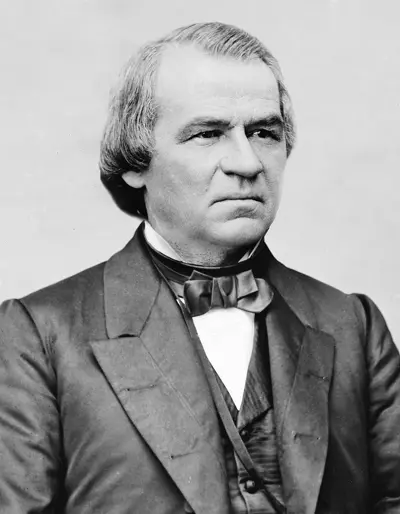
Andrew Johnson was the 17th president of the United States, serving from 1865 to 1869. He assumed the presidency as he was vice president at the time of the assassination of Abraham Lincoln. Johnson was a Democrat who ran with Lincoln on the National Union ticket, coming to office as the Civil War concluded. He favored quick restoration of the seceded states to the Union without protection for the former slaves. This led to conflict with the Republican-dominated Congress, culminating in his impeachment by the House of Representatives in 1868. He was acquitted in the Senate by one vote.
