Maryland Quotes
All Negroes and other slaves within this province, and all Negroes and other slaves to be hereinafter imported into this province, shall serve during life; and all children born of any Negro or other slave, shall be slaves as their fathers were, for the term of their lives.
In contrast to Massachusetts with had passed a law in 1641 banning slavery (Quote 643567), Maryland 22 years later became to first state to pass a law to formally recognize and allow Negro slavery.
Maryland General Assembly. "An Act Concerning Negroes and Other Slaves." Archives of Maryland: Proceedings and Acts of the General Assembly of Maryland, January 1637/8-September 1664, edited by William Hand Browne, vol. 1, Maryland Historical Society, 1883, pp. 533-534.

This law, reflecting the religious values of the Puritans, would form the basis and example of slavery prohibition in some of the other Northern States of Colonial America. They colony allowed indentured servitude, if voluntary, but required that even indentured servants have certain freedoms, and of course when the period of indenture was served, the servant was totally free.

This treaty shows slaves were a major currency of the times and cultures. The Arab Armies of Egypt and the Nubians with this treaty declared an armistice. The extensive Arab use of Black slaves officially begun at this time, has plagued Africa since. Arab slave traders were the middle men who met the European and American demand for slaves until the 19th century. Even at the millennium the Sudanese civil war between the Arab North and Black South has reflected this resentment and hostility and has involved the Northerner’s enslaving tens of thousands of Black Southerners.

He was the last Pope to hold temporal power. This defense of slavery was all the more surprising because America was fighting about the issue in the Civil War and nations like England had abolished slavery. 99 years later Vatican II altered Pius IX’s statement forever. See {612715}.

See the Vermont Constitution for another variant of how slavery was abolished: {616994}

This is one of the major reasons that Slavery was so hard to end in the South. At the time, the dollar value of the Southern slaves was greater than the value of all the land, factories, inventory, and capital equipment of the South. Slaves were not only capital, they were the largest component of Southern capital and Southern wealth. There were numerous ideas of paying slave owners for the freedom of their slaves, and if this was done, it would have been far less expensive in money alone than the Civil War cost. However, the Southern leadership, like Fitzhugh, were totally intransient with culture and customs—indeed the Southern concept of manhood—was dependent in Slavery. The result was that no compensation was paid to slave owners and the South was impoverished as a result of its capital loss and it would not recover for 150 years.


The “lords of the lash” were the Southern slave owners. The “lords of the loom” were the Northern mill owners. The Southern cotton, grown by cheap slave labor was sold to the Northern mill owners at very low prices. They in turn wove the cotton into cloth and sold it throughout the nation and to foreign countries. So, although there was strong Northern anti-slavery sentiment, the wealthy and politically powerful mill owners had a vested interest in maintaining slavery in the South.


Louisiana to this day has a different legal system from the rest of the United States as it was originally based on the French Napoleonic Code. Most people did not realize that Louisiana had strictures against breaking up families—even with slaves.

The Mormons were in Missouri at the time. Phelps was warning the church members essentially not to get involved with the slavery issue. The Mormon Church tended to support the institution of slavery at that time although Mormons themselves did not own slaves. However, we should remember that the Mormons themselves were a very persecuted group and Phelps and other Church leaders probably didn’t want their members alienating the non Mormons more than they already did by their existence. This was very similar to the Roman Catholic Church leaders at the time. The Catholics were also a persecuted minority and the Catholic Bishops often supported slavery—especially in the South to try and avoid hostility from the power structure and the majority. Some individual Mormons and individual Catholics were much opposed to slavery. See {629158} and {629154} for more on the Mormons and slavery. Later, Smith altered his early view.

There was little thought of emancipating slaves or their value to the South by the senior officers of the Union Army at the beginning of the war. The Secretary of War however changed that. See {629184}.


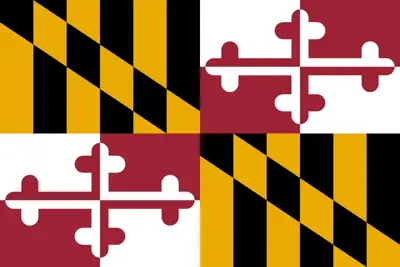
Maryland (US: /ˈmɛrələnd/ (listen) MERR-ə-lənd) is a state in the Mid-Atlantic region of the United States, bordering Virginia, West Virginia, and the District of Columbia to its south and west; Pennsylvania to its north; and Delaware and the Atlantic Ocean to its east. Baltimore is the largest city in the state and the capital is Annapolis. Among its occasional nicknames are Old Line State, the Free State, and the Chesapeake Bay State. It is named after the English Queen Henrietta Maria, known in England as Queen Mary, who was the wife of King Charles I.
