Paul Robeson Quotes
The artist must elect to fight for freedom or slavery. I have made my choice. I had no alternative. the history of the capsulize era is characterized by the degradation of my people: despoiled of their lands, their true culture destroyed...denied equal protection of the law, and deprived their rightful place in the respect of their fellows.
Paul Robeson, 1898-1976, Entertainer, Pacifist and Civil Rights Leader, Quoted in Susan Robeson, Paul Robeson, The Whole World in His Hands, 1981
Sourced by: Eigen's Political and Historical Quotations


The issue of slavery which had been suppressed in Congress for the first decades of the nation broke out when Missouri statehood was considered. By previous agreement, slavery was not even discussed in Congress but the time period elapsed. Tallmadge not only proposed that no more slaves could come into Missouri {613176} but most shocking to the Southerners was that every person born in the new state would be free at the age of 25. In a generation, there would be no more slavery in Missouri and there would be no economic compensation for slave owners at all. The House of Representatives accepted the amendment, but it failed in the Senate. At that time, Senators were not elected by voters but were appointed by the state legislators and the Southern slave states had a disproportionate share of the senate from a population point of view. But what this quotation shows clearly that a majority of the country in 1819 were opposed to slavery and were willing to end it without compensation.

This quotation explains why so many of the Southern poor so actively supported the racist Slavery system even though they could not afford slaves and received no direct benefit from slavery or the discrimination against free Blacks. The poor were not at the bottom of the totem pole, and therefore had a dignity and social status, that the poor in a racially integrated society never possessed.

The President often referred to this statement as an example of his wife’s acumen. She had been born to a Southern plantation and inherited the land and the slaves. Her view, and his, were typical of the Southern point of view in early America.

What is interesting is that when he cites the dreadful facts about American slavery, he never points out that the American slave traders rarely raided the villages and captured the slaves themselves. Most often this was done my Khamenei’s Muslim brethren slave traders who dominated the slave trade in Africa. Nor does he point out what after realizing the evil that Americans perpetrated with slavery, we ended it in the 1860s. Saudi Arabia, the central nation of Islam, did not make slavery illegal until 100 years later, and even today, there are many Saudi’s who get caught practicing slavery with household servants and forms of indentured servitude. And while Christians and the Bible tolerated slavery, the Koran and the Prophet never once condemn the practice of slavery. Democracy at any point in time is not always morally right, but it is a process by which under pressure from the people it improves over time because the people can change it and do.


Moss and two other blacks had had the temerity to open a grocery store. White competitors attempted to have the city authorities close the store. When that failed, a mob took the three Black owners to the city limits and shot them all to death. Moss was a close friend of Ida B. Wells, and his lynching started her on her no famous anti-lynching expose and campaign. See {44393} for her initial response.


Before the civil rights act was passed, most labor unions will racist and discriminated against black workers. The United Auto Workers union was an exception and Reuther was a strong advocate of desegregation and equal rights.


Johnson was then Vice President.


She was one of the first prominent white southerners to denounce racial segregation.

His Indian Removal Policy forced Native American to leave their lands which were theirs by treaties signed by the United States and marched to the poorest land in Oklahoma where they were "resettled". This is often referred to as the "Trail of Tears". What made his actions evern wors was the fact that The Supreme Court had already ruled that such land belinged to the Cherokee Indian Tribe and the government of the United States may not force them from it. Jackson was the only President in Amrican History to defy a Supreme Court order.
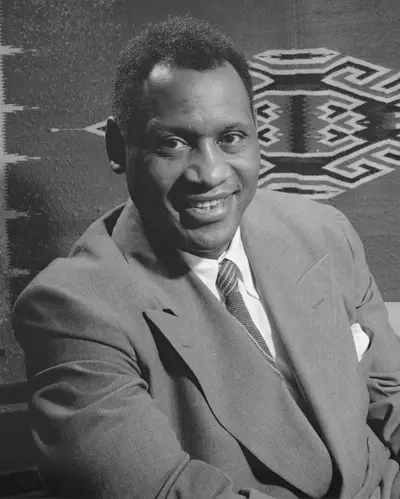
Paul Leroy Robeson was an American bass baritone concert artist and stage and film actor who became famous both for his cultural accomplishments and for his political activism. Educated at Rutgers College and Columbia University, he was a star athlete in his youth. He also studied Swahili and phonetics at the School of Oriental and African Studies in London in 1934. His political activities began with his involvement with unemployed workers and anti-imperialist students whom he met in Britain and continued with support for the Republican cause in the Spanish Civil War and his opposition to fascism. In the United States he became active in the Civil Rights Movement and other social justice campaigns. His sympathies for the Soviet Union and for communism, and his criticism of the United States government and its foreign policies, caused him to be blacklisted during the McCarthy era.
