John C. Calhoun Quotes
The two great divisions of society are not the rich and poor, but white and black. And all the former, the poor as well as the rich, belong to the upper class, and are respected and treated as equals.
This quotation explains why so many of the Southern poor so actively supported the racist Slavery system even though they could not afford slaves and received no direct benefit from slavery or the discrimination against free Blacks. The poor were not at the bottom of the totem pole, and therefore had a dignity and social status, that the poor in a racially integrated society never possessed.
John C. Calhoun, 1782-1850, U. S. Congressman & U. S. Senator, U. S. Secretary of War & U. S. Secretary of State, Vice President of the United States (Democrat, SC), Senate Speech, 1848
Sourced by: Eigen's Political and Historical Quotations

the white Southern racist system She was one of the first prominent white southerners to denounce racial segregation.


It was not until this publication that people who suggested that discrimination and lack of education and opportunity might have something to do with the problem Blacks faced in society were regarded by many Americans as anything but left wing intellectuals.

Booth was the younger son of a very prominent Northern family of actors. His older brother was considered the greatest American actor, and the rest of the family were abolitionists and vehement Union supporters. They found young John’s views reprehensible.


Robert Allen Zimmerman

Charleston was in the Southern part of the state where most people supported slavery. Douglas made an unequivocal pitch for the racist vote {600060} and forced Lincoln to take a stand. Like many politicians today, Lincoln decided to give the audience what they wanted to hear. It is not clear whether or not he ever believed this statement or was just pandering in a political campaign. He had never said this in the Northern part of the state of before. Lincoln’s views on race changed and matured over the years, culminating in the Emancipation Proclamation. Lincoln lost the Senate seat to Douglas.

Moynihan was an Assistant Secretary of Labor at the time. At the time politicians did not overtly discuss the racism that had, did then, and still does permeate the American culture. Segregation had just been made illegal but was still rampant. Many whites were highly insulted by this paper. Most Blacks were outraged at Moynihan's general thesis. So the report offended many.

Referring to Montgomery Alabama in 1950.

Incredible as it seems today, no Black person had ever dined in the White House as a guest of the President. African American servants were common. And Abraham Lincoln had received many Black visitors as had Presidents after him. But no president had ever had a Black person to dine as a social equal. The photo, reproduced here, illustrates the parity. But that was the worst thing a President could do so far as Tillman and his fellow racists were concerned. They had, since the end of the Civil war, used violence and terrorism to murder, maim and/or intimidate the Negro population to remain in an economic and socially inferior position. In Tillman’s state over these decades they had more lynchings than legal executions and there were plenty of them. Newspapers over the South riled up the whites and there was a wave of terror to be sure that the President’s importune action would not be taken as an endorsement of the Negro’s right to any equality or even dignity. This dinner essentially wedded all the Blacks to the Republican Party and all the Southern Whites to the Democratic Party. This would remain the political situation for over 60 years until the Democrats passed the LBJ Civil Rights Act in 1964 and the Republicans decided to solicit the Southern White racists who accepted the invitation and within a few years, there was a complete reversal of party loyalty of most Blacks and most Southern White Racists.

The editor at the time was Dr. William H. Boyle but no one is sure whether he, the owner, or someone else, wrote the editorial. The quotation illustrated a fascinating twist of logic that was very commonly held at the time. “If God created men of different colors, he must have meant them to be separate.” It is fascinating that virtually no one at the time made a similar argument about hair or eye color, intellect or other differential traits of people. Although this logical fallacy waned in the latter part of the 20th century, there are some who still hold to it.

Perhaps there is no more dramatic quotation illustrating MacArthur’s arrogance where his own views and decisions should obviously prevail regardless of the policies of his superiors and his commander-in-chief. The army had been officially integrated by President Truman, The reality was that the general honestly believed that he had no superiors among the military, that civilians should not control the military, and in any event that the President—Truman—was not fit to be Commander-in-Chief.

Captain W.W. Polk, commanding the Coast Guard revenue cutter Florida, wrote Treasury Secretary asking permission to employ a young Negro on board. Existing regulations prohibited such. The Negro in question was a free Black born in New York who was an “expert sailor for his age and competent to the duty of a boy of the first class.” Polk had hired the boy as a servant after he had worked at sea for another Captain. Good seamen were hard to come by, decision was extremely contentious. Ingham “compromised” by limiting the allowable role of Negroes at sea—a practice that lasted till the Second World War.

Newsletter of the United Sons of Confederate Veterans

This classic quotation illustrates several things. First, the degree of racism that existed in 1944 in West Virginia. Second, not how young Robert Byrd immediately leaped from the possibility of integrating our fighting forces to interracial sex. That has been typical of white racism in America—a preoccupation with race and sex. Last, Byrd who became a member of the KKK, completely changed his mind over the year and ended up supporting the things that, as a youth were worse than the demise of the nation. He matured and grew on the race issue as much of the country did and ended as a strong supporter of equality and civil rights—including affirmative action.

She was one of the first prominent white southerners to denounce racial segregation.

This was the first of the famous Lincoln-Douglas Debates. The men were contesting for the U. S. Senate. Douglas won the election.
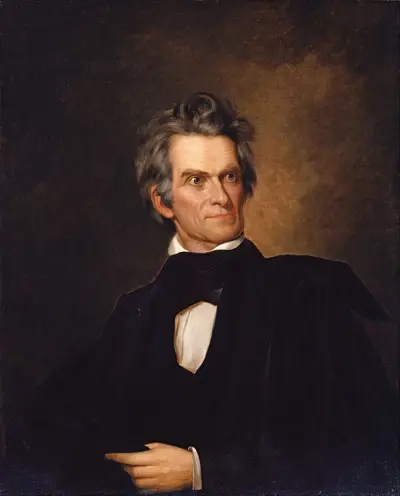
John Caldwell Calhoun was an American politician and political theorist from South Carolina who held many important positions including being the seventh vice president of the United States from 1825 to 1832, while adamantly defending slavery and protecting the interests of the white South when its residents were outnumbered by Northerners. He began his political career as a nationalist, modernizer, and proponent of a strong national government and protective tariffs. In the late 1820s, his views changed radically, and he became a leading proponent of states' rights, limited government, nullification, and opposition to high tariffs. He saw Northern acceptance of those policies as a condition of the South remaining in the Union. His beliefs and warnings heavily influenced the South's secession from the Union in 1860–1861.
