John Rankin Quotes
Another doctrine, worse still is gaining ground. It is that the colored people are not sufficiently informed to chose what is best for themselves, and that they ought to be compelled to go to Africa. Many colonizationists now avow it openly. And thus there is danger that the society will grow up into one of the most dreadful systems of cruelty that have ever afflicted the world.
John Rankin, 1793-1886, Pastor of the First Presbyterian Church of Ripley, Ohio, Founder of the first anti-slavery society in Ohio, 1835, Operator of Rankin House, a key stop on the Underground Railroad, Defense of Seminary Students organizing Anti-Slavery Activities, 1935
Sourced by: Eigen's Political and Historical Quotations


Actually Blacks did all three. Some returned to Africa and established the state of Liberia. Others went to South America and most stayed in the United States and continued to help build the nation.
_0_thumbnail_47x47.jpg "A portrait of Richard Allen, a Methodist bishop and founder of the African Methodist Episcopal Church")
Many whites thought that the solution to the problem of free and emancipated Negroes was to send them to Africa. They assumed that the negroes would by desirous of that solution also, but they rarely asked them. When they did, they received answers much like this one from one of the leading Black clergymen in America.


Jamaica, then part of the British Empire which had outlawed slavery, was quite racially integrated with negroes and mulattos in civil positions such as magistrate. When the ship landed, the slave, John Anderson, was kept locked below deck since if he ran off and reached shore, the Jamaican authorities would have declared him a free man. The presence of the captive negro slave leaked out and a group of Jamaicans boarded the ship uninvited and forcibly removed Anderson, He was taken before a Jamaican magistrate who declared him a free person. The ship’s captain demanded that the authorities return the American private property which had been stolen from an American ship by a “mob”. Harrison, the US Counsel complained to the Jamaican Governor of the “Insult” to the American Flag that had taken place and demanded redress. In both efforts, the original decision of the magistrate was supported and Anderson was a free man. Harrison, an ardent Southerner from Virginia was apoplectic and asked the State Department to make this case a major issue in relations with London. His description of the public opinion then in Jamaica was classic. His racial bias was even supplemented by a virulent anti-Semitism because not only had Jewish Jamaican merchants supported abolition of slavery but some had intermarried with Negroes who had converted to Judaism.


He was also himself a ship owner in the slave trade and he was the brother of the leading Rhode Island abolitionist, Moses Brown. See {585793}. Brown became the first American, prosecuted in federal court for illegal slave trading –-- a prosecution brought, in part, by his own brother. He was, however, acquitted.

Many Quakers saw Negroes as brothers and invited them to worship. Even some who owned slaved allowed them to attend their Quaker religious services. As such, they were a model of Christianity at a time when most other churches were not as advanced. The majority of the slave owners saw a great threat in Christianizing the Black slaves and hence they passed this law.

This idea has been rejected by American Blacks from before the Civil War. There were many Black families that have been in America longer than Rockwell who always had the choice to go back to where they cam from if they were unhappy with America but they never did.


The Boers were lower class, uneducated, farmers from Holland who came to South Africa before the English did. They were at the bottom of the Dutch socioeconomic ladder. Unlike the English who were interest in establishing a trading colony, the Boers just wanted to own and farm the land and use blacks as slave or cheap labor. The Dutch Government and Trading companies lost interest in South Africa as there were much more profitable parts of the world, and they felt no obligation to the Boers whom they were glad to be rid of. So the Boers found themselves having to follow the British laws and rules of the British Colonial Office. Slavery was outlawed, and Blacks could be educated and become citizens under British law. They could own land, and contest the right of the Boers who had settled in some uninhabited land and some that was owned by Black tribes. The Blacks outnumbered the whites in general and the Boers, and there were educated Blacks who “outclassed” the still relatively uneducated Boers. So the Boers, fighting for their “way of life” set up their own area in Southern Africa and claimed independence. But Blacks claimed that it was their land and looked to the British to exercise English law. The Boer war ensued. Although the Boers lost the war, the bred at a much faster rate than the English, many of whom did not even have their families in South Africa. By the end of WWII, the Boer white majority controlled the government and kept the majority Blacks from voting and having full citizenship rights. They dominated Apartheid South Africa until the Black Revolutionists obtained control and although Black and white relations are better in South Africa than most countries, the extemeist Boers and most militant Blacks are in political, but not violent, conflict. Churchill and the British have always perceived themselves as being caught in the middle between the Boers and the Blacks.


As an entertainer she had toured much of the world and seen American slavery and that of some other nations. She became a staunch abolitionist and like entertainers in the 20th and 21st centuries she used her celebrity to give anti-slavery lectures and perform for audiences where she donated the proceeds of the event to the abolition cause. She is a particularly interesting political figure in that she seems to be one of the first entertainers to perform for a social cause and become an activist.


Abraham Lincoln in his famous eulogy to Clay in Springfield, IL, used this quotation.


Julian, the chemist who developed the industrial process of producing human steroids from soybeans, was the most famous and accomplished African American chemist at the time and the first Black laboratory director in America.
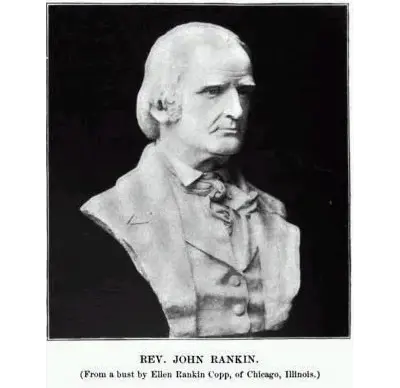
John Rankin was an American Presbyterian minister, educator and abolitionist. Upon moving to Ripley, Ohio, in 1822, he became known as one of Ohio's first and most active "conductors" on the Underground Railroad. Prominent pre-Civil War abolitionists William Lloyd Garrison, Theodore Weld, Henry Ward Beecher, and Harriet Beecher Stowe were influenced by Rankin's writings and work in the anti-slavery movement.
