Gustave de Beaumont Quotes
I have seen the Indian in his forests and the negro in his chains, and thought as I contemplated their pitiable condition, that I saw the very extreme of human wretchedness, but I did not then know the condition of unfortunate Ireland …. In all countries, more or less, paupers may be discovered but an entire nation of paupers is what never was seen till it was shown in Ireland. The misery of Ireland descends to degrees unknown elsewhere.
Gustave de Beaumont, 1802-1866, French magistrate, prison reformer, and writer, Travel companion to Alexis de Tocqueville, Observation of Ireland, 1837
Sourced by: Eigen's Political and Historical Quotations

The highway was planned to go through a poor neighborhood which had a high percentage of Black residents—all of whom would have to find other housing and move to make room for the highway. If the government plans a highway through a wealthy area, the cost to condemn and pay for the land will be much greater than if a poor neighborhood is acquired. For urban highways, the poor almost always bear a disproportionate share of the inconvenience while the major benefit inures to the wealthy and middle class. Abbot had been a labor organizer and a professional artist before he entered politics. The graphic is of his famous poster which by itself stopped the plans to build the highway very quickly.


Parker and other escaped slaves in Christiana fought off slave catchers and killed the slave owner leading them. Charged with treason, he escaped to Canada with his family and lived there the rest of his life. While not a polished writer, after he himself had escaped and went to Christiana and leaned to read and write. He wrote this narrative of his life as a slave—one of the few written works we have from slaves.


Indian and Black slaves were outlawed very early in Connecticut, not on moral grounds of concern for the Indians and Blacks, but because of the negative effects on the white poor. Why would anyone pay the poor any more than the amortization costs of a slave? Therefore there was no way a poor white could make a living wage if slavery were to coexist.


In many of the non—slave states, free negroes were not allowed to enter or reside in the state

This quotation is interesting for two reasons. First it is a good example of the twisted logic of some of the Slavery apologists who claimed that the Negro slave was better off than the free wage earner. The second reason is that it illustrates the norms of the treatment of the working man before the Civil War. The union movement would change the situation for the free laborer over the next century and then holidays and worker rights became normalized in American society. See {641290} for another of his absurd arguments.


This quotation was a the description of the nail manufacturing operation using slave labor on Thomas Jefferson’s plantation, Monticello. Note the almost romantic scene that the author paints of slavery and forced child labor. That is why this is a very important quotation. This biography of Jefferson, written for a young audience, was typical of material written about the South and slavery from the late 19th century till the late 20th century. The South was still resentful about losing the war, and there was still, late in the 19th century, negative feelings in the rest of the nation about the South’s lack of patriotism and worse their basic morality of having not only supported but fought to maintain the cruel, evil institution of slavery. Many wanted to get these sectional feelings behind them and move forward. One way was to do much revisionist history about the institution of slavery and the reasons for the Civil war. Books, plays, and later films, and the school curricula, were designed to edit out or minimize the brutality and cruelty of slavery. And the reasons for the Southern rebellion was not any longer only to maintain slavery, but more palatable, almost noble reasons were substituted for the reality that slavery was the only major reason for the Southern rebellion. Maintaining a different culture and way of life, freedom from Federal intrusion in state and local affairs, honor and others were then new given reasons, and the problems of Reconstruction for the South exaggerated to justify the then Jim Crow American era of legal discrimination and lynching. This passage came from a book that was so popular with young people, that it was published again in a new edition as late as 1961. Most white Americans, growing up in the 20th century learned this version of events and many vestiges of it could be seen, even in the 21st century. In the 1970s, with an end to legal segregation, attention turned to the culturally and historically distorted views, and slowly schools began to change curricula. However, in the Southern States, in order to prevent the schools from departing from the false, romantic view of Southern Slavery, local schools where not allowed to select their own textbooks and in many cases even their own library books.

For more about the Bureau. See {629185}.and {629187}.
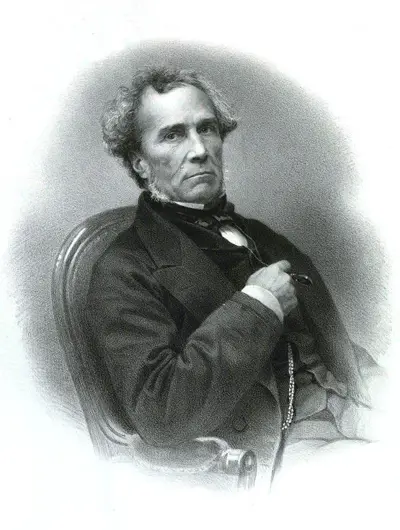
Comte Gustave Auguste Bonnin de la Bonninière de Beaumont (1802 in Beaumont-la-Chartre, Sarthe – 1866, Tours) was a French magistrate, prison reformer, and travel companion to the famed philosopher and politician Alexis de Tocqueville. While he was very successful in his lifetime, he is often overlooked and his name is synonymous with Tocqueville's achievements.
