Salmon P. Chase Quotes
…separation was in everyone’s best interest…blacks would find happier homes in other lands.
Actually Blacks did all three. Some returned to Africa and established the state of Liberia. Others went to South America and most stayed in the United States and continued to help build the nation.
Salmon P. Chase, 1808-1873, U. S. Senator (Free-Soil & Republican, OH), Ohio Governor (Free-Soil), U. S. Secretary of the Treasury, Chief Justice, U. S. Supreme Court, Urging that blacks be freed and returned to Africa or South America
Sourced by: Eigen's Political and Historical Quotations

This idea has been rejected by American Blacks from before the Civil War. There were many Black families that have been in America longer than Rockwell who always had the choice to go back to where they cam from if they were unhappy with America but they never did.

_0_thumbnail_47x47.jpg "A portrait of Richard Allen, a Methodist bishop and founder of the African Methodist Episcopal Church")
Many whites thought that the solution to the problem of free and emancipated Negroes was to send them to Africa. They assumed that the negroes would by desirous of that solution also, but they rarely asked them. When they did, they received answers much like this one from one of the leading Black clergymen in America.

The first sentence is inscribed on the Jefferson Memorial in Washington DC. The last two sentences are rarely quoted.

In many of the non—slave states, free negroes were not allowed to enter or reside in the state


In 1862 the president requested a $600,000 congressional appropriation to finance a pilot program for Negroes freed by the Civil War to emigrate to Africa. He met with a delegation of Black leaders:

Incredibly enough, after the Civil War and emancipation, most Virginia leaders opposed any form of rights for Blacks with one of the major reasons being that they were ignorant and uneducated. It was actually a crime to teach even a free Black to read.

The letter was written in the supposed style of a Black after Emancipation and includes most of the ugly false stereotypes of the worst of the racists of the present and the slaveowners of past times. Williams stated that he was not a racist and was trying to make a point about freedom required risk and responsibility. However, the effort was interpreted by many people, Black and white, to be insulting and a put down of African Americans. At the same time, although most of the Tea Party members were not racists, most of the racists in America were supporters of the Tea Party. Those people interpreted the quotation as "telling it like it is" about Blacks who do not want the responsiblities and risks of freedom and are not yet developed sufficiently to be equal citizens in a democracy.

In that year he resigned from the War Department in protest of the discrimination and racism in the armed forces.


Under the previous Republican administrations, virulent and overt racists were not generally appointed especially as they were generally then Democrats. However, when Woodrow Wilson was elected president, he not only appointed many overt racists but he himself may have been one of the most racist Presidents every to inhabit the white House. He fired almost all the Blacks who held positions in the Federal government.


Lincoln, just before the Civil War, quoted Jefferson that if slavery were not ended in America the results would be disastrous. But Lincoln at the time probably did not imagine how right Jefferson was, and Jefferson himself probably 1 how terrible the Civil War would be.
One of the most amazing things about Abraham Lincoln is the way he grew and matured over time. In 1854 he was not sure that the Negro could be the equal of the white. As he met more Black leaders, saw more, reflected more, and had more responsibility, he grew and developed his views on race. But it was statements like this that led to the great distrust that the very strong abolitionists like Wendell Phillips had in him.


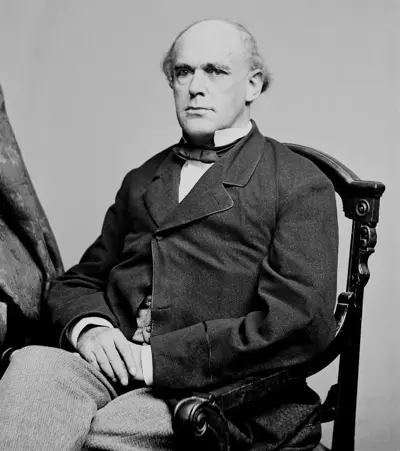
Salmon Portland Chase was a U.S. politician and jurist who served as the sixth Chief Justice of the United States. He also served as the 23rd Governor of Ohio, represented Ohio in the United States Senate, and served as the 25th United States Secretary of the Treasury. Chase was therefore one of a few U.S. politicians who served in all three branches of the federal government.
