William Legge Quotes
Take the most effectual measures to arresting, detaining and securing any Gunpowder, or any sort of Arms or Ammunition which may be attempted to be imported into the province under your government.
The Revolution was clearly underway although formal hostilities were not to begin until the following year. The Patriots were already trying to stockpile arms and ammunition—especially gunpowder. See {636945}.
William Legge, 1731-1801, 2nd Earl of Dartmouth, English Secretary of State for the Colonies Instructions to the Colonial Governors of America, Early 1775
Sourced by: Eigen's Political and Historical Quotations

It was the Dutch that first founded New York and there were many mercantile relationships existing between New Yorkers and Dutch merchants. Initially, the Dutch gunpowder was smuggled into New York because it was less expensive than English gunpowder or gunpowder from Kentucky or other parts of America. (The transportation costs by ship from Holland were much less than the overland cost from Kentucky.) By 1774, there was great friction between American patriots and the British and the smuggling was used to stockpile gunpowder for a possible revolutionary war. See {636944} for insight into the gunpowder shortage.

Note that Britain was blockading Boston in the middle of 1775, some time before the outbreak of battles in Concord and Lexington in 1776. What Gates did not tell Lord Dartmouth, and maybe did not know himself, was that the skilled Massachusetts sailors smuggled a great deal through the blockade in small boats at night landing in the many inlets and coves in the Boston area. Also, do not think of Boston in 1775 as today. At that time most people had, in the city, their own farms and gardens and grew much of their own food. The Boston Commons was a common area for grazing sheep. So the British Blockade of Boston was not very effective.


Several years before the Battle of Bunker Hill, revolutionary activity had already broken out in the American colonies—See {634132} for an example. This law gave the British authorities much more “clout” in dealing with the “seditious” American activities. It protected English law enforcement officials from being tried in local Colonial courts for murder or assault in putting down insurrections. George Washington and other Patriots were outraged over this law. See {634131}.
We are so used to hearing the freedom seeking reasons for the American Revolution that we overlook the more selfish and venal motives. This quotation shows that the large merchants of the colonies had banded together in an illegal conspiracy trust and monopoly and managed to keep many British competitive products out of the colonies. The British, for equally venal reasons, began to enforce the laws in favor of free trade. Many large American merchants were getting huge profits (and American consumers paying more) from their protectionist illegal monopoly. A Revolution would de facto assure that monopoly for many years to come, so they became supporters—patriots—of the American Revolution. As the Revolution drew closer, the Americans made efforts to protect the protectionism and monopoly of some of the richest Americans. See {636861}.
While the official battles of the American Revolution did not begin until 1776, parts of the American colonies were in a de facto state of rebellion and the British could not enforce their laws. See {636925} for another of the King’s statements.


Amazingly, a critical mass of Middle Atlantic citizens, joined in a vision of independence and persuaded their colonies to make common cause with the other colonies to gain independence from England and an end to monarchy. In a way, they had the most to lose and the least to gain from the revolution. Led by Livingston, John Jay, Alexander Hamilton, and Benjamin Franklin and others, these states had the greatest intellectual commitment to the Revolution as they would not financially benefit and would likely lose economically.

The Continental Congress told each colony should establish its own republican government quickly so that the people did not have to depend on England for anything, and that the English Monarchy be opposed and supplanted anywhere where they wanted to exercise authority.

The crackdown on Boston which was intended to set an example and intimidate all of the other colonies backfired, and the British were told about it by their own officials in America. But they were so rigid and ideological about monarchy, that the stimulated rebellion rather than suppress them.

Of the 13 colonies, the 3 Middle Atlantic States, were the least enthusiastic about an armed revolution against England. Jersey—Now New Jersey—was the most recalcitrant then with Benjamin Franklin’s son as Governor. See {634108} for an explanation of why that was.

See {636935}for the policy decision that triggered this order.
This quotation shows that the dissent leading to the American Revolution did not emerge suddenly in 1776 after the Battle of Bunker Hill. Dissent, sedition and even violence was documented here in 1774. Salem at the time was the second largest port in the colony and the customs tax collectors—Loyalist Americans—were run out of Salem.

during and after the American Revolution


Wilkes was a strong advocate for the American cause—so much so that some in Parliament tried to deny him his seat in Parliament for his disloyal point of view.
There was, well before the American Revolution, a restriction on the importation of British goods into the American colonies. Partially this was to pressure Parliament to stop some of its most repressive lawmaking. But it also supported what had become a very lucrative protectionist monopoly of large American merchants. See {636861}.
He was wrong. The protesters were general including merchants, lawyers, politicians, shopkeepers, sailors and other occupations. The Privateer Captains were no more or less involved as other occupations.


This was written more than a year before the “blows” began. It took time to ship the men and supplies to America and the British did not handle that task with much efficiency.

Fox was one of the opposition leaders who were opposed to the heavy handed policies that the British King and Government had used.
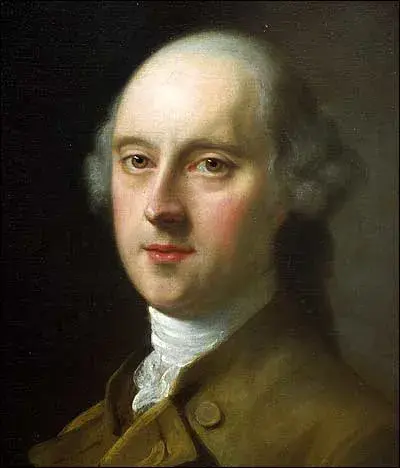
- Born: June 20, 1731
- Died: July 16, 1801
- Nationality: British
- Profession: Statesman, Philanthropist
William Legge, 2nd Earl of Dartmouth, PC, FRS, styled as Viscount Lewisham from 1732 to 1750, was a British statesman who is most remembered for his part in the government before and during the American Revolution, and as the namesake of Dartmouth College.
