Continental Congress Quotes
It is necessary that the exercise of every kind of authority under the said crown be totally suppressed.
The Continental Congress told each colony should establish its own republican government quickly so that the people did not have to depend on England for anything, and that the English Monarchy be opposed and supplanted anywhere where they wanted to exercise authority.
Continental Congress, Resolution, 1776
Sourced by: Eigen's Political and Historical Quotations

This resolution was the trigger that began the debate which became the Declaration of Independence.


The document was signed in his name by his ministers.

Americans were by no means united in wanting to take up arms against Britain. Relatively few of the loyalist quotations have come down to us, but here is one. It also illustrates why some Americans wanted complete independence: So that they could escape their debts to English merchants. Most however had more noble and unselfish motives. As a matter of fact, the American Revolution is unusual in the sense that there were so many men of substance who sacrificed much of their material wealth for the American ideal. There were also the rogues and opportunists as Galloway describes.

When Henry came to “George II” he was interrupted by the Speaker, John Robinson, who shouted “Treason!” Henry had been railing against the Stamp Act.

He was acting as French Foreign Secretary at the time.


Several years before the Battle of Bunker Hill, revolutionary activity had already broken out in the American colonies—See {634132} for an example. This law gave the British authorities much more “clout” in dealing with the “seditious” American activities. It protected English law enforcement officials from being tried in local Colonial courts for murder or assault in putting down insurrections. George Washington and other Patriots were outraged over this law. See {634131}.
This was written more than a year before the “blows” began. It took time to ship the men and supplies to America and the British did not handle that task with much efficiency.

While the official battles of the American Revolution did not begin until 1776, parts of the American colonies were in a de facto state of rebellion and the British could not enforce their laws. See {636925} for another of the King’s statements.

Fox was one of the opposition leaders who were opposed to the heavy handed policies that the British King and Government had used.
Some of the Patriots of Early America realized that the oppressions of British rule were coming from Parliament and initially took the position that only the King could make laws for the colonies and not Parliament. Therefore, they were as Englishmen challenging illegal English laws. Most American hostility was directed at Parliament and not the King. However, once there was any physical resistance, King George came down with such a heavy hand that American hatred transferred to him. For related quotes on the King/Parliament issue, see {639145}, {639144}, {639142}, {639141}, {639140}, & {639137}


This is the same man who introduced the Stamp Act 12 years before which started the whole problem in America. See {74956}.

Many American colonists had relatives and friends in England, and Paine argued that American independence would help and not het the English people.

The Revolution was clearly underway although formal hostilities were not to begin until the following year. The Patriots were already trying to stockpile arms and ammunition—especially gunpowder. See {636945}.
Note that Britain was blockading Boston in the middle of 1775, some time before the outbreak of battles in Concord and Lexington in 1776. What Gates did not tell Lord Dartmouth, and maybe did not know himself, was that the skilled Massachusetts sailors smuggled a great deal through the blockade in small boats at night landing in the many inlets and coves in the Boston area. Also, do not think of Boston in 1775 as today. At that time most people had, in the city, their own farms and gardens and grew much of their own food. The Boston Commons was a common area for grazing sheep. So the British Blockade of Boston was not very effective.

2nd Earl of Guilford. This bill cut off all trade with the American Colonies. It was meant as pressure to cease the rebellion. It did not work.

His fear was well founded. That is exactly what the British tried to do.


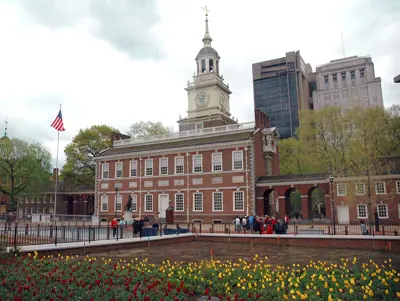
The Continental Congress was a series of legislative bodies which met in the British American colonies and the newly declared United States just before, during, and after the American Revolution. The term "Continental Congress" most specifically refers to the First and Second Congresses of 1774–1781 and may also refer to the Congress of the Confederation of 1781–1789, which operated as the first national government of the United States until being replaced by the current congress. Thus, the term covers the three congressional bodies of the Thirteen Colonies and the new United States that met between 1774 and 1789.
