Samuel Adams Quotes
If ye love wealth better than liberty, the tranquility of servitude better than the animating contest of freedom, go home from us in peace. We ask not your counsels or arms. Crouch down and lick the hands which feed you. May your chains set lightly upon you, and may posterity forget that ye were our countrymen.
Samuel Adams, 1722-1803, Governor of Massachusetts, Member of the Continental Congress, Speech, Philadelphia State House, August 1, 1776
Sourced by: Eigen's Political and Historical Quotations

Hopkins was complaining about the fact that England could tax the colonies and thereby take their property without their consent made the American colonists in the “miserable condition of slaves.” Essentially the fundamental complaint of the Americans was this and in a decade it would erupt as the American Revolution. At the same time, Hopkins was a slave owner and yet saw nothing wrong with that.

The Congress was encouraging all men volunteer for the military and defend the new nation now that the British were landing in force to put down the revolution. By modern language standards, this is a little “over the top” but it shows not only the passion felt by the Congress but the importance they placed on the struggle.


At that time, Russia and Germany were autocracy, and the ruler could simply take the English money and force the soldiers to fight in a war they had not stake in nor understood.


Marion was the initiator of Guerilla Warfare and he and his men traveled lightly spending much time in the South Carolina swamps. They had few supplies and when chased by the British could not stop to hunt. The British called him the “Swamp Fox”. The American colonists at this point still thought of the British as “their countrymen.”


This was written more than a year before the American Revolution Battles began. It took time to ship the men and supplies to America and the British did not handle that task with much efficiency. See {636926} for another of the King’s statements.

1st Earl of Chatham. The Continental Congress had endorsed and sent to England a set of resolutions from Suffolk County, Massachusetts, drawn up by Joseph Warren. Legislators forever since have admired the logic and presentation of the case for America. The King and the Prime Minister failed to heed Pitt’s view, and the Declaration of Independence and the American Revolution followed.


Beaumarchais served the French King Louis XVI as a spy and advisor on foreign affairs. He was instrumental in influencing the French King and his government to tilt in favor of the American Revolutionaries.

Lafayette was so engrossed with fighting in the Revolution that he really did not have a true picture of the total American attitude on slavery. He had fallen in love with the American idea and ideal based on the writings of intellectuals like Paine and Jefferson. Most of his time in America was spent with George Washington. The few American leaders he talked with were Northerners and/or intellectuals who were not rabid enthusiasts for slavery or were opposed. Slavery was so contradictory to the Declaration of Independence, Lafayette assumed that after the war was won and America was independent, the Americans would surely abolish slavery. After the Constitutional Convention many people were disappointed that the delegates had given in to the Southern slavery bloc. None more so than Lafayette.


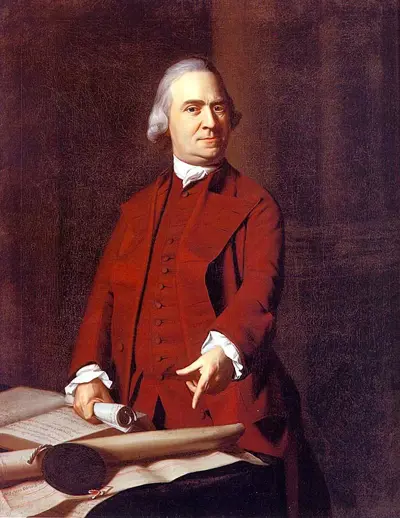
Samuel Adams was an American statesman, political philosopher, and one of the Founding Fathers of the United States. He was a politician in colonial Massachusetts, a leader of the movement that became the American Revolution, and one of the architects of the principles of American republicanism that shaped the political culture of the United States. He was a second cousin to his fellow Founding Father, President John Adams.
