Marquis de Lafayette Quotes
I would never have drawn my sword in the cause of America, if I could have conceived that thereby I was founding a land of slavery.
Lafayette was so engrossed with fighting in the Revolution that he really did not have a true picture of the total American attitude on slavery. He had fallen in love with the American idea and ideal based on the writings of intellectuals like Paine and Jefferson. Most of his time in America was spent with George Washington. The few American leaders he talked with were Northerners and/or intellectuals who were not rabid enthusiasts for slavery or were opposed. Slavery was so contradictory to the Declaration of Independence, Lafayette assumed that after the war was won and America was independent, the Americans would surely abolish slavery. After the Constitutional Convention many people were disappointed that the delegates had given in to the Southern slavery bloc. None more so than Lafayette.
Marquis de Lafayette, 1757-1834, Motier, Marie Joseph Paul Yves Roch Gilbert du, French Statesman & Major General in the American Revolutionary Continental Army, Letter to Thomas Clarkson
Sourced by: Eigen's Political and Historical Quotations


Beaumarchais served the French King Louis XVI as a spy and advisor on foreign affairs. He was instrumental in influencing the French King and his government to tilt in favor of the American Revolutionaries.


Most Canadians supported the English despite the letter.


At that time, Russia and Germany were autocracy, and the ruler could simply take the English money and force the soldiers to fight in a war they had not stake in nor understood.


The Continental Army needed everything from uniforms to muskets, mules to food. The British were mobilizing in force. General Washington was pleading for material assistance. Some members of Congress thought the spiritual was as, if not more important. See {583803} for other Continental Congress spiritual contributions to the war effort.

His prediction would come true 72 years later. He was a slave trader and a strong supporter of the institution. See {624060}. However unlike most slave supporting Southerners, he came from one of the richest families of New England. His own brother Moses Brown was an ardent abolitionist and John was able to see the arguments and forces lined up against slavery. He saw that abolitionists as the trouble makers because they were trying to change the status quo. Having much experience with Southerners and selling them many slaves, he realized early how the South was totally dependent on slavery for its economic and social way of life. Few Americans had that broad a perspective.

In the Civil War a drafted conscript could pay money instead of serving in the army. Many rich and middle class men did so leaving a higher proportion of the poor to be drafted. The song is sometimes misattributed to William Cullen Bryant.


At the time of the American Revolution there were strong abolitionist forces working against slaver and the slave trade. Southern American slave-owners, the political leadership of the South, feared that England would force slavery reforms on their colonies. Hence, severance from England eliminated that threat. In retrospect, they were quite right for it was England which outlawed the slave trade and led the worldwide anti-slavery movement which had little effect on the new independent America and the political bias in favor of the south of the American compact caused slavery to survive in America, long after the vast majority of the population would have it ended. It took the Civil War to do it.

This was Wesley’s last letter. Wilberforce, a member of Parliament, had been a convert to Methodism and was the leading spokesperson in Parliament for making participation in the slave trade illegal. It would take 16 years of effort before England outlawed participation in the slave trade. Note the distinction commonly made by abolitionists at the time regarding American slavery as the worst of all.

The resolution was transmitted to the Provincial Congress on June 6, 1775 where it was tabled. Essentially this position was taken by the Continental Congress and General Washington—See {614018}—and then Washington reversed himself, {614220}

Eisenhower was then Supreme Allied Commander.

The French Revolution was out of control and terribly bloody. Most Americans and even English who supported the principles and reasons for the French revolution ceased their support because of the Reign of Terror. Jefferson, however, saw a link between France and American democracy and was reluctant to end support.
The enthusiasm for the American Revolution caught the imagination of many throughout Europe. See {631977}.

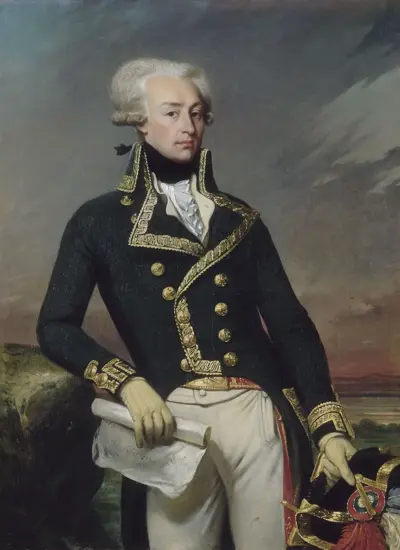
Marie-Joseph Paul Yves Roch Gilbert du Motier, Marquis de La Fayette, known in the United States as Lafayette (/ˌlɑːfiːˈɛt, ˌlæf-/, French: [lafajɛt]), was a French aristocrat and military officer who fought in the American Revolutionary War, commanding American troops in several battles, including the siege of Yorktown. After returning to France, he was a key figure in the French Revolution of 1789 and the July Revolution of 1830. He has been considered a national hero in both countries.
