Jeremy Bentham Quotes
Regulating the prices of goods in general would be an endless task, and no legislator has ever been weak enough to think of attempting it.
Jeremy Bentham, 1748-1832, British Jurist & Philosopher, Letter #4 to Crichoff, January 1787
Sourced by: Eigen's Political and Historical Quotations

Hoover was the Food Administrator at that time. Although he gave lip service to the free market economy concept, he was proposing government price controls and rationing. When the free market was not functioning, at this time in his career, he was willing to use government controls and regulation. By the end of 1918 over 250,000 food-handling corporations, firms, and individuals were under Food Administration licenses. Meat, fish, poultry, eggs, butter, milk, potatoes, fresh and dried vegetables, and fruits, canned goods, the coarse grains and rice, vegetable oils, coffee, and such various commodities accessory to food-handling, as ice, ammonia (for ice-making), arsenic (for insecticides), jute bags, sisal, etc., were under direct control. Ironically, later when he was President and faced with the Great Depression, he had become much more rigid and would not “interfere” with the free, private market and use government to solve the national problems. It was Franklin Delano Roosevelt who did that after Hoover would not. At the time he gave this speech, Hoover was not very political and was more of a technocrat. It may have been that by the time he became President he was intellectually and politically locked in to Republican Party conservative economic ideology.

To the modern reader utterances such as this from a Conservative Prime Minister seem astounding. However, the Great Depression existed in Canada as well as the United States, and Franklin Delano Roosevelt was not the only world leader who would reach the conclusion that business and capitalism must be profoundly regulated and the system changed if it was to be saved.

This quotation illustrates one of White’s correct early grasps of what was happening in the political economy of the time and its future direction with growing industrialization and technological complexity. Most historians agree that White passed classified information to the Russians. He was accused of being a Communist, but there was never any evidence of that. Some people believe that he was a spy for the Russians and committed espionage, but others disagree observing that White was very much his own man and felt that much information that was classified never should have been. White substituted his own judgment, it is believed, about what could be given to the Russians for the security system. He was an admirer of what Russian socialism had accomplished economically, educationally and medically since the 1917 revolution deposing the Czar. Russia had been a valuable military ally, which had taken the brunt of both military and civilian casualties in WWII. White’s economics were certainly not Marxist but very much Keynesian. He was subpoenaed by the House Un-American Activities Committee where he was accused of being a Communist which he denied (see {634907}). He died of a heart attack 3 days later.

Collection of Spoken Words of the Prophet. Ironically, despite the reverence with which words of the Hadith are accorded in Islam, from time to time Muslim theologians and authorities have attempted to establish “fair prices” despite this free market view of the Prophet.


Professor Epstein is a libertarian free market economist who advocates patience even if there are clear problems like corruption, unsafe working conditions, and the like. This view holds that the free market will sort itself out more effectively than the government will be able to do. Others, disagree.

Manava Dharma Shastra. Ancient Hindu India had what may well have been the most regulated mercantile economy of any society in history. All prices for all goods were to be set by the king. In order to prevent the stultifying effect of price controls, the Hindus required that the prices be reset very frequently to reflect various market conditions. It was a highly regulated form of capitalism. This text is a part of the Hindu Holy Texts. Hindus believe that Manu was a prophet whose text is revealed or inspired.

These appear to be the first economic regulations of New England. Note that although there was a Governor of the Colony, such economic issues were considered to be fundamentally religious in nature. Therefore Cotton—the leading cleric of the colony—was called upon to in effect legislate on the subject. Ironically, this is not terribly different from the theocracy in Iran or some other Muslim countries of today where like some of the early American Colonies, there was no separation of church and state.

The Black Plague, which raged in Europe from 1347 to 1349, had left relatively few able bodied people alive. Given this shortage of labor there was a rapid inflation, especially to the distress of the landed class who had to pay much more for their food. The king therefore established what amounted to price controls, wage controls and forces labor. See {611125} and {611126}

Abd al-Rahman Ibn Mohammad. He is generally regarded to be the World’s first social scientist. The largest statue in Tunisia of not of a military leader of king, but of this social scientist.

Some economic conservatives see little or no role for government. For many of them, in a free market there is no role for government. This quotation, from one of the economic heroes of the conservatives, shows that he not only saw a role for government, but believed that government was essential to the operation of a free market.

The prime minister had a political and philosophical position that government should not interfere with or set or control pricing in the economy. However, a scandal broke out involving payday lending—short term lending the working class does to tide them over till pay day if they run out of money. Lenders were charging huge interest rates beyond anything that is conscionable. Cameron’s government placed controls on interest rates and other facets of that industry as they might have lost a vote of confidence in Parliament had they not acted. He was then questioned about the hypocrisy involved in his regulation, and he gave this amazing quotation, which was the classic reason for government price controls on the private sector that had been given by the Labor Party opponents for years. This also distressed extreme conservatives, who argue that market controls are always preferable to government controls.


Whenever price controls have been tried, there always seems to develop a black market. However, some argue that price controls can work very well for a modest period of time in a national emergency and give WWII as an example. Although there was a black market, very few Americans participated in it, and the effect was positive as a result of the patriotism that was so keenly felt by most Americans at that time. Further, capital punishment has rarely worked to prevent any illegal activity. In London, pickpockets were publicly hung while other pickpockets fleeced the crowd watching the hanging ostensibly to dissuade people from pickpocketing.


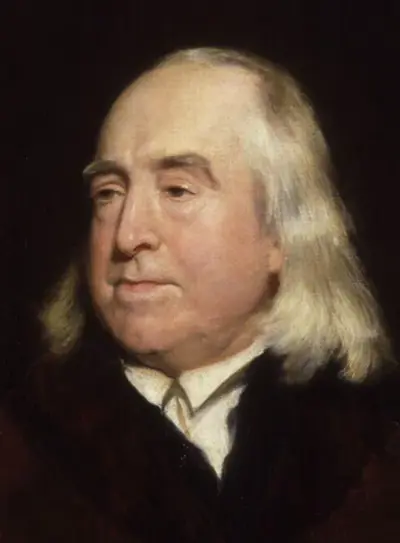
Jeremy Bentham was an English philosopher, jurist, and social reformer regarded as the founder of modern utilitarianism.
