Theodore Roosevelt Quotes
More and more it is evident that the State and if necessary the Nation, has got to possess the right of supervision and control as regards the great corporations.
Theodore Roosevelt, 1858-1919, 26th President of the United States (Republican, NY) Speech Minnesota State Fair, August 31, 1901
Sourced by: Eigen's Political and Historical Quotations

TR came from a wealthy, upper class family, and because of his position favoring regulation of corporations he was called a traitor to his class by many.


Federal regulation of corporations involved in Interstate Commerce was then a “radical new notion”.


During The Depression although business in general was doing very poorly, there were a few which had grown immensely powerful and abused the power as there was little or no regulation at the time.

To the modern reader utterances such as this from a Conservative Prime Minister seem astounding. However, the Great Depression existed in Canada as well as the United States, and Franklin Delano Roosevelt was not the only world leader who would reach the conclusion that business and capitalism must be profoundly regulated and the system changed if it was to be saved.


This quotation illustrates one of White’s correct early grasps of what was happening in the political economy of the time and its future direction with growing industrialization and technological complexity. Most historians agree that White passed classified information to the Russians. He was accused of being a Communist, but there was never any evidence of that. Some people believe that he was a spy for the Russians and committed espionage, but others disagree observing that White was very much his own man and felt that much information that was classified never should have been. White substituted his own judgment, it is believed, about what could be given to the Russians for the security system. He was an admirer of what Russian socialism had accomplished economically, educationally and medically since the 1917 revolution deposing the Czar. Russia had been a valuable military ally, which had taken the brunt of both military and civilian casualties in WWII. White’s economics were certainly not Marxist but very much Keynesian. He was subpoenaed by the House Un-American Activities Committee where he was accused of being a Communist which he denied (see {634907}). He died of a heart attack 3 days later.
This statement demonstrated the classic difference that Roosevelt had with the right wing of his party and that of the contemporary Republican party. Namely they thought that the only obligation of the corporation of other business was to the owners / shareholders while Roosevelt saw the obligation to the State and the people. The State and the society gives corporations many privileges that normal businesses do not have—most important is limited liability for the corporation’s negligence or even intentional damage to people. If the Corporation had no obligation to the State and to the people, why should they get this limited liability and other benefits?


Actually, both political parties had a range of opinion on the issue of control of the trusts, monopolies and large corporations. Roosevelt and his liberal wing of the Republic opinion were for regulating corporations and strengthening and enforcing the anti-trust laws. However, many of his party refused to admit that there were any abuses and/or if there were, the effect of Federal regulation and anti-trust enforcement would be worse that then problems caused by the trusts. At the same time, the Democrats had Bryan’s wing that wanted to break up the trusts and large corporations, and that is why Roosevelt had so much public support—enough to pass the legislation and make the President’s initiatives very popular. Roosevelt a shrewd campaigner attacked the Democrats knowing full well that many agreed with him, and ignored the conservative wing of his own party who were the ones who actively opposed his corporate reform effort.


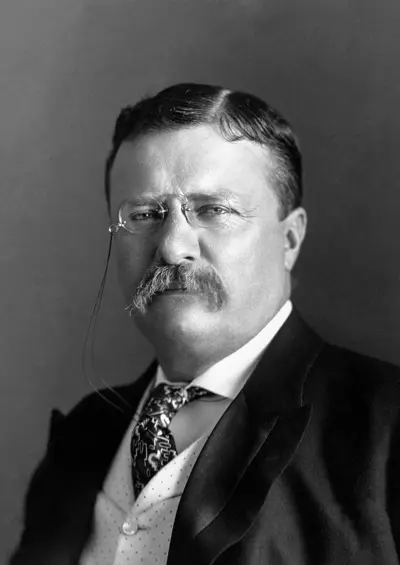
Theodore Roosevelt Jr., often referred to as Teddy or his initials T. R., was an American statesman, conservationist, naturalist, historian, and writer, who served as the 26th president of the United States from 1901 to 1909. He previously served as 33rd governor of New York from 1899 to 1900 and the 25th vice president of the United States from March to September 1901. Roosevelt emerged as a leader of the Republican Party and became a driving force for anti-trust and Progressive policies.
