Harry Dexter White Quotes
Change will be in the direction of control over industry and increased restrictions on the operations of competition and free enterprise.
This quotation illustrates one of White’s correct early grasps of what was happening in the political economy of the time and its future direction with growing industrialization and technological complexity. Most historians agree that White passed classified information to the Russians. He was accused of being a Communist, but there was never any evidence of that. Some people believe that he was a spy for the Russians and committed espionage, but others disagree observing that White was very much his own man and felt that much information that was classified never should have been. White substituted his own judgment, it is believed, about what could be given to the Russians for the security system. He was an admirer of what Russian socialism had accomplished economically, educationally and medically since the 1917 revolution deposing the Czar. Russia had been a valuable military ally, which had taken the brunt of both military and civilian casualties in WWII. White’s economics were certainly not Marxist but very much Keynesian. He was subpoenaed by the House Un-American Activities Committee where he was accused of being a Communist which he denied (see {634907}). He died of a heart attack 3 days later.
Harry Dexter White, 1892–1948, Economist, Assistant to the U. S. Secretary of the Treasury, Liaison between the Treasury & State Departments, Manager of the Exchange Stabilization Fund, Senior Negotiator, 1944 Bretton Woods Conference, Major architect of the International Monetary Fund & World Bank, 1st Director and U.S. representative of the International Monetary Fund. Political Economy in the Future, 1944
Sourced by: Eigen's Political and Historical Quotations

He was subpoenaed by the House Un-American Activities Committee where he was accused of being a Communist which he eloquently denied starting with this statement. He died of a heart attack 3 days later. However, most historians agree that White passed classified information to the Russians. He was accused of being a Communist, but there was never any evidence of that. Some people believe that he was a spy for the Russians and committed espionage, but others disagree observing that White was very much his own man and felt that much information that was classified never should have been. White substituted his own judgment, it is believed, about what could be given to the Russians for the security system. He was an admirer of what Russian socialism had accomplished economically, educationally and medically since the 1917 revolution deposing the Czar. Russia had been a valuable military ally, which had taken the brunt of both military and civilian casualties in WWII. White’s economics were certainly not Marxist but very much Keynesian.

To the modern reader utterances such as this from a Conservative Prime Minister seem astounding. However, the Great Depression existed in Canada as well as the United States, and Franklin Delano Roosevelt was not the only world leader who would reach the conclusion that business and capitalism must be profoundly regulated and the system changed if it was to be saved.


Collection of Spoken Words of the Prophet. Ironically, despite the reverence with which words of the Hadith are accorded in Islam, from time to time Muslim theologians and authorities have attempted to establish “fair prices” despite this free market view of the Prophet.


Some economic conservatives see little or no role for government. For many of them, in a free market there is no role for government. This quotation, from one of the economic heroes of the conservatives, shows that he not only saw a role for government, but believed that government was essential to the operation of a free market.


TR came from a wealthy, upper class family, and because of his position favoring regulation of corporations he was called a traitor to his class by many.


At the time extreme socialist doctrine was that the state should own the factories and the other means of industrial production. The socialists believed that the people through their government had to be able to control the economy and the private owners’ greed would always drive the economy for themselves and not for the society in general. Deal was one of the first who argued that there were other, less draconian modes of economic control like government regulation and central banks. Deat turned traitor during WWII and served in the Vichy Nazi cabinet of Pierre Laval. He was sentenced to death for treason but escaped to Italy where he assumed a new identity and then was sheltered by a right-wing Catholic religious order in the convent of San Vito, near Turin, where he wrote his memoirs and lived undiscovered until his death.


She was then the European Commissioner for Competition.


Hoover was the Food Administrator at that time. Although he gave lip service to the free market economy concept, he was proposing government price controls and rationing. When the free market was not functioning, at this time in his career, he was willing to use government controls and regulation. By the end of 1918 over 250,000 food-handling corporations, firms, and individuals were under Food Administration licenses. Meat, fish, poultry, eggs, butter, milk, potatoes, fresh and dried vegetables, and fruits, canned goods, the coarse grains and rice, vegetable oils, coffee, and such various commodities accessory to food-handling, as ice, ammonia (for ice-making), arsenic (for insecticides), jute bags, sisal, etc., were under direct control. Ironically, later when he was President and faced with the Great Depression, he had become much more rigid and would not “interfere” with the free, private market and use government to solve the national problems. It was Franklin Delano Roosevelt who did that after Hoover would not. At the time he gave this speech, Hoover was not very political and was more of a technocrat. It may have been that by the time he became President he was intellectually and politically locked in to Republican Party conservative economic ideology.


The prime minister had a political and philosophical position that government should not interfere with or set or control pricing in the economy. However, a scandal broke out involving payday lending—short term lending the working class does to tide them over till pay day if they run out of money. Lenders were charging huge interest rates beyond anything that is conscionable. Cameron’s government placed controls on interest rates and other facets of that industry as they might have lost a vote of confidence in Parliament had they not acted. He was then questioned about the hypocrisy involved in his regulation, and he gave this amazing quotation, which was the classic reason for government price controls on the private sector that had been given by the Labor Party opponents for years. This also distressed extreme conservatives, who argue that market controls are always preferable to government controls.


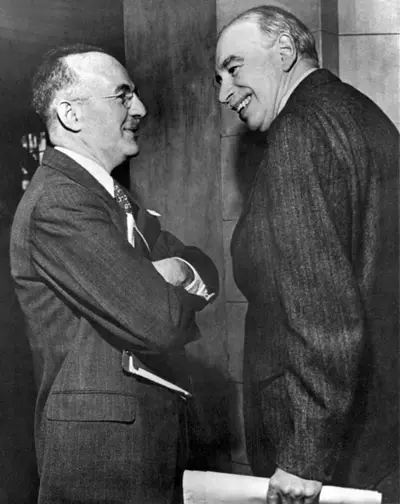
- Born: October 29, 1892
- Died: August 16, 1948
- Nationality:
- Profession: Economist
Harry Dexter White was a senior U.S. Treasury department official. Working closely with the Secretary of the Treasury Henry Morgenthau, Jr., he helped set American financial policy toward the Allies of World War II. He was later accused of espionage by passing information to the Soviet Union.
