William Gilpin Quotes
The wise rule of action is to restrict the powers of corporations within the … constitutional barrier.
William Gilpin, 1813-1894, Futurist & Governor of the Colorado Territory, First Message to the Citizens of the Legislative Assembly of Colorado Territory, September 10, 1861
Sourced by: Eigen's Political and Historical Quotations


During The Depression although business in general was doing very poorly, there were a few which had grown immensely powerful and abused the power as there was little or no regulation at the time.

The Chief Justice refused to accept the previously established legal precedents of other states which would limit considerably the right of the state to regulate corporations. As a result Wisconsin became one of America’s pioneers in regulating corporations which over 25 years later, Theodore Roosevelt was to do for the nation as a whole. The phrase “empire within an empire,” the translation of the Latin that Ryan used, has often been quoted to describe the power corporations had at that time.

The term “great corporations” had been in common use to indicate large corporations with no implications of quality as “great” would imply today. Search for “great corporations” to see the common usage.

TR came from a wealthy, upper class family, and because of his position favoring regulation of corporations he was called a traitor to his class by many.


This extreme view of regulation is one of the many views that caused the Nevada voters to reject her.


The issue was still not decided by the beginning of the 21st Century except that a certain amount of public disclosure was required if the company raised funds by selling stock to the public, but there were some giant corporations that were private and exercised huge power and influence and yet whose operations were secret.
This statement demonstrated the classic difference that Roosevelt had with the right wing of his party and that of the contemporary Republican party. Namely they thought that the only obligation of the corporation of other business was to the owners / shareholders while Roosevelt saw the obligation to the State and the people. The State and the society gives corporations many privileges that normal businesses do not have—most important is limited liability for the corporation’s negligence or even intentional damage to people. If the Corporation had no obligation to the State and to the people, why should they get this limited liability and other benefits?


Theodore Roosevelt had made many changes to control corporate rapaciousness and disregard for the law. Taft, his handpicked successor, wanted to roll back some of the regulations feeling that the problem of corporate corruption and venality had been solved. TR did not agree and the men’s close friendship dissolved over this issue—so much so that Roosevelt ran against Taft in the 1912 election.

McCain held this view despite the fact that most other politicians of his party supported removal of any corporate restraints.

1st Baron Thurlow. This famous statement expressed the great concern and distrust that England had for corporations. Their worst fears were exceeded by the 20th century and was completely over the top by the 21st century when many corporations could control entire nations and even in America and the UK, they were very powerful and often acted against the public and even national interest with impunity. The chancellor was very concerned as to how the behavior of corporations would be controlled and regulated. For individuals, there was a combination of conscience and legal punishment to control behavior. Partnerships were an extension of individuals. But what was the corresponding mechanism for corporations? The same question is often asked in modern times when corporate scandals and excesses are brought to light. See {586120} for another version of this concern that was stated a few generations later.
Federal regulation of corporations involved in Interstate Commerce was then a “radical new notion”.
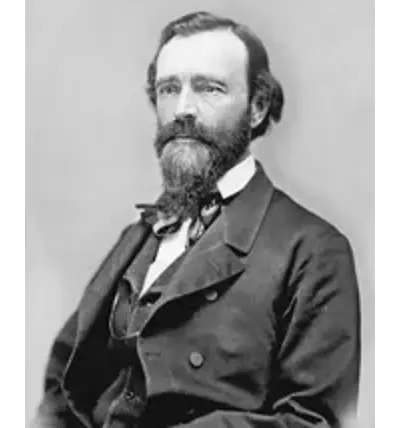
William Gilpin was a 19th-century US explorer, politician, land speculator, and futurist writer about the American West. He served as military officer in the United States Army during several wars, accompanied John C. Frémont on his second expedition through the West, and was instrumental in the formation of the government of the Oregon Territory. As a politician and writer, he was an inveterate believer in Manifest Destiny and was a visionary booster of new settlement to the West, helping lay the groundwork in his writings for a modern theory of the succession of civilizations.
