Nathanael Greene Quotes
Victory was long doubtful; and had the North Carolina Militia done their duty it was certain. They had the most advantageous position I ever saw, and left it without making scarcely the shadow of opposition. Their General and field Officers exerted themselves but the Men would not stand. Many threw away their Arms and fled with utmost precipitation; even before a gun was fired at them.
The notion that all the Americans fought bravely in the American Revolution is a myth. George Washington and his other generals were constantly frustrated by some of the state militias which complained often, sometimes mutinied, and frequently ran from battles as in this example of the North Carolina Militia. The federal troops, trained by Washington and his officers, with longer enlistment periods than the militia fought much better and together with the French, won the war.
Nathanael Greene, 1742-1786, Revolutionary American Southern Military Commander & Quarter-Master-General, Letter to Joseph Reed, March 18, 1781
Sourced by: Eigen's Political and Historical Quotations

Rush ran the hospitals for the Revolutionary Army and talked to many officers and enlisted men, and also observed much of the British military practices. These suggestions were discussed but never passed as regulations. They are fascinating insights into the problems of the general officers of the time who were generally selected for their socioeconomic status rather than other qualifications. Note the drunkenness limitation for a commanding general was proposed to be limited to only 1 allowed bout of drunkenness every 24 hours. It was, he thought, totally unrealistic to require generals to be always sober when on duty. With the mediocre quality of senior officers, Washington had to depend on foreigners like Lafayette, Von Steuben and others. And Generals who were leading attacks out in front of their men like Benedict Arnold immediately became heroes and one of the reasons he ended up as a traitor was that he thought that he was badly treated relative to the “society” Generals who would not accept him and denigrated his exploits when they themselves had never been close to a battle front.
General Howe was the Commander of British Troops in the American Revolution. The early American Army was neither professional, experienced, or well officered. Execution as a means of punishment was much more common than in the larger, professional British army. Rush ran the hospitals for the Revolutionary Army and talked to many officers and enlisted men, and also observed much of the British military practices.


At one level this quotation shows that Congress made the rules and regulations of the armed forces and not the Commander in Chief or the General Officers. But the quotation is important for several other reasons. First, it is the first federal attempt to regulate alcohol and drinking. It is also what we would regard today as a severe infringement of freedom of speech. Politically, it was very hard for any member of Congress not to support legislation to prevent blasphemy. But these and other examples of over a decade of the Continental Congress legislation persuaded most Americans that Congress was not to be trusted to protect their rights and there was a real need for a Bill of Rights so that much of the early activity of the Continental Congress would not continue.

The issue of how to raise an army plagued the Founding Fathers. The State Militias had very short enlistment periods so that as soon as the soldiers had been trained and were effective, their enlistments would be up. Washington and others wanted a draft or at least long enlistment periods in an American Army. The debate which then began has never ended. How much regular Army as opposed to the Army Reserves—the equivalent of the State Militias, whether or not there should be a draft, whether or not an enlistment period may be extended if there is a military need—none of these are new issues but have been with us since the country was founded. See {591369} for more of Washington’s view of this issue.

The Emperor was writing to his son to explain the defeat of Japan. In what was a bit of revisionist history, the Emperor neglected to mention that with the exception of some of the incursions in China, Hirohito had personally approved every Japanese invasion including Pearl Harbor. Further, it was he who had approved the orders that Japanese troops should fight to the death rather than retreat or surrender.

There is a , romantic American myth about the Militiamen in Colonial and Revolutionary America—the citizen soldiers who would leave their farms and rise to the military necessity of the day. However, not only were the militia very hard to muster to duty, but most actually didn’t own or have experience with firearms, and the prevailing opinion of knowledgeable military leaders from George Washington on down was that the militia were not very good soldiers. See {613015}, {613016}, {613022}, {613027}, {621987}, {621988}, {613030}, {613033}, & {613056}.
Washington quickly changed his mind when he realized that there were many Negroes fighting for his army and acquitting themselves very well. The pressure for troops and the English invitation to Negroes to help them and get their freedom, caused Washington to flip-flop on this point to the distress of most of his fellow Southerners. See {614220}.

While most modern armies treat officers and enlisted men who desert equally or even favor the officers, the Visigoths made desertion by an officer the severest of crimes. A centurion was the officer in charge of 100 men. There were 10 decurians (leaders of 10) under him, They were the modern equivalent of the Sergeants—non-commissioned officers. Their penalty for desertion was only the paying of a heavy fine. It was the officers who had to set the example. This set of laws is the most formalized and sophisticated compendium of laws of the so-called “barbaric peoples” of Europe. The compilation was in many ways a documentation of the traditional laws of the Visigoths that had evolved over hundreds of years.

Rush ran the hospitals for the Revolutionary Army and talked to many officers and enlisted men, and also observed much of the British military practices. This is a fascinating quotation because it discusses a problem of the early American Military which has been a constant throughout history: Generals and Admirals using soldiers and sailors as personal servants and retinue. While there have been Generals like Horatio Gates, Omar Bradley and Dwight D, Eisenhower and others of every era who did not take advantage of their power to obtain this personal aggrandizement, many have and continue to use their position to obtain personal perks.
Conway was made a Major General by Congress and appointed as Inspector General of the Revolutionary Army. However, then as now, officers who told the truth about the failings of other senior officers were not well liked by the officer corps. The cover up was the norm even then. Rush ran the hospitals for the Revolutionary Army and talked to many officers and enlisted men, and also observed much of the British military practices.

Patton, though a great leader and fighting general, also was almost crazy and irrational at times. This quotation illustrates one of those periods. Somehow, most of the officers and enlisted men under his command were generally able to distinguish and live with him. In this case, no one tried to ferret out the cowards and kill them despite the Generals exhortation. Also, his—and other people’s notion that bravery is genetically inherited is scientifically incorrect.

His aggressive tactics which had served him so well in the West got his army into trouble at the Second Battle of Bull Run, where he was out maneuvered by Stonewall Jackson and Robert E. Lee. He was sent back to the West.


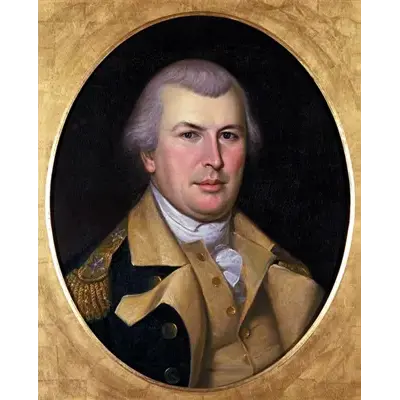
Nathanael Greene was a major general of the Continental Army in the American Revolutionary War. He emerged from the war with a reputation as General George Washington's most talented and dependable officer, and is known for his successful command in the southern theater of the war.
