TACITUS
(Publius Cornelius Tacitus | Cornelius Tacitus)
This is a very important historical and political quotation. The first clause shows us that earmarks and private bills for the benefit of individuals and their commercial enterprises are not a new form of corruption; they have existed ever since there have been legislatures.
The most important aspect of this quotation is the SECOND clause. Very frequently, this is quoted alone without the context of the first clause. Taken alone, the meaning seems to be that the more corrupt governments pass the most laws, and there is an implication that fewer laws mean less corruption. This interpretation fits perfectly with the conservative ideology of the late 20th and early 21st centuries that believed that the smaller the government, the better; the fewer the laws passed, the better. However with the context of the first clause, we see that what Tacitus was criticizing the legislature that passed many earmarks and bills benefitting special interests. The more of these that were passed, the more corruption he argued. So he did not object to laws per se. He was not opining on the relationship between the number of laws and a corrupt government if the laws are for general benefit and not for special interests. Out of context, it might appear that Tacitus was supporting the small government, conservative philosophy. In context, he is arguing against earmarks and special interest legislation and supports what we call “good government” which has been bipartisan in America with parts of each party agreeing with Tacitus and other parts of each party trying to pass earmarks and special interest legislation.
During the Nazi period, this quotation was used as propaganda amongst the German people to create the image of a pure Master Race.
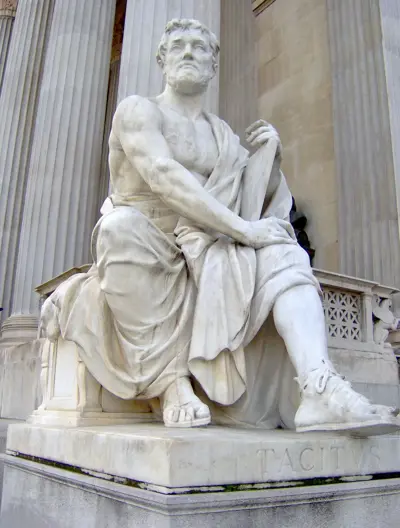
Publius (or Gaius) Cornelius Tacitus (AD 56 – c. 120) was a Roman historian and politician. Tacitus is widely regarded as one of the greatest Roman historians by modern scholars. He lived in what has been called the Silver Age of Latin literature, and has a reputation for the brevity and compactness of his Latin prose, as well as for his penetrating insights into the psychology of power politics.
