Tacitus Quotes
Germans are not tainted by intermarriage with any other nations.
During the Nazi period, this quotation was used as propaganda amongst the German people to create the image of a pure Master Race.
Cornelius Tacitus, c. 55-c. 117, Roman Historian, Description of the First Century B.C. Germans, The Agricola and Germania
Sourced by: Eigen's Political and Historical Quotations

At the time he was not Church president. The Mormon Church has had a very complex history regarding race; Blacks for example were prohibited from leadership positions in the Church. While not the only racist church, Mormon racism was more nuanced. Mormons aggressively sought Blacks and other ethnics for conversion into the church and on a personal and social level did not exhibit the antipathy towards non-whites that so many in other religions did. Yet their theology prohibited Blacks from certain leadership positions. Other religious racism was personal and social but not theological; Mormon racism was theological and not personal. Reforms have changed things slightly but critics of the church leadership at the start of the 21st century pointed to the attitudes of the President of the Church.

He sent this to his German agent who suggested that it not be sent and recommended not answering at all such a disgusting request.


At the time, most of the world did not believe that the Germans were literally serious in their anti-Semitic rhetoric. It was assumed that this kind of talk was just populist rhetoric to get votes and maintain power. The main lesson of Nazi Germany is when leaders of a country, threaten the existence of another country or a people, they must be taken seriously, and not just as politicians being populists and pandering to an ignorant, biased public.

The danger of racial and ethnic interbreeding was a fabricated myth. We now know that the danger can come from pure breeding and not obtaining enough genetic diversity. One reason that man has been so successful is that the species is the product of very extensive genetic diversity. For example EVERY human being on the planet had some genetic relationship to a Black African woman.


Russell like the rest of the Southern Congressional delegation, though members of the President’s own party were vehemently opposed to any civil rights legislation that would erode the legal racism and segregation that was prevalent in the South. The irony of Russell’s statement is that by Russell’s definition of a “mongrel race” the South was just that. And in a very real genetic sense all the great civilizations were characterized by interbreeding which is what Russell and other Southerners were paranoid about. The Southern institution of slavery was rife with the sexual abuse of the female slaves by the white masters and/or members of their family, overseers and other whites with power over the slaves. While many of the offspring were identifiable as mixed race (defined as Black by the laws at the time) many appeared to be white and light skinned enough to “pass” and did. A very large percentage of Southern white and black families had mixed blood in the family when Russell was complaining. More to the point, although it was not known at the time, we now know that every human being on earth can be genetically traced back through myocardial DNA to Blacks emanating from Africa. However, even using his narrow vision of race, his history was wanting. A number of great civilizations were of mixed race. One dramatic example was the great dynasties of Egypt. Cleopatra, herself, was from the union of Alexander the Great’s Greek General Ptolemy and the traditional line of Egyptian Pharos. Alexander’s Greek Soldiers interbred, as part of Alexander’s policy of occupation as suggested by Aristotle. All those societies thereafter were “mongrel” races at least in the ruling and upper classes. Actually the United States and the Soviet Union, the two super powers of the day both were ethnically and racially, highly diversified and both had a great deal of miscegenation. Scientists had made a very good argument that miscegenation strengthens a people—not weakens it.

Hoxha was a mixture of extreme Communist and extreme nationalist. Note the paranoia about intermarriage and interbreeding with other nationalities which was typical of Balkan nations,. He actually deluded himself into thinking that Albanian occupation and invasion had never resulted in female fraternization or rape and subsequent ethnic mixing. International communism however, on this point was just the opposite of Hoxha’s—the advocated an international view of intermarriage and breeding. Theirs was a class paranoia, not a nationalistic or racial paranoia.


Later, Italy was totally subservient to Germany later and Mussolini accepted German racist policies. Actually, there is only one human race and all members of it have the same original common ancestor, and African female.


See {401426} for more on his view of nationality and nationalism.

This is a very important quotation. This was not the ravings of a right wing extremist. It was a normative view. This book was a best seller in Germany. This quotation illustrates the mentality of the conservative, militarist, culture that dominated Germany at the time. Racism was normative then in Germany. It was not the Nazis who introduced the concept of inferior races to Germany. Through this book and much before it, the idea was well established in aristocratic, militaristic culture. Also, note that the “inferior races” were considered a threat to civilization, not just inferior beings.

Lawrence was one of the very advanced scientists of his time presaging Darwin on a few issues. But he erroneously believed that character and intellect were heretical capabilities. Intellect has been shown to be an inheritable trait to some extent (50-60 percent), but it is not racial per se. And character as we now know is not inherited.


This proposed Amendment would also have repealed the 14th and 4th Andmendments
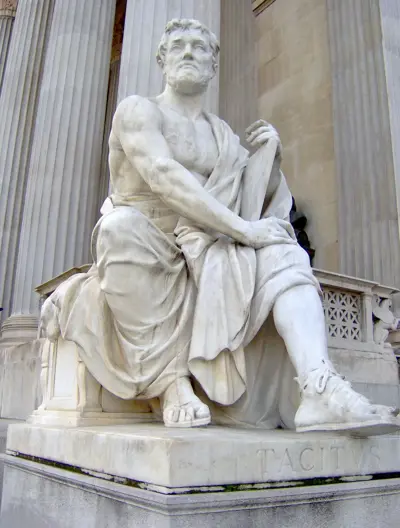
Publius (or Gaius) Cornelius Tacitus (AD 56 – c. 120) was a Roman historian and politician. Tacitus is widely regarded as one of the greatest Roman historians by modern scholars. He lived in what has been called the Silver Age of Latin literature, and has a reputation for the brevity and compactness of his Latin prose, as well as for his penetrating insights into the psychology of power politics.
