Elizabeth I Quotes
the parson, vicar, or curate, and parishioners of every parish within this realm, shall in their churches and chapels keep one book or register, wherein they shall write the day and year of every wedding, christening, and burial made within their parish for their time, and so every man succeeding them likewise; and also therein shall write every person's name that shall be so wedded, christened, and buried. And for the safe keeping of the same book, the parish shall be bound to provide of their common charges one sure coffer, with two locks and keys, whereof the one to remain with the parson, vicar, or curate, and the other with the wardens of every parish church or chapel, wherein the said book shall be laid up
Elizabeth I, 1533-1603, Queen of England, Injunction, June 1559
Sourced by: Eigen's Political and Historical Quotations

In this particular injunction the Queen actually proscribes the amount of church revenues that MUST be distributed to the poor. See {617526} where actual prayers are proscribed by the government.


1st Viscount Bolingbroke. This is the argument that was and still is given by most theocracies and nations opposed to pluralism. It was also a quotation which with the American founders were familiar and were targeting this view when they demanded the 1st Amendment.

Augustine had been sent by Pope Gregory to bring Christianity to England. He began by trying to preach to King Ethelbert and his court. The king’s response was the essence of what most modern democratic societies would formulate as a policy and is given in full. It is one of the great statements of religious toleration in the history of the world.

The King's staff had threatened Parliament before. See Dudley Carleton.

A very passionate minority of India’s Muslims demanded a separate Islamic State (that would become Pakistan) but Hindu’s and Muslims were mixed throughout India and many Indians and British were concerned that there would be a bloodbath if the plans for independence went forward. When the decision had been made to partition India, Radcliffe had the unenviable task of deciding where the boundary was to be between Pakistan and India. No one on either side was satisfied with his effort. So, realizing that violence was about to break out, he packed quickly and went back to England. Over two million Indians were killed in the violence that broke out in the next weeks as there was a huge migration and ethnic cleansing to implement Radcliffe’s boundaries. Fifty years later, both India and Pakistan acknowledge that Radcliffe did a very reasonable job.


England had, under Henry VIII, left the Roman Catholic Church where the King replaced the Pope as head of the English Church. Henry’s successors then had to organize and manage the national Christian church. James was discussing the hierarchy of the Church of England and there was a suggestion that Bishops be eliminated and have every priest directly responsible to the crown. Bishops would be powerful figures who might form a power center. (They did later). However, King James I observed that the King is God’s choice and rules by divine right. So there had to be bishops to crown kings. The bishoprics were retained.

Anne was a Protestant but her father James II was a Roman Catholic. There was always suspicion about her true religious allegiance by the extremists in the Church of England. The Act of Toleration, despite its name, required the Church of England to be the established church and the sovereign’s to be the heads of the church.

The King assumed the role of head of the Church of England.

It is this proclamation and others like it that caused many of the American Founding Fathers to include the doctrine of separation of church and state. In this case, and many others, the government actually proscribed and controlled the prayers and the liturgy. See {617532} where the government proscribes the proportion of revenues that must be spent on the poor.
The major targets of this law were the Puritans who would not attend the normal Church of England services but had their own, usually in a private home.


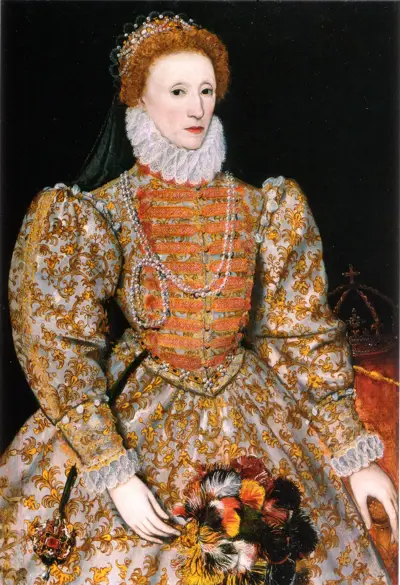
- Born: September 7, 1533
- Died: March 24, 1603
- Nationality: English
- Profession: Royalty
Elizabeth I was Queen of England and Ireland from 17 November 1558 until her death in 1603. Sometimes called the Virgin Queen, Gloriana or Good Queen Bess, Elizabeth was the last of the five monarchs of the House of Tudor.
