Matthew Parker Quotes
On Sundays there be no shops open, nor artificers commonly going about their affairs worldly, and that in all fairs and common markets falling upon the Sunday, there be no showing of any wares before the service be done.
Matthew Parker, 1504-1575, English Archbishop of Canterbury, Edict after the Vestiarian Controversy, 1564
Sourced by: Eigen's Political and Historical Quotations


Shabbat is the Hebrew word for the Sabbath. In Israel there is conflict between ultra-orthodox Jews on the one side and secular Jews, Christians and Arabs on the other regarding store openings and closings on Saturday—the Jewish Sabbath. The orthodox want the power of the state to force stores to close on the Sabbath. The others want the freedom of the individual to either close or open a store, to shop or not to shop, to keep Friday as the Sabbath as the Muslims do, Saturday as the Jews and a few Christian sects do, or Sunday as most Christians do. This used to be a major issue in the United States. Local communities all had what were called “Blue Laws” that controlled the Sabbath. The courts however found these unconstitutional and these issues have disappeared as political issues in America.

In effect this was one of the earliest civil Blue Laws.


1st Viscount Bolingbroke. This is the argument that was and still is given by most theocracies and nations opposed to pluralism. It was also a quotation which with the American founders were familiar and were targeting this view when they demanded the 1st Amendment.

The major targets of this law were the Puritans who would not attend the normal Church of England services but had their own, usually in a private home.
It is this proclamation and others like it that caused many of the American Founding Fathers to include the doctrine of separation of church and state. In this case, and many others, the government actually proscribed and controlled the prayers and the liturgy. See {617532} where the government proscribes the proportion of revenues that must be spent on the poor.


The King assumed the role of head of the Church of England.
In the case of Christmas celebrations, in addition to the huge commercial consequences, there is tradition and religion involved which brings out non-monetary vested interests as well. This is true in England as well as America.

Anne was a Protestant but her father James II was a Roman Catholic. There was always suspicion about her true religious allegiance by the extremists in the Church of England. The Act of Toleration, despite its name, required the Church of England to be the established church and the sovereign’s to be the heads of the church.

England had, under Henry VIII, left the Roman Catholic Church where the King replaced the Pope as head of the English Church. Henry’s successors then had to organize and manage the national Christian church. James was discussing the hierarchy of the Church of England and there was a suggestion that Bishops be eliminated and have every priest directly responsible to the crown. Bishops would be powerful figures who might form a power center. (They did later). However, King James I observed that the King is God’s choice and rules by divine right. So there had to be bishops to crown kings. The bishoprics were retained.


3rd Earl Russell of Kingston. He wrote this just after turning 16.

King Henry VIII had left the Roman Catholic church and taken England and Ireland out also. He replaced the Pope as the head of the English and Irish churches. There was much opposition in Ireland and the priests were the most assertive opponents to the change and were still loyal to the Pope. Queen Elizabeth continued to have problems with the Priests. James I, Elizabeth’s successor, became fed up by the Roman Catholic Priests and therefor issued this Proclamation.
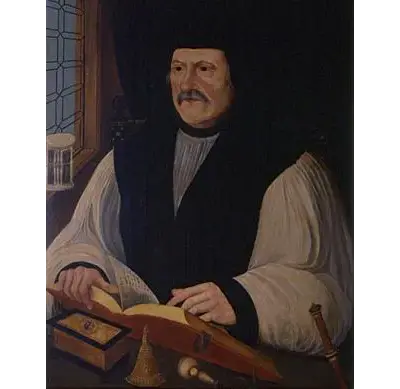
Matthew Parker was an English bishop. He was the Archbishop of Canterbury in the Church of England from 1559 until his death in 1575. He was also an influential theologian and arguably the co-founder (with a previous Archbishop of Canterbury, Thomas Cranmer, and the theologian Richard Hooker) of a distinctive tradition of Anglican theological thought.
