James Monroe Quotes
The care of the Indian tribes within our limits has long been an essential part of our system, but, unfortunately, it has not been executed in a manner to accomplish all the objects intended by it. We have treated them as independent nations, without their having any substantial pretensions to that rank. The distinction has flattered their pride, retarded their improvement, and in many instances paved the way to their destruction. The progress of our settlements westward, supported as they are by a dense population, has constantly driven them back, with almost the total sacrifice of the lands which they have been compelled to abandon. They have claims on the magnanimity and, I may add, on the justice of this nation which we must all feel.
James Monroe, 1758-1831, 5th President of the United States (Democratic Republican, VA), Second Inaugural Address, March 5, 1821
Sourced by: Eigen's Political and Historical Quotations

This quotation is interesting in that the Madison Administration was being very careful to not alienate the Indians in Federal land purchases. Although there are many who believe the whites never should have enticed Indians to sell land at all, there were many cases where the land sales were fraudulent and gross—The Cherokee Indians in Georgia. At this time, the Federal government would negotiate an amount for some land and pay the Indian tribe the agreed upon sum. Then another tribe might claim that the land was really theirs, they had also been hunting or living there. In some cases there were Indian wars and one tribe had banished another. Madison’s policy which he reported in this speech was to negotiate with BOTH tribes separately and pay them each the agreed upon amount—he tells the public that it is worth paying double to avoid bad feelings among the Indians. Jefferson and Madison in particular had relatively liberal Indian policies. It was President Jackson who had the worst Indian policy and produced a large proportion of immoral actions, atrocities and subsequent bad feeling.


Wayne played so many parts depicting whites in the process of expanding Westward that many people saw him as an expert on the history of the Westward Expansion. He did not comment on the whites who then kept huge ranches “selfishly” for themselves or those who selfishly would not share the mineral rich land that they had taken with anyone including the original Indian owners. So in this view, the Indians should have not been capitalists but they should have been socialists and shared their resources.
Jefferson probably had the most enlightened policy towards the Native Americans and did not see them as a people apart from Americans. His phrase “we consider them as part of ourselves” would not be concurred with by another American President for over 100 years. Unfortunately, there were many American whites who did not have Jefferson’s view, and there was no practical way the Federal Government at the time could enforce benign and equality policies. Relations with most Indian tribes went down hill and may have reached the lowest point under the Administration of Andrew Jackson.


Not all Indians resented the coming of the white man. Several of the more peaceable tribes benefiting by interactions with the United States and some even sought affiliation—especially the military weaker tribes which would be protected by an alliance with the Americans.

This law allowed the President to forcibly move entire tribes from their native lands to sparsely settled land in the West. Oklahoma became knows as Indian Territory as so many Indians were relocated there. The act, and this clause in particular, gave the President the authority over all Indian tribes in the nation and established the difficult if not impossible relationship between the Indian nations and the Federal government. The act—the last sentence of the quote—also ratified all treaties with the Indians and pronounced them inviolate. That was not to be.

He and the 7th Cavalry were themselves whipped and killed shortly thereafter.


“Transported” meant they were convicted criminals in England who were sold into indentured servitude for a number of years. When their sentence was up, they became free but had no assets or land, so they went to the frontier and settled on land there which sometimes was Indian occupied land, but was more often Indian hunting land. This often caused friction between the new Americans and the Indians. The original criminal origin of these Americans was constantly views in a negative light by the upper class English (See {605546}.). He was the de facto Governor of the colony as there was no one senior to him on the American side of the Atlantic.

Carson was one of the few Indian Agents who spent every penny of his budget on the Indians as opposed to himself. He was married to an Indian woman and was close enough to many Indians that he understood their resentment whenever they came into a town. They were treated terribly and while most of them were literally starving, seeing the white opulence produced resentment.

See {633119} for the basic provision of the Dawes Act.

In the midst of the French & Indian Wars, the Board of Trade drafted the royal proclamation of October 7, 1763, forbidding the granting of lands in the vast interior, which was specifically reserved to the Indians. Washington had earlier reservations about the attempt to protect Indian lands for the Indians. See {612772} Washington after the American Revolution did grant and protect Indian lands to the minority of the Indians who had allied with the Americans against the British and the majority of the other Indian tribes.

Many American leaders wanted to comply with and enforce the Indian treaties, but the remoteness made it difficult. There were always those whites who did not want to be restricted by Indian treaties who took advantage of the situation when there was a leader like Clinton who wanted to enforce the treaties. However in many cases, the American leadership really did not want to enforce the treaties and in some cases, as with President Andrew Jackson, wanted to abrogate the treaties with the Indians.

It is very hard, when we have let the King's subjects have so much of our lands for so little value.
He had received an English style education and had a much better idea of the market value of the land than most of the other Iroquois.
Most of the American Indian Tribes did not practice slavery. These two were very large tribe exceptions. There were also some tribes which would capture a prisoner and maintain them by coercion, but typically these captives could be adopted and have the same rights and freedoms and obligations as other tribe members. The Cherokee and Comanche practiced the Southern white style of chattel slavery.

One of the reasons that Jefferson and others were so anxious to expand the territory of the United States was that Britain had operated with the policy that curtailed and limited the population growth of the American colonies and the resentment of this policy led to growth of America and the Westward expansion.
In March of 1814 Jackson led a force to track down the Red Sticks. When they did so at Horseshoe Bend. Jackson made a frontal assault on the Red Stick Breastworks which might have gone badly had not a cotangent of Cherokee Indians—also concerned about the Red Sticks attack on their settlements, assaulted the Red Sticks from the rear. The Red Sticks, caught between the two uncoordinated attackers, lost over 900 men and the battle which then decided the war. In this Battle, Junaluska, a Cherokee, saved Jackson’s life. Years later he would not differentiate between the different Indian peoples and contrary to a Supreme Court order, forced the Cherokee from their settled farms and ranches and moved them to the Oklahoma Territory.
The whites had constantly encroached on the Cherokee land which was too large for any reasonable patrolling by the Indians themselves. The Federal government persuaded the Cherokee to sign a treaty by which the Indians would give up their title to the larger part of their land. The most important quid pro quo was that the Federal Government would protect the remainder of the Cherokee land from incursion by whites or even other Indians. However, whites who coveted the land started to encroach and build farms and ranches. The Federal government was reluctant to use American soldiers against American citizens and was looking for a way out. However, the Cherokee chiefs were reminding them of their obligation. The state governments were less concerned about Federal treaties, and Georgia passed a law that said that all the Cherokee land must be governed by State Law contrary to the Treaty which gave the Cherokee total sovereignty. But the Feds were not anxious to have a showdown with the states on this issue. Whites, with the connivance of the state governments and the support of some Federal Officials offered to amend the treaty with the Cherokee. The whites would pay the Indians fair market value for their land in the East. The Federal Government would provide equal amount of land in the Indian Territory of Oklahoma, then a territory. The Feds would assist with the relocation and provide troops to protect the Cherokee from thieves and raiders—whites and Indians, and would guarantee that the Cherokee would be completely sovereign in the new land. The chief’s did not want to renegotiate the old treaty—they just wanted it enforced. The Supreme Court ruled in their favor, but President Jackson, ignored the ruling and forced the Cherokee onto the Trail of Tears for Oklahoma and the whites took over the valuable Cherokee land.

The Cherokee were settled Indians with farms and ranches. These lands were coveted by many whites and many including President Andrew Jackson was trying to get the Cherokee to trade their land for land in the Oklahoma Territory, despite the white promises of the past Ross took the case to the Supreme Court which ruled that the Cherokee land was theirs and it must be protected for them by the government. But President Andrew Jackson, disobeying the Supreme Court Opinion, forced the Cherokee at gun and bayonet point onto the Trail of Tears to Oklahoma, totally reneging on this quotation and deeds and promises of the past.
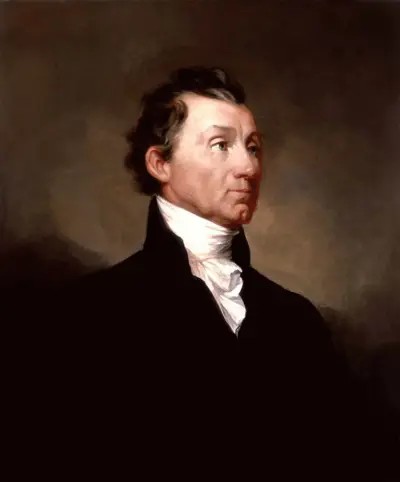
James Monroe was an American statesman, lawyer, diplomat and Founding Father who served as the fifth president of the United States from 1817 to 1825. A member of the Democratic-Republican Party, Monroe was the last president of the Virginia dynasty; his presidency coincided with the Era of Good Feelings. He is perhaps best known for issuing the Monroe Doctrine, a policy of opposing European colonialism in the Americas. He also served as the governor of Virginia, a member of the United States Senate, the U.S. ambassador to France and Britain, the seventh Secretary of State, and the eighth Secretary of War.
