Joseph Brant Quotes
It is very hard, when we have let the King's subjects have so much of our lands for so little value.
He had received an English style education and had a much better idea of the market value of the land than most of the other Iroquois.
Joseph Brant, 1742-1807, [Thayendanega], Mohawk Indian Chief, Observation about the low prices that his fellow Iroquois were willing to take for their land
Sourced by: Eigen's Political and Historical Quotations

This is an important quotations for two reasons. First, one of the white Europan myths in the colonial era was that the Native America had not concept of land ownership and title. This quotation clearly refutes that/ Second, this shows that some Europeans coming to the new world opposed the view that the white Christians and a moral right to the Native American “heathen” land. A few like Williams did not.


The Romans were very organized regarding land ownership. When they conquered Africa, defeating Carthage, they found no written records of land ownership, no deeds, no bills of sale. Therefore, they opened up the entire land mass of Africa for what amounted to public colonization where the land could be worked and claimed legally. Illiterate Africans had no written records, and most areas where under the control of a strongman who “owned” all of the land with no notion of private ownership of land.


The Iroquois were among the most sophisticated of the North American Indian Tribes. They also were highly assimilated into the American society. In the next decades, they would switch their political position when New York State provided better legal guarantees for Iroquois land than the Federal Government. By the end of the 20th Century, led by the Iroquois, the Indian residents of New York State had the same level of earnings as the white man—and that was with NO INDIAN GAMING.
Many of the delegates to the Constitutional Convention of 1787 had invested in land that had formerly belonged to the Iroquois Indians who had sided with the British in the Revolution and been driven up to Canada. They had paid very little and wanted to sell it at large profits. However, there was little gold and silver left in the colonies after the war and there was great reluctance in the rest of the world to lend gold and silver backed money to a new country that did not have a rule of law and courts to collect debts. For example, Madison and Monroe had formed a partnership and bought former Iroquois land near Rome, New York. There was idealism to be sure but there was also self-interest functioning in the secret Constitutional Convention.


The central Indian policy problem for Jefferson’s Administration was the fact that most Indians hunted for subsistence and the amount of land needed to support a hunting society was per capita much greater than an agricultural and especially an industrial one. Jefferson had no personal animosity against the Indians as many in his day did. But he perceived the need to obtain Indian lands for white agricultural use.
While the economics of land is described accurately, immigrants from most of the world would never in their home country ever be able to earn enough in a few years to acquire that much land. So the prospect of land ownership was a fundamental selling point and was a major spur to immigration to America where land was and is plentiful.


Commenting on the status of the Cherokee Indians.


Thunder Rolling Down the Mountain


Many American leaders wanted to comply with and enforce the Indian treaties, but the remoteness made it difficult. There were always those whites who did not want to be restricted by Indian treaties who took advantage of the situation when there was a leader like Clinton who wanted to enforce the treaties. However in many cases, the American leadership really did not want to enforce the treaties and in some cases, as with President Andrew Jackson, wanted to abrogate the treaties with the Indians.

Note that this opportunity to obtain very inexpensive public land was given not only to citizens, but to new immigrants as well provided they had filed their intention to become nationalized citizens. Loyalty was required however.

Note that there was still a serious attempt to coexist with the Indians and to pay for lands that whites moved into. This would change radically in the administration of Andrew Jackson who would replace Adams.

This quotation is interesting in that the Madison Administration was being very careful to not alienate the Indians in Federal land purchases. Although there are many who believe the whites never should have enticed Indians to sell land at all, there were many cases where the land sales were fraudulent and gross—The Cherokee Indians in Georgia. At this time, the Federal government would negotiate an amount for some land and pay the Indian tribe the agreed upon sum. Then another tribe might claim that the land was really theirs, they had also been hunting or living there. In some cases there were Indian wars and one tribe had banished another. Madison’s policy which he reported in this speech was to negotiate with BOTH tribes separately and pay them each the agreed upon amount—he tells the public that it is worth paying double to avoid bad feelings among the Indians. Jefferson and Madison in particular had relatively liberal Indian policies. It was President Jackson who had the worst Indian policy and produced a large proportion of immoral actions, atrocities and subsequent bad feeling.

This is one of the first Policy Statements of the new Republic about the Indians. Essentially, although the government policy was reasonable and fair, public opinion was totally different and the leadership could not persuade the people on this point. One complicating factor was the fact that most of the Indian tribes had overtly or covertly sided with the British in the Civil War. Many Indians were exiled to Canada. Even the Indians who were American allies, had their lands encroached upon however.
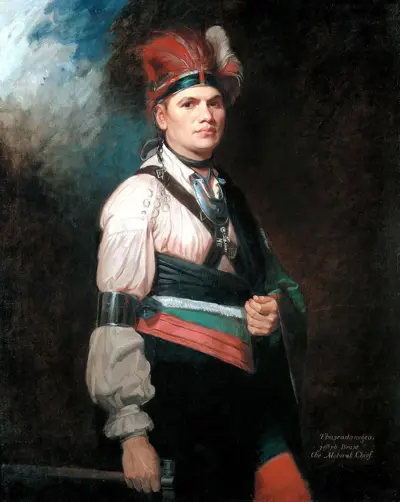
Thayendanegea or Joseph Brant was a Mohawk military and political leader, based in present-day New York, who was closely associated with Great Britain during and after the American Revolution. Perhaps the Native American of his generation best known to the Americans and British, he met many of the most significant Anglo-American people of the age, including both George Washington and King George III.
