Roman Empire Quotes
As regards the land or place in Africa, whatever such land ... anyone may hold, possess, or have the usufruct of, as if this land or place had been publicly owned.
The Romans were very organized regarding land ownership. When they conquered Africa, defeating Carthage, they found no written records of land ownership, no deeds, no bills of sale. Therefore, they opened up the entire land mass of Africa for what amounted to public colonization where the land could be worked and claimed legally. Illiterate Africans had no written records, and most areas where under the control of a strongman who “owned” all of the land with no notion of private ownership of land.
Ancient Rome, Agrarian Law, 111 B.C.
Sourced by: Eigen's Political and Historical Quotations


While the economics of land is described accurately, immigrants from most of the world would never in their home country ever be able to earn enough in a few years to acquire that much land. So the prospect of land ownership was a fundamental selling point and was a major spur to immigration to America where land was and is plentiful.

The Diggers were a religious-economic movement that even today would be considered very radical. They advocated the right of the poor to go onto public lands and farm them—thus the name “Diggers.” Beyond their opposition to the private ownership of land to the exclusion of the poor, Winstanley and the Diggers promulgated another very modern doctrine: That the poor should take the responsibility and have the right to determinine how the society should provide for the poor. A version of this became one of the Mottos of the Poverty Program of 1964. See {616966}.
In every society where there had been past unjust ownership of land, all efforts of land reform were faced with the problem of having to dispossess the current “owners” who themselves had not been guilty of the crimes of their ancestors in unjustly obtaining the land originally. In America land reform was unworkable in most cases and the solution was usually a large monetary payment as compensation for the land.

This is an important quotations for two reasons. First, one of the white Europan myths in the colonial era was that the Native America had not concept of land ownership and title. This quotation clearly refutes that/ Second, this shows that some Europeans coming to the new world opposed the view that the white Christians and a moral right to the Native American “heathen” land. A few like Williams did not.

See {638124} for how this Biblical passage evolved into a concept of property ownership

It is very hard, when we have let the King's subjects have so much of our lands for so little value.
He had received an English style education and had a much better idea of the market value of the land than most of the other Iroquois.


His bill introduced in the House of Representatives. It did not pass.


The central Indian policy problem for Jefferson’s Administration was the fact that most Indians hunted for subsistence and the amount of land needed to support a hunting society was per capita much greater than an agricultural and especially an industrial one. Jefferson had no personal animosity against the Indians as many in his day did. But he perceived the need to obtain Indian lands for white agricultural use.
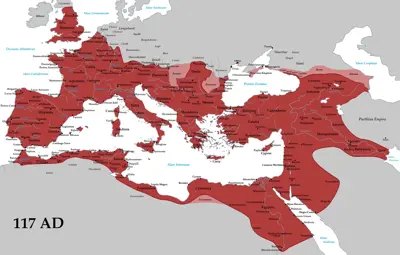
The Roman Empire (Latin: Imperium Romanum [ɪmˈpɛri.ũː roːˈmaːnũː]; Koinē Greek: Βασιλεία τῶν Ῥωμαίων, romanized: Basileía tōn Rhōmaíōn) was the post-Republican period of ancient Rome. As a polity it included large territorial holdings around the Mediterranean Sea in Europe, Northern Africa, and Western Asia ruled by emperors. From the accession of Caesar Augustus to the military anarchy of the 3rd century, it was a principate with Italy as metropole of the provinces and the city of Rome as sole capital (27 BC – AD 286). After the military crisis, the empire was ruled by multiple emperors who shared rule over the Western Roman Empire and over the Eastern Roman Empire (also known as the Byzantine Empire). Rome remained the nominal capital of both parts until AD 476, when the imperial insignia were sent to Constantinople, following the capture of Ravenna by the barbarians of Odoacer and the subsequent deposition of Romulus Augustulus. The adoption of Christianity as the state church of the Roman Empire in AD 380 and the fall of the Western Roman Empire to Germanic kings conventionally marks the end of Classical antiquity and the beginning of the Middle Ages. Those events, along with the gradual hellenization of the Eastern Roman Empire is why historians distinguish the medieval Roman Empire that remained in the Eastern provinces as the Byzantine Empire.
