Samson Occom Quotes
I am afraid the poor Indian will never stand a chance against the English in their land controversies because they are very poor, they have no money. Money is almighty nowadays and the Indians have no learning, no wit, no cunning, the English have it all.
Samson Occom, 1723-1792, Mohegan Indian & Christian Minister, 1764
Sourced by: Eigen's Political and Historical Quotations


At the time, the traders were mostly French who traded all kinds of goods and especially alcohol—usually rum—for fur animal pelts. Many of the Indians were partial to the French and French oriented traders who did not covet their land and would provide the Indians with alcohol and guns, lead and powder while English traders sometimes tried to restrict these items. Many tribes of American Indians are genetically very susceptible to alcohol—both in terms of immediate impairment—getting drunk and in developing a dependency on having alcohol—addiction or alcoholism.


Many American leaders wanted to comply with and enforce the Indian treaties, but the remoteness made it difficult. There were always those whites who did not want to be restricted by Indian treaties who took advantage of the situation when there was a leader like Clinton who wanted to enforce the treaties. However in many cases, the American leadership really did not want to enforce the treaties and in some cases, as with President Andrew Jackson, wanted to abrogate the treaties with the Indians.

At the time, some Palestinian Arabs claimed exclusive rights to the territory on the grounds that Arabs had dominated the area for the longest period of time. They gave no credence to the fact that the Jews had dominated the area and it was the center of their kingdom for many years before—that Jews had constantly lived in the area of longer than the Arabs, nor did they give any credence to the fact that the Christians had conquered the area from the Muslims during the Crusades.

The highway was planned to go through a poor neighborhood which had a high percentage of Black residents—all of whom would have to find other housing and move to make room for the highway. If the government plans a highway through a wealthy area, the cost to condemn and pay for the land will be much greater than if a poor neighborhood is acquired. For urban highways, the poor almost always bear a disproportionate share of the inconvenience while the major benefit inures to the wealthy and middle class. Abbot had been a labor organizer and a professional artist before he entered politics. The graphic is of his famous poster which by itself stopped the plans to build the highway very quickly.


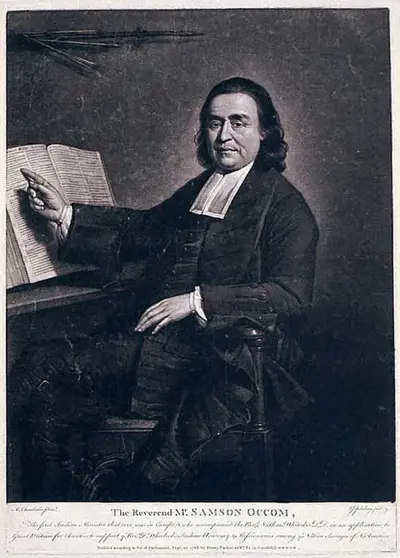
The Reverend Samson Occom was a member of the Mohegan nation, from near New London, Connecticut, who became a Presbyterian cleric. Occom was the second Native American to publish his writings in English (after son-in-law Joseph Johnson (Mohegan/Brothertown) whose letter to Moses Paul, published April of 1772, preceded Occom’s by 6 months), the first Native American to write down his autobiography, and also helped found several settlements, including what ultimately became known as the Brothertown Indians. Together with the missionary John Eliot, Occom became one of the foremost missionaries who cross-fertilised Native American communities with Christianized European culture.
