Andrew Jackson Quotes
That those tribes can not exist surrounded by our settlements and in continual contact with our citizens is certain. They have neither the intelligence, the industry, the moral habits, nor the desire of improvement which are essential to any favorable change in their condition. Established in the midst of another and a superior race, and without appreciating the causes of their inferiority or seeking to control them, they must necessarily yield to the force of circumstances and ere long disappear. Such has been their fate heretofore, and if it is to be averted -- and it is -- it can only be done by a general removal beyond our boundary and by the reorganization of their political system upon principles adapted to the new relations in which they will be placed.
President Jackson was the most extreme President in terms of abuse of Native American Rights. His racist views and policies were a large reason for the continuing problems that Indians have had gaining fair treatment and equality. Jackson was the only American President who ever refused to obey a Supreme Court decision when he removed the Cherokee Indians from their lands, despite the fact that the Supreme Court had ruled that such a removal was illegal. See {623405} for other Jackson views on Indian policy.
Andrew Jackson, 1767-1845, 7th President of the United States (Democrat, TN), Fifth State of the Union Address, December 3, 1833
Sourced by: Eigen's Political and Historical Quotations

Jackson’s policies regarding Indians set back all the work of the earlier Presidents and created facts on the ground and attitudes that vex us to this day. In this occasion he said very forthrightly that it was his intention to deny Indians title to ANY land in the then United States. His idea was to send all the Indians to the Oklahoma Indian Territory and establish reservations for them there. Of course, as the Western states joined the Union, the Whites wanted those Indian Lands as well. See {643150} for other Jackson views on Indian policy.

See {633119} for the basic provision of the Dawes Act.

The Indians did not have the wheel when the whites came, but soon there were wagons, stage coaches and railroads.

Wayne played so many parts depicting whites in the process of expanding Westward that many people saw him as an expert on the history of the Westward Expansion. He did not comment on the whites who then kept huge ranches “selfishly” for themselves or those who selfishly would not share the mineral rich land that they had taken with anyone including the original Indian owners. So in this view, the Indians should have not been capitalists but they should have been socialists and shared their resources.

His Indian Removal Policy forced Native American to leave their lands which were theirs by treaties signed by the United States and marched to the poorest land in Oklahoma where they were "resettled". This is often referred to as the "Trail of Tears". What made his actions evern wors was the fact that The Supreme Court had already ruled that such land belinged to the Cherokee Indian Tribe and the government of the United States may not force them from it. Jackson was the only President in Amrican History to defy a Supreme Court order.


Carson was one of the few Indian Agents who spent every penny of his budget on the Indians as opposed to himself. He was married to an Indian woman and was close enough to many Indians that he understood their resentment whenever they came into a town. They were treated terribly and while most of them were literally starving, seeing the white opulence produced resentment.

Lawrence was one of the very advanced scientists of his time presaging Darwin on a few issues. But he erroneously believed that character and intellect were heretical capabilities. Intellect has been shown to be an inheritable trait to some extent (50-60 percent), but it is not racial per se. And character as we now know is not inherited.


First Indian newspaper in the U.S.


Thunder Rolling Down the Mountain


They were corresponding about the anti-Chinese movement in America and the attempt to exclude Chinese from immigration to the United States and ethnically cleanse the country.


The reason for the secrecy was that he was informing Congress of the Lewis & Clark Expedition. Potentially, the Spanish, English or French might try to interfere with the expedition which was the precursor to American domination of the entire continent. Unfortunately, Jefferson’s plan for the Indians was not supported by many other Americans with the exception of New York State and the Iroquois remaining after many left after supporting the British in the Revolution. But the Iroquois who remained were already farmers in fixed communities and were experienced traders. Further, they had a complex governmental structure with many elements of democracy, and several had already succeeded in European educational settings. Their successful integration with the rest of New York can be demonstrated by the fact that New York is the only state where the average Native American Income is the same as the average white income, and there is no Indian gaming in New York. Jefferson’s vision, unfortunately, was never implemented in early the Westward Expansion.

At the time, some Palestinian Arabs claimed exclusive rights to the territory on the grounds that Arabs had dominated the area for the longest period of time. They gave no credence to the fact that the Jews had dominated the area and it was the center of their kingdom for many years before—that Jews had constantly lived in the area of longer than the Arabs, nor did they give any credence to the fact that the Christians had conquered the area from the Muslims during the Crusades.

By 1887 the government behavior towards Indians had come far from the Andrew Jackson days of Indian Removal and the government and reformers were trying to do better with Indian policy. This law was very well intended, and yet angered some Indians and tribes Where there was good agricultural or grazing land, the law required that the land be divided amongst the individual Indians who would thereafter own the deed and control the land. The problem had been that there was no concept of individual land ownership in most tribes. There were no deeds and whites would buy land unknowingly (and sometime knowingly who claimed to (or did) speak for the tribe. With this law, farm and grazing land would pass to the ownership of individual Indians. There are over 500 different Indian tribes—nations in America and they are very diverse. This law was good for some tribes and negative for others. With no communal say in the use of the land, the reservation was like a white farming community where the individual was dominant and not the town, group or culture. It minimized the dependency that Indians had on each other and the group. Within individual tribes there were often those Indians who preferred collective ownership and those who preferred individual ownership as provided in this legislation.
The meeting included several Indians, President Grant, and the Secretary of the Interior and the Director of the Bureau of Indian Affairs. The Indians had been offered $25,000 and land in the Oklahoma Indian Territory in exchange for moving from their traditional lands.
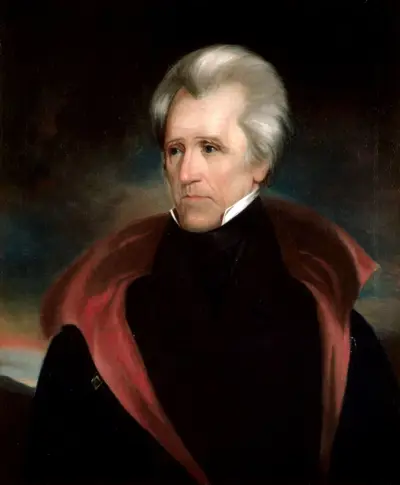
- Born: March 15, 1767
- Died: June 8, 1845
- Nationality: American
- Profession: President
Andrew Jackson was an American lawyer, soldier, and statesman who served as the seventh president of the United States from 1829 to 1837. Before being elected to the presidency, Jackson gained fame as a general in the United States Army and served in both houses of the U.S. Congress. An expansionist president, Jackson sought to advance the rights of the "common man" against a "corrupt aristocracy" and to preserve the Union.
