George Armstrong Custer Quotes
I can whip all the Indians on the continent with the 7th Cavalry.
He and the 7th Cavalry were themselves whipped and killed shortly thereafter.
George Armstrong Custer, 1839-1876, Major General, U. S. Army, Boast, 1876
Sourced by: Eigen's Political and Historical Quotations

The months later, Colorado “volunteers” attacked a Cheyenne village flying and American and White flag, killing the women and children at what would come to be known as the Sand Creek Massacre.


His Indian Removal Policy forced Native American to leave their lands which were theirs by treaties signed by the United States and marched to the poorest land in Oklahoma where they were "resettled". This is often referred to as the "Trail of Tears". What made his actions evern wors was the fact that The Supreme Court had already ruled that such land belinged to the Cherokee Indian Tribe and the government of the United States may not force them from it. Jackson was the only President in Amrican History to defy a Supreme Court order.


Large wagon trains of settlers crossed the content on their way to the Oregon Territory. The Sioux Indians whose land the wagon trains had to pass through often attacked the wagon trains in a vain effort to discourage others from passing through the area. The Sioux believed that the large wagon trains frightened the buffalo away, which was probably not a significant factor in the diminishing of the buffalo herds. The Indians and white hunters both over-hunted the buffalo which became few in numbers. With modern wildlife management Buffalo are not only back but are plentiful and being raised for their lean meat which has become a delicacy.

Not all whites were allowed to usurp all Indian lands. There were many attempts to limit white settlement to avoid friction with the Indians although the overall tendency was for the whites to take over and dominate the land.

The officer who testified at the inquiry of the Sand Creek Massacre, Lieutenant Joseph Cramer, was murdered thereafter in Denver by a supporter of Chivington’s. Sand Creek’s Indians were mutilated even after death with breasts and scrotums cut off as souvenir tobacco pouches. Ironically, President Lincoln had med with some of the killed Cheyenne leaders at the White House the year before and his quotation presages those whites who would break treaty.


Cody had fought a one-against-one battle against Chief Yellow Hair whom he killed and scalped. He then rode back to his troops shouting the quotation. Later, he displayed the scalp publicly.
This was the beginning of the Jeffersonian effort culminating in the Corps of Discovery and the Lewis & Clark Expedition. Presidential, confidential memoranda to the Congress were more common then than now when they have become a rarity.


Shabonee in a warning ride reminiscent of Paul Revere, warned many white settlers of an impending attack by unfriendly Indians. He also gave an eyewitness account of the Battle of Tippecanoe which propelled Harrison to the Presidency. The U. S. Navy named a ship in his honor in the 1940s. Several schools are named for him also.

This editorial was written just after the Massacre of Wounded Knee. An irony is that this editor who called for the extermination of Native Americans was later the author of The Wizard of Oz.

Marquis de Seignelay. This shows that the concept of ethnic cleansing has been around for some time. The only thing that prevented the French from implementing the plan was that they couldn’t defeat the Iroquois. There is a certain irony here in that the Iroquois were very much allied with the British even during the American Revolution. After that war, the Iroquois were run out of their traditional lands, not by the French but by the Americans. And where did they go and resettle? Up to then British Canada, the very area where the French so feared them.

Wayne played so many parts depicting whites in the process of expanding Westward that many people saw him as an expert on the history of the Westward Expansion. He did not comment on the whites who then kept huge ranches “selfishly” for themselves or those who selfishly would not share the mineral rich land that they had taken with anyone including the original Indian owners. So in this view, the Indians should have not been capitalists but they should have been socialists and shared their resources.

The railroads that opened up the West are often used as examples of American corporate and entrepreneurial achievement. But private enterprise would not risk the capital for such a visionary and innovative scheme. It was the Federal Government which provided loans to start and paid for every mile of track with huge grants of land along the right of way. Then the Federal government provided the security and conducted numerous wars against the Indians to make the construction and operation possible. Had the Government and President Lincoln not pushed and supported the plan, there would have been no transcontinental railroad.


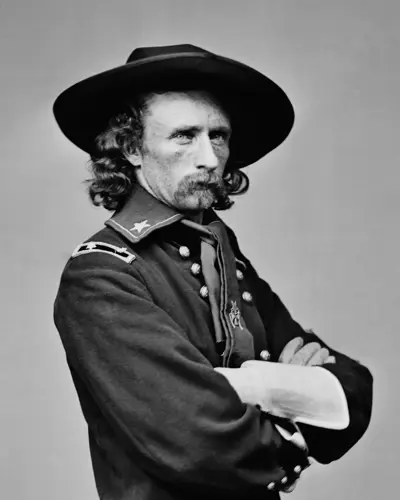
George Armstrong Custer was a United States Army officer and cavalry commander in the American Civil War and the American Indian Wars.
