George Washington Quotes
It (the proclamation of 1763) must fall, of course, in a few years, especially when those Indians consent to our occupying the lands. Any person, therefore, who neglects the present opportunity of hunting out good lands, and in some measure marking out and distinguishing them for his own, in order to keep others from settling them, will never regain it.
In the midst of the French & Indian Wars, the Board of Trade drafted the royal proclamation of October 7, 1763, forbidding the granting of lands in the vast interior, which was specifically reserved to the Indians. Washington had earlier reservations about the attempt to protect Indian lands for the Indians. See {612772} Washington after the American Revolution did grant and protect Indian lands to the minority of the Indians who had allied with the Americans against the British and the majority of the other Indian tribes.
George Washington, 1732-1799, 1st President of the United States (VA), 1767
Sourced by: Eigen's Political and Historical Quotations

In the midst of the French & Indian Wars, the Board of Trade drafted the royal proclamation of October 7, 1763, forbidding the granting of lands in the vast interior, which was specifically reserved to the Indians. Most whites, themselves interested in land, saw this as a temporary expediency only. This quotation must be viewed in juxtaposition with his of 1767 on the subject: {624055}


While the economics of land is described accurately, immigrants from most of the world would never in their home country ever be able to earn enough in a few years to acquire that much land. So the prospect of land ownership was a fundamental selling point and was a major spur to immigration to America where land was and is plentiful.


At the time, the United States wanted as many Mexicans as citizens as they could get—so much so that if Mexicans in the new American territories did not elect American Citizenship within 1 year, they became American Citizens automatically.

Jackson’s policies regarding Indians set back all the work of the earlier Presidents and created facts on the ground and attitudes that vex us to this day. In this occasion he said very forthrightly that it was his intention to deny Indians title to ANY land in the then United States. His idea was to send all the Indians to the Oklahoma Indian Territory and establish reservations for them there. Of course, as the Western states joined the Union, the Whites wanted those Indian Lands as well. See {643150} for other Jackson views on Indian policy.


See {633119} for the basic provision of the Dawes Act.

Burke was one of the few in England who predicted economic and commercial success of America.


The railroads that opened up the West are often used as examples of American corporate and entrepreneurial achievement. But private enterprise would not risk the capital for such a visionary and innovative scheme. It was the Federal Government which provided loans to start and paid for every mile of track with huge grants of land along the right of way. Then the Federal government provided the security and conducted numerous wars against the Indians to make the construction and operation possible. Had the Government and President Lincoln not pushed and supported the plan, there would have been no transcontinental railroad.

Wayne played so many parts depicting whites in the process of expanding Westward that many people saw him as an expert on the history of the Westward Expansion. He did not comment on the whites who then kept huge ranches “selfishly” for themselves or those who selfishly would not share the mineral rich land that they had taken with anyone including the original Indian owners. So in this view, the Indians should have not been capitalists but they should have been socialists and shared their resources.

His expedition to Kentucky was illegal as it was against British law to expand to the West. Soon, hundreds of thousands of Americans would follow Boone and his men.

One of the reasons that Jefferson and others were so anxious to expand the territory of the United States was that Britain had operated with the policy that curtailed and limited the population growth of the American colonies and the resentment of this policy led to growth of America and the Westward expansion.

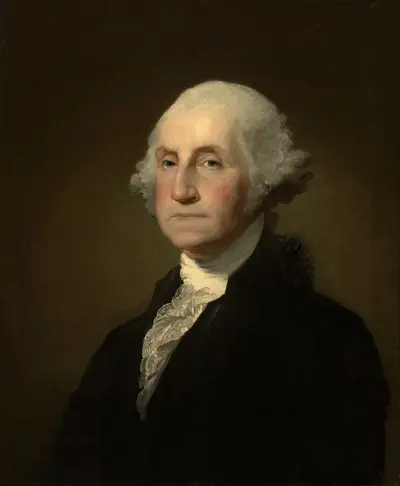
- Born: February 22, 1732
- Died: December 14, 1799
- Nationality: American
- Profession: President
George Washington was the first President of the United States (1789-97), the Commander-in-Chief of the Continental Army during the American Revolutionary War, and one of the Founding Fathers of the United States. He presided over the convention that drafted the current United States Constitution and during his lifetime was called the "father of his country".
