Daniel Boone Quotes
One day thousands will desire this land.
His expedition to Kentucky was illegal as it was against British law to expand to the West. Soon, hundreds of thousands of Americans would follow Boone and his men.
Daniel Boone, 1734-1820, Explorer & Member of the Virginia General Assembly, Statement to his men emerging from the Cumberland Gap into the Kentucky Territory, 1775
Sourced by: Eigen's Political and Historical Quotations

While the economics of land is described accurately, immigrants from most of the world would never in their home country ever be able to earn enough in a few years to acquire that much land. So the prospect of land ownership was a fundamental selling point and was a major spur to immigration to America where land was and is plentiful.


Use included renting it. What he opposed was simply holding land when whites were driving Indians off their lands because all the unused land outside of the reservation was owned by someone and the asking price was very high. Ingersoll was considered to be the greatest orator and political thinker of his day, but his overt atheistic views curtailed his elected political career.

This edict in effect divided up the New World between Spain and the other Catholic countries. The Pope wanted to avoid conflict among the Catholic powers of Europe. Shortly afterward, the Pope brokered a specific deal, The Treaty of Tordesillas, dividing exploration rights between Spain and Portugal. The Pope divided up the New World, land he had never visited, people he had never met, among Catholic European powers.

before there were railroads in the West


The Romans were very organized regarding land ownership. When they conquered Africa, defeating Carthage, they found no written records of land ownership, no deeds, no bills of sale. Therefore, they opened up the entire land mass of Africa for what amounted to public colonization where the land could be worked and claimed legally. Illiterate Africans had no written records, and most areas where under the control of a strongman who “owned” all of the land with no notion of private ownership of land.

Paine, one of America’s founding fathers and the man most responsible for influencing Americans to revolt, is generally not given much attention in modern times. One of the main reasons was that his philosophy regarding land and land ownership is today considered socialist if not communist. Paine’s other views are mostly Apple pie American, but this is shocking to many Americans.

This is an important quotations for two reasons. First, one of the white Europan myths in the colonial era was that the Native America had not concept of land ownership and title. This quotation clearly refutes that/ Second, this shows that some Europeans coming to the new world opposed the view that the white Christians and a moral right to the Native American “heathen” land. A few like Williams did not.

See {638124} for how this Biblical passage evolved into a concept of property ownership
Many of the delegates to the Constitutional Convention of 1787 had invested in land that had formerly belonged to the Iroquois Indians who had sided with the British in the Revolution and been driven up to Canada. They had paid very little and wanted to sell it at large profits. However, there was little gold and silver left in the colonies after the war and there was great reluctance in the rest of the world to lend gold and silver backed money to a new country that did not have a rule of law and courts to collect debts. For example, Madison and Monroe had formed a partnership and bought former Iroquois land near Rome, New York. There was idealism to be sure but there was also self-interest functioning in the secret Constitutional Convention.


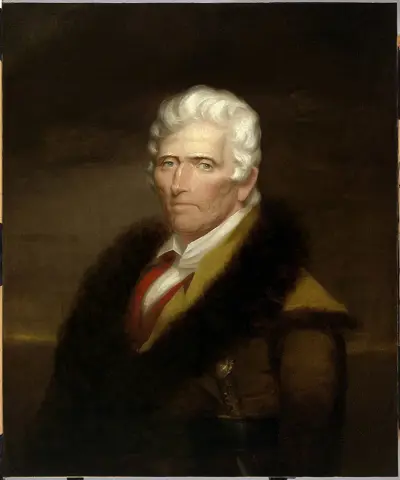
Daniel Boone was an American pioneer and frontiersman whose exploits made him one of the first folk heroes of the United States. Boone became famous for his exploration and settlement of what is now Kentucky, which was then beyond the western borders of the Thirteen Colonies. Despite resistance from American Indians, for whom Kentucky was a traditional hunting ground, in 1775 Boone blazed the Wilderness Road through the Cumberland Gap and into Kentucky. There he founded Boonesborough, one of the first English-speaking settlements west of the Appalachian Mountains. By the end of the 18th century, more than 200,000 people entered Kentucky by following the route marked by Boone.
