George Washington Quotes
Measures calculated to insure a continuance of the friendship of the Indians and to preserve peace along the extent of our interior frontier have been digested and adopted. In the framing of these care has been taken to guard on the one hand our advanced settlements from the predatory incursions of those unruly individuals who can not be restrained by their tribes, and on the other hand to protect the rights secured to the Indians by treaty - to draw them nearer to the civilized state and inspire them with correct conceptions of the power as well as justice of the Government.
George Washington, 1732-1799, 1st President of the United States (VA), Eighth Annual Message to Congress, December 7, 1796
Sourced by: Eigen's Political and Historical Quotations


There were a few members of Congress who were distressed at the deception that was very often used in negotiations with Indians. They never were a sufficient majority to pass serious, meaningful legislation.

This was passed in 1787 before the Constitution had become operative, but was then ratified by Congress in 1789. It was one of the first acts of our new nation, and one of the most frequently violated throughout our history.

In a tragic irony, the two chiefs were killed by a year later at the Sand Creek Massacre.
Not all Indians resented the coming of the white man. Several of the more peaceable tribes benefiting by interactions with the United States and some even sought affiliation—especially the military weaker tribes which would be protected by an alliance with the Americans.

This law allowed the President to forcibly move entire tribes from their native lands to sparsely settled land in the West. Oklahoma became knows as Indian Territory as so many Indians were relocated there. The act, and this clause in particular, gave the President the authority over all Indian tribes in the nation and established the difficult if not impossible relationship between the Indian nations and the Federal government. The act—the last sentence of the quote—also ratified all treaties with the Indians and pronounced them inviolate. That was not to be.
Jefferson probably had the most enlightened policy towards the Native Americans and did not see them as a people apart from Americans. His phrase “we consider them as part of ourselves” would not be concurred with by another American President for over 100 years. Unfortunately, there were many American whites who did not have Jefferson’s view, and there was no practical way the Federal Government at the time could enforce benign and equality policies. Relations with most Indian tribes went down hill and may have reached the lowest point under the Administration of Andrew Jackson.
Many American leaders wanted to comply with and enforce the Indian treaties, but the remoteness made it difficult. There were always those whites who did not want to be restricted by Indian treaties who took advantage of the situation when there was a leader like Clinton who wanted to enforce the treaties. However in many cases, the American leadership really did not want to enforce the treaties and in some cases, as with President Andrew Jackson, wanted to abrogate the treaties with the Indians.


The intentions of the Founding Fathers towards the Indians was decent, respectful, and well intentioned. However, there was not enough of a system of enforcement or the will to enforce when the greed of the average whites grew too great. Many settlers saw these vast lands and could not see any harm in using a few acres for their farm. And if there had been only a few, there would have been little trouble. However, the settlers kept coming and coming and soon the Indians began to push back. In a sense, it was a class problem. The members of the Continental Congress who wrote the Northwest Ordinance were educated, affluent men who had plenty of land. Most of the men who contested for the Indian lands had little land or were newly affluent and saw few limits to America.

This quotation is interesting in that the Madison Administration was being very careful to not alienate the Indians in Federal land purchases. Although there are many who believe the whites never should have enticed Indians to sell land at all, there were many cases where the land sales were fraudulent and gross—The Cherokee Indians in Georgia. At this time, the Federal government would negotiate an amount for some land and pay the Indian tribe the agreed upon sum. Then another tribe might claim that the land was really theirs, they had also been hunting or living there. In some cases there were Indian wars and one tribe had banished another. Madison’s policy which he reported in this speech was to negotiate with BOTH tribes separately and pay them each the agreed upon amount—he tells the public that it is worth paying double to avoid bad feelings among the Indians. Jefferson and Madison in particular had relatively liberal Indian policies. It was President Jackson who had the worst Indian policy and produced a large proportion of immoral actions, atrocities and subsequent bad feeling.

The Republican controlled Senate had turned down the ratification of the League of Nations presented by Democratic President Wilson, and looked like they would turn down any international treaty even if presented by a Republican President. This statement allowed the treaty ratification by only a few votes. However, after that the Senate turned down our participation in the Permanent Court of Arbitration at the Hague. See {640099}.


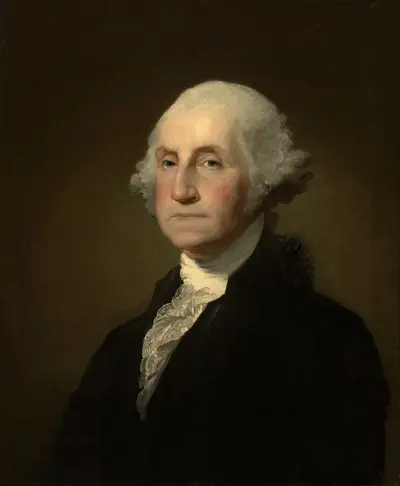
George Washington was the first President of the United States (1789-97), the Commander-in-Chief of the Continental Army during the American Revolutionary War, and one of the Founding Fathers of the United States. He presided over the convention that drafted the current United States Constitution and during his lifetime was called the "father of his country".
