George Washington Quotes
Just as we cool our coffee at the breakfast table we pour legislation into the senatorial saucer to cool it
Jefferson had not been present at the 1887 Constitutional Convention as he was representing the country in France. Upun his return, he chided Washington for having agreed to the second legislative body and taking power away from the immediate representatives of the people. This reply of Washington’s has been described by many but no eyewitness was present and the event was never described by either Washington or Jefferson.
George Washington, 1732-1799, 1st President of the United States (VA), Statement to Thomas Jefferson
Sourced by: Eigen's Political and Historical Quotations

This was the President’s original role regarding legislation. However, in the 20th century, Presidents have become more active and suggest laws and often initiate the process and then end it by signing the law that he suggested and shepherded through the Congress. But this was never the vision of the Founding Fathers, but since it is not addressed in the Constitution is not an unconstitutional process.


His main reason for believing this is that all appropriations bills must be initiated by the House of Representatives. Lobbyists therefore often give the House more attention than the Senate.

Originally published as The Cynic’s Word Book


Despite having passed the House and a majority of the Senate favoring McCain’s bill, a filibuster was led by a few holdouts from his own party. Patiently, McCain assembled sufficient Senate support to break the filibuster.


President Abraham Lincoln had pocket vetoed his own party's reconstruction bill in the midst of an election year.


Monroe was then Secretary of State.


The Congress and most of the State Legislatures are bicameral (two houses). Nebraska has only a unicameral (one house) legislature.

Morris had it wrong. He perceived that the Senate could not be a check on the House or the President because to him, the Senate was the house of aristocrats and America really did not have aristocrats since there was no nobility so that there would be no difference between Representatives and Senators-–they both were drawn from the same egalitarian population. He missed however that the Senate, being elected by states, would represent a broader constituency than a member of the House, and because of this broader perspective, would come to see issues in nationalist and state terms while Representatives would perceive the same issues in local terms. Hence the two houses of Congress became effective checks on each other, and the Senate on the President because not of different social or economic class, but of broader and narrower perspectives. It was not what Senators were but what they would become once they were elected and had to be reelected.


He was a Congressman at the time. The problem of legislating in an election year seems to have always been difficult.
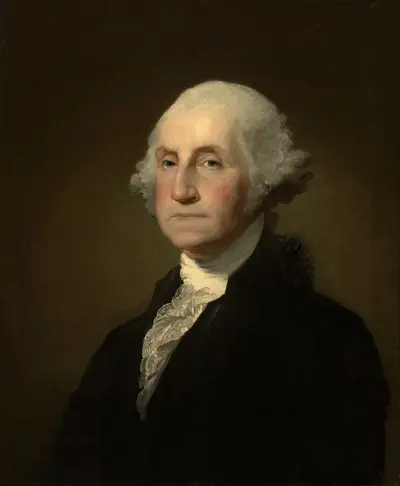
George Washington was the first President of the United States (1789-97), the Commander-in-Chief of the Continental Army during the American Revolutionary War, and one of the Founding Fathers of the United States. He presided over the convention that drafted the current United States Constitution and during his lifetime was called the "father of his country".
