Grover Cleveland Quotes
I am not responsible to the Senate and will not submit my actions to them.
Grover Cleveland, 1837-1908, 22nd & 24th President of the United States (Democrat, NY), Statement when he refused to provide the Senate with documents they wanted regarding some of his actions
Sourced by: Eigen's Political and Historical Quotations


This constitution was written 7 years before the national constitutional convention. It shows that there was concern about the separation of powers in United States even before the Constitution was drafted. See {616750} for an even clearer statement of the separation of powers principle.


Barstow the Democratic Governor who had no serious opposition in 1853 found himself challenged for reelection by Coles Bashford of the new Republican Party. The Board of Canvassers reported that Governor Barstow had won reelection but by less than 200 votes in the whole state. The Republicans charged that there had been fraud in some of the rural districts and petitioned the Wisconsin Supreme Court which ruled that nonexistent precincts had indeed voted for the Governor. The Barstow however refused to recognize the decisions of the court claiming that the court had no jurisdiction over the Board of Canvassers who were part of the executive branch. The Republicans held their own inauguration and two men claimed to be Governor. But the Governor claimed that the state constitution did not give the court any authority to deal with the crisis, He even called out the State Militia to maintain his office and intimidate the Supreme Court and keep the “other governor” from the state house. Nonetheless the court ruled that even the Governor had to obey the law and the Supreme Court would determine what the law was. Barstow finally “resigned.” See {587917} & {587914}.

President Abraham Lincoln had pocket vetoed his own party's reconstruction bill in the midst of an election year.


Hatch was the chairman of the Senate Judiciary Committee at the time.


This was Executive Privilege of the time. The result of this type of conflict between the executive and the legislative body was a Civil War in which Parliament won. This concept of executive privilege operates to this day in America where the President typically refuses to have his special assistants and staff be questioned by Congressional investigating committees. IT also extends to documents where the President has refused to allow Congress access to papers. In the Watergate scandal, it was the Supreme Court Decision that President Nixon could not claim Executive Privilege with respect to the Watergate tapes. Their exposure forced his resignation.


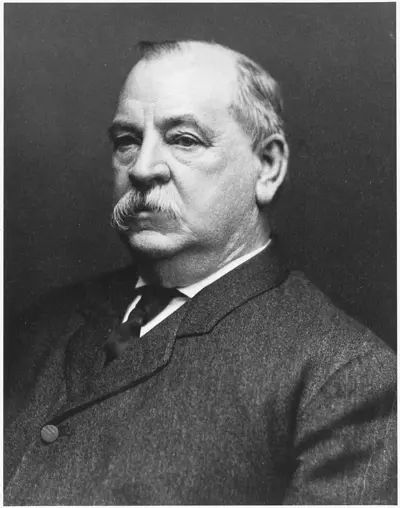
Stephen Grover Cleveland was an American politician and lawyer who served as the 22nd and 24th president of the United States from 1885 to 1889 and from 1893 to 1897. Cleveland is the only president in American history to serve two nonconsecutive terms in office. He won the popular vote for three presidential elections—in 1884, 1888, and 1892—and was one of two Democrats (followed by Woodrow Wilson in 1912) to be elected president during the era of Republican presidential domination dating from 1861 to 1933.
