Ulysses S. Grant Quotes
Early on the morning of the 8th the pursuit was resumed. General Meade followed north of the Appomattox, and General Sheridan, with all the cavalry, pushed straight ahead for Appomattox Station, followed by General Ord’s command and the 5th corps. During the day General Meade’s advance had considerable fighting with the enemy’s rear-guard, but was unable to bring on a general engagement. Late in the evening General Sheridan struck the railroad at Appomattox Station, drove the enemy from there, and captured twenty-five pieces of artillery, a hospital train, and four trains of cars loaded with supplies for Lee’s army.
These were the critical immediate events thst forced General Robert E. Lee to surrender at Appomatix. The surrender did not end the Civil War, but it made the end inevitable and close at hand.
Ulysses S. Grant, Memoir of the Military Events leading up to Lee's surrender at Appomattox in1865
Sourced by: Eigen's Political and Historical Quotations

Lee was trying to negotiate a peace treaty as a part of his his potential surrender. However, Grant would not be drawn into that, Lee was NOT the government of the Confederacy, and Grant had served with him earlier in the Mexican War and knew he was not a fanatic on teh subject of slavery and race as most of the Southern leaders were. They werenthe ones who would have to be captured or driven to surrender. Grant could have gotten authoirioty as he was in almost real time contact with President Lincoln by telegraph. However, neither wanted to negotiate peace with Lee. Instead, Grant gave Lee and his men incredibly gracious termsof surrender which he and Lincoln hoped would casue the avarage Southern soldiers to feel better about surrender for although Lee's was the largest Confederate Army, there were still others out there that had to be dealt with,

Committee of the Congress. This was the prevailing Congressional and public view except for the South which had coalesced around an intellectual rationalization. See {618013}.

The so called War on Terror had many lessons. President Obama and many of the military leaders in the Pentagon realized that just as we evolved the concept of a Cold War, a new concept was needed to deal on the long run with the Al Qaeda terrorists. Typically in war, the nation is fully mobilized with the surrender of the enemy the major objective. When peace is negotiated, there is some demobilization and other things begin to take precedence. However, given the non state highly decentralized nature of Al Qaeda, there is no way to ever negotiate peace because no Al Qaeda official can speak for any more than his immediate cell and cadre. They will likely never stop attacking in any foreseeable future since their motivation is ideological and religious. It doesn’t take full military mobilization to protect against individual acts of terrorism, and indeed arguably the large mobilization only gives the terrorists more nearby targets. So American leaders were evolving a state of high protection, surgical strikes and attacks on Al Qaeda leadership and cells, and at the same time a demobilization of many of the overseas ground troops. It is not a state of war yet there will be attacks from time to time against us and attacks by us on Al Qaeda, yet there cannot be an all out war which is de factor non winnable in toto, but is very controllable. For Stein and other hawks, this new state is unfathomable. If there is any attack on Americans or American interests to them we are either at war with full mobilization or have surrendered. The total number of American civillians killed in the 10 year war on terror has been less than 2 months of normal automobile crash deaths or 3 months worth of gun accidents, or one tenth of the deaths caused by flu in a single year.


Instead Lee took Longstreet’s advice and surrendered at Appomattox.

The Virginia Campaign of May 1864 was clearly the beginning of the end of the war. This was clear at the time, not only to the military leaders of both sides, but also to the media and thence the general public in the North. At the beginning of the war the Army of the Potomac, the largest Union Army was commanded by McClellan whose concerns were with his own political career and not winning the war. He had an aversion to heavy fighting and did not see the war strategically as Lincoln, Grant and Sherman did: To cripple the capacity of the South to wage war. So the early history of the Army of the Potomac was a series of undecisive battles which were either standoffs or the Confederates won despite the much larger and better armed and equipped Union army. As soon as McClellan was replaced, things began to turn around and when Grant was selected for Command of all Union Troops, the Army of the Potomac performed much better, including taking Richmond, the Confederate Capital.


Wade was one of the Radical Republicans who advocated a much more vigorous prosecution of the Civil War effort in the North. It is important for two reasons: First, it illustrates the position of the “Hawks” who constantly pressured Lincoln to counter the Democrat lack of enthusiasm for the fighting. Many believed that the South would come to its senses and end the rebellion. Second and more important, this is one of the quotations that apologists for the South during the Jim Crow segregation issue use to show that there was a strong desire to impoverish the South. This is partly true. Wade and the other radicals did argue to impoverish the South only so long as they were continuing the war and rebellion. They did not argue that the South should be impoverished after the war was over. However, the reality was that the Southern economy had become so dependent on slave labor, that after Emancipation, it was very difficult to rebuild the Southern Economy. With Slavery Southern Cotton sold to England was cheaper than Egyptian Cotton. If labor had to be paid, the Egyptian cotton became cheaper. The South had squandered almost all of their capital resources on financing the war and had no capital to finance modern manufacturing enterprises. And they so resented Northerners that it was very difficult for Northern businessmen who did have capital to start and finance enterprises in the South. There also was little money for good public schools after the war, and the inferior education of the South made the situation very hard to change.
General Grant had the fort surrounded and the confederate general hoped to surrender the fort and allow him and his men to leave to fight again some other day. This was often agreed to so the military objective would be gained without the casualties of a battle. However, Grant and Lincoln did not simply want to gain forts and territory. They wanted to end the war. Those Confederates who survived the battle were taken prisoner and were out of the fight.

Hunton was an old West Point classmate of Sherman’s and was also a Tennessee slave holder, who wanted his escaped slaves back under the Fugitive Slave Act. Actually, Army Commander McClellan had issued an order just a few days before, prohibiting the Army of returning fugitive slaves to their rebel owners who were guilty of treason. See {619337} Sherman however wrote his friend and made a moral and ethical argument that transcended the law and at the same time pointed out the ethical hypocrisy of the treasonous Confederates.

Committee of the Congress


The ultimatum was rejected, Cromwell’s forces took the town and massacred the defenders as well as many civilians. See {632366}.

Armstrong was a Union military chaplain with the troops that had captured Petersburg, Virginia. Of particular interest in this quotation is his report on the attitude of the poor whites after the war had destroyed the economy of the area and reduced the former wealthy aristocrats to poverty.

President Lincoln and Several of the Commanding Union Generals had declared that black slaves were free during the midst of the Civil War under the legal theory that if the slaves were property of the rebels, then they cold be seized as “contraband” and removed from the control of those who had committed treason. The question was, what would happen to those now free Negroes after the war? Many Negro leaders were anxious that if there were surrender, then the status quo ante might prevail and the Negroes—many have who had fought for the Union might be returned to slavery. This speech by the Secretary of State alarmed them further. This is why the Emancipation Proclamation was so important and even that might have been overturned by a subsequent President. This is why Lincoln, the white radical Republicans and the Black leadership placed so much emphasis on passing the 13th Amendment.
“The enemy were the Dutch revolutionists and the French who had sent a small army to assist the Dutch rebels. The Count had his Castle right near the border of Holland in the Austrian controlled part of the Netherlands.
The American plan was to capture Quebec and add that province to the 13 colonies. See {636940} . However, the American officers botched the invasion and did not attack as soon as they arrived when the British had almost no troops to defend Quebec.

He had just assumed his post 6 days earlier. At this point he did not have enough knowledge to favor or oppose the regime change, but he did realize that the decision was a serious one and there would be no turning back. Diem was a creature of the Central Intelligence Agency. An anti-Communist Christian in a Buddhist county, the CIA engineered his rise to power, created his political party, provided him with cash to bribe other Vietnamese politicians, and paid for all the propaganda so he would “win” the Presidential elections. However, he abused the Buddhists, was thoroughly corrupt and ran a corrupt administration, but worst of all from the American point of view, he was unable to motivate the South Vietnamese population to fight the Communists. He reached the point where he was more of a liability, and the Central Intelligence Agency engineered a coup d’etat to remove him from power and replace him with a President more to our liking. (See {634540}.)

This is one of the best summaries of Lincoln’s early strategic thinking about the war. Unfortunately for him and the country, his generals were all trained in tactics rather than strategy. And the then modern world placed industry, logistics, and economics on a par with battlefield tactics. Until Generals Grant and Sherman were elevated to higher command, there were no military leaders who thought about the war in overall strategic terms. Lincoln, Grant, and Sherman in a sense created the first strategic approach to modern warfare.
Lincoln and the Union leaders were still hopeful of ending the rebellion and getting things back to a pre-war footing economically. At this point they were trying to preserve components of the Southern Economy at no small cost. As that hope was shown to be futile, the Total War strategy of Grant and Sherman prevailed to the satisfaction of men like Opdycke. That actually ended the war quickly, but the Southern Economy was devastated in the process.
The South could not replenish their lost arms and munitions nor could they replace most of the men wounded, killed or taken prisoner. The Union could do both. Therefore as long as the Union army inflicted casualties, it mattered little who won which battle as long as the fighting was in the South. This critical strategic reality was never appreciated by the Union Generals who were generally reluctant to take large casualties. When Grant and Sherman finally were able to set the strategy of attrition in operation, the Union actually won most of the battles though he and Grant took very high casualties. The casualties of the Confederates were generally higher but they did not have to be for the Union to win. The Civil War was a strategic form of suicide. Ironically, at a few points the rebellion might have succeeded because of the incompetent and timid Union military leadership at the beginning of the war.

This cry echoed throughout the North where the public wanted a full invasion of the capital of the Confederacy to put an end to the rebellion. However is was not clear what effect that would have on the Border States—Maryland and Kentuucky—and many politicians thought that the South would “come to its senses” once they realized what they had done. But the South would not change its course, and the Union Generals in Command were very reluctant to actually invade the South. It was only after the South attacked in the North that the Union Military began to realize that this was a Civil War that would not be resolved politically.

Response to an offer by Commodore Preble to exchange prisoners.
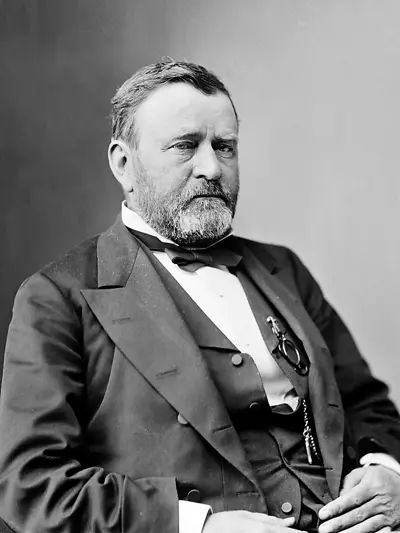
Ulysses S. Grant was an American military leader who served as the 18th president of the United States from 1869 to 1877. As president, Grant was an effective civil rights executive who created the Justice Department and worked with the Radical Republicans during Reconstruction to protect African Americans. As Commanding General, he led the Union Army to victory in the American Civil War in 1865 and thereafter briefly served as Secretary of War.
