New York Tribune Quotes
Forward to Richmond! Forward to Richmond!
This cry echoed throughout the North where the public wanted a full invasion of the capital of the Confederacy to put an end to the rebellion. However is was not clear what effect that would have on the Border States—Maryland and Kentuucky—and many politicians thought that the South would “come to its senses” once they realized what they had done. But the South would not change its course, and the Union Generals in Command were very reluctant to actually invade the South. It was only after the South attacked in the North that the Union Military began to realize that this was a Civil War that would not be resolved politically.
New York Tribune, Headline, 1861
Sourced by: Eigen's Political and Historical Quotations


Warren was the Washington correspondent and Editorial Writer of the Tribune at the time. Many people erroneously attributed this editorial to Horace Greeley, the Tribune owner or Charles Dana, the Managing Editor


Two days later Lee surrendered at Richmond, and the Civil War was over. On April 14, Lincoln was assassinated. He died the next day.

That is the way he was killed. The phrase, “We are bound to believe that, anyhow” indicates that Stuart really realized how futile the Southern war effort would be but loyalty and patriotism required him to suspend his rational belief structure.


The Virginia Campaign of May 1864 was clearly the beginning of the end of the war. This was clear at the time, not only to the military leaders of both sides, but also to the media and thence the general public in the North. At the beginning of the war the Army of the Potomac, the largest Union Army was commanded by McClellan whose concerns were with his own political career and not winning the war. He had an aversion to heavy fighting and did not see the war strategically as Lincoln, Grant and Sherman did: To cripple the capacity of the South to wage war. So the early history of the Army of the Potomac was a series of undecisive battles which were either standoffs or the Confederates won despite the much larger and better armed and equipped Union army. As soon as McClellan was replaced, things began to turn around and when Grant was selected for Command of all Union Troops, the Army of the Potomac performed much better, including taking Richmond, the Confederate Capital.

The Civil War produced more deaths than all other American wars put together. Lee’s skill and gentlemanly demeanor subdue the fact that his treasonous efforts caused more American soldiers to die than the entire Second World War—and yet some Americans regard him as a hero while others see him as a traitor.
Lincoln and the Union leaders were still hopeful of ending the rebellion and getting things back to a pre-war footing economically. At this point they were trying to preserve components of the Southern Economy at no small cost. As that hope was shown to be futile, the Total War strategy of Grant and Sherman prevailed to the satisfaction of men like Opdycke. That actually ended the war quickly, but the Southern Economy was devastated in the process.

Committee of the Congress. This was the prevailing Congressional and public view except for the South which had coalesced around an intellectual rationalization. See {618013}.


General Grant had the fort surrounded and the confederate general hoped to surrender the fort and allow him and his men to leave to fight again some other day. This was often agreed to so the military objective would be gained without the casualties of a battle. However, Grant and Lincoln did not simply want to gain forts and territory. They wanted to end the war. Those Confederates who survived the battle were taken prisoner and were out of the fight.
This is an important quotation because it helps to dispel a myth that the Civil War was not about slavery. That was the reason that the rebelling states gave for secession, but apologists for the Confederacy have claimed that the average soldier on both sides did not care about slavery. (Two thirds of the Southern Soldiers came from families that did not own slaves; nonetheless it was clear that the main motivation of the Confederate Soldier was to protect the institution of slavery, while that of the Union soldiers was to destroy slavery.) Professor Manning found this in her book: What This Cruel War Was Over: Soldiers, Slavery, and the Civil War.
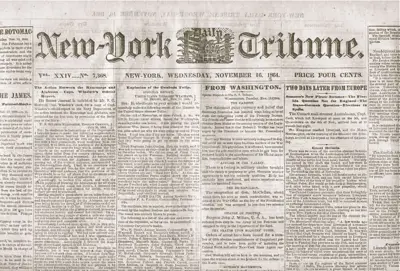
The New-York Tribune was an American newspaper, first established in 1841 by editor Horace Greeley. Between 1842 and 1866, the newspaper bore the name New-York Daily Tribune. From the 1840s through the 1860s it was the dominant Whig Party and then Republican newspaper in the United States. The paper achieved a circulation of approximately 200,000 in the 1850s, making it the largest daily paper then in New York City. The Tribune's editorials were widely read, shared, and copied in other city newspapers, helping to shape national U.S. opinion. It was one of the first papers in the north to send reporters, correspondents, and illustrators to cover the campaigns of the American Civil War.
