Ulysses S. Grant Quotes
GENERAL:–Your note of yesterday is received. I have no authority to treat on the subject of peace; the meeting proposed for ten A.M. to-day could lead to no good. I will state, however, general, that I am equally anxious for peace with yourself, and the whole North entertains the same feeling. The terms upon which peace can be had are well understood. By the South laying down their arms they will hasten that most desirable event, save thousands of human lives, and hundreds of millions of property not yet destroyed. Seriously hoping that all our difficulties may be settled without the loss of another life,
Lee was trying to negotiate a peace treaty as a part of his his potential surrender. However, Grant would not be drawn into that, Lee was NOT the government of the Confederacy, and Grant had served with him earlier in the Mexican War and knew he was not a fanatic on teh subject of slavery and race as most of the Southern leaders were. They werenthe ones who would have to be captured or driven to surrender. Grant could have gotten authoirioty as he was in almost real time contact with President Lincoln by telegraph. However, neither wanted to negotiate peace with Lee. Instead, Grant gave Lee and his men incredibly gracious termsof surrender which he and Lincoln hoped would casue the avarage Southern soldiers to feel better about surrender for although Lee's was the largest Confederate Army, there were still others out there that had to be dealt with,
Ulysses S. Grant, Note to General Robert E, Lee, just prior to Lee's surrender at Appomattoz, 1865
Sourced by: Eigen's Political and Historical Quotations


Generally after civil wars there have been extensive reprisals and trials of the winning side against the losing one. Lincoln was determined that this pattern not be followed as the bloody war was coming to an end. Ironically, Andrew Johnson, Lincoln’s successor and a Southerner, was, together with some of the Radical Republicans, in favor of trying many of the Southern leaders for treason and rebellion. Lincoln’s view however and that of the moderate members of Congress prevailed. However, the Southern Whites generally would not comply with the Constitutional Amendments and laws regarding the role of the Negro, and Johnson was very sympathetic to their racism which led to a conflict between Johnson and Congress.

In 1786 the Barbary Pirates demanded bribes so as not to seize American ships. England and France customarily paid the bribes. Thomas Jefferson proposed to build a navy and attack the pirates. However, there was no American navy at the time, Adams counseled a different course and in January of 1787 they signed a “pact” with Morocco whereby America paid for protection.


General Grant had the fort surrounded and the confederate general hoped to surrender the fort and allow him and his men to leave to fight again some other day. This was often agreed to so the military objective would be gained without the casualties of a battle. However, Grant and Lincoln did not simply want to gain forts and territory. They wanted to end the war. Those Confederates who survived the battle were taken prisoner and were out of the fight.


Santa Ana was, at the time, a captive of Sam Houston.


In this case, he was referring to the situation with the Barbary Pirates who had an incredible extortion racket going in the Mediterranean. If nations would pay them an annual sum each year, they would not attack and seize merchant ships of that country and sell the ships and goods while holding the sailors for ransom. Jefferson favored and authorized war—a naval attack which for many reasons the European nations had not done (they just paid the tribute). Then a peace treaty was finally signed—the first American Treaty.


The so called War on Terror had many lessons. President Obama and many of the military leaders in the Pentagon realized that just as we evolved the concept of a Cold War, a new concept was needed to deal on the long run with the Al Qaeda terrorists. Typically in war, the nation is fully mobilized with the surrender of the enemy the major objective. When peace is negotiated, there is some demobilization and other things begin to take precedence. However, given the non state highly decentralized nature of Al Qaeda, there is no way to ever negotiate peace because no Al Qaeda official can speak for any more than his immediate cell and cadre. They will likely never stop attacking in any foreseeable future since their motivation is ideological and religious. It doesn’t take full military mobilization to protect against individual acts of terrorism, and indeed arguably the large mobilization only gives the terrorists more nearby targets. So American leaders were evolving a state of high protection, surgical strikes and attacks on Al Qaeda leadership and cells, and at the same time a demobilization of many of the overseas ground troops. It is not a state of war yet there will be attacks from time to time against us and attacks by us on Al Qaeda, yet there cannot be an all out war which is de factor non winnable in toto, but is very controllable. For Stein and other hawks, this new state is unfathomable. If there is any attack on Americans or American interests to them we are either at war with full mobilization or have surrendered. The total number of American civillians killed in the 10 year war on terror has been less than 2 months of normal automobile crash deaths or 3 months worth of gun accidents, or one tenth of the deaths caused by flu in a single year.


Ironically, the Japanese Government and military were so polarized that it took several days for the authorities to get together and agree on a course of surrender action. The second atomic bomb dropped on Nagasaki speeded things up.


1st Earl of Beaconsfield. Contrast this statement with that of Neville Chamberlain returning from Munich in 1941. Disraeli had threatened war and forced the Russians to accept all the British demands by diplomatically isolating them first and moving armed troops into position just before the peace conference.
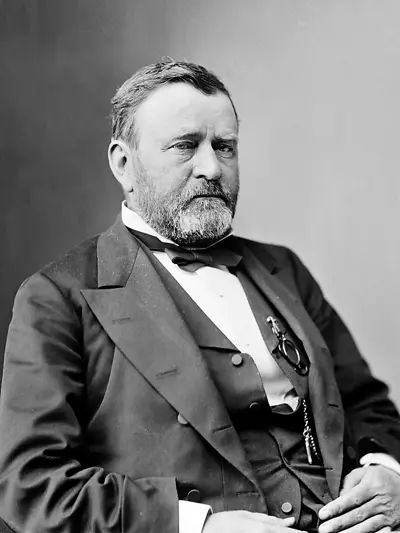
Ulysses S. Grant was an American military leader who served as the 18th president of the United States from 1869 to 1877. As president, Grant was an effective civil rights executive who created the Justice Department and worked with the Radical Republicans during Reconstruction to protect African Americans. As Commanding General, he led the Union Army to victory in the American Civil War in 1865 and thereafter briefly served as Secretary of War.
