George I Quotes
All Germans and Swiss emigrating to the colonies will be awarded transportation subsidies and land, provided they are not Catholic.
The King wanted colonists for the American colonies, but did not want Roman Catholics.
George I, 1660-1727, King of England, Instruction to his German agent
Sourced by: Eigen's Political and Historical Quotations


The Governor had banished John Bowne, the Quaker from the colony. In general, he was opposed to Quakers, Jews and other “non-Christians.”


The Koran is even more discriminatory regarding Jewish & Christian clerics: {584380}.

Poland was one of the Nazi occupied nations which cooperated in the mass murder of Jews and facilitated the Holocaust. Even after the war, much of the Polish Catholic clergy maintained virulent anti-Semitic views and in 1946 Polish thugs with the encouragement of some priests engaged in a pogrom in Kielce of returning Polish Jewish refugees. Catholic Primate of Poland, Augustus Hlond, made numerous anti-Semitic statements further exacerbating the problem. Many cast blame on Pope Pius XII who was not very vocal during the Nazi era regarding the ill treatment and murder of Jews, Gypsies, and handicapped, giving a “green light” to the Polish Prelate and those lower anti-Semitic priests. Papal apologists note that Hitler could have turned on the Catholic Church; the Pope had to walk a fine line between condemning evil and risking the welfare of the Church. Nonetheless, many Catholic priests risked and some lost their lives speaking out against the Nazi evil and protecting Nazi targets.

This quotation was used by the Lyndon B. Johnson 1964 Campaign as: “We represent the majority of the people in Alabama who hate niggerism, Catholicism, Judaism, and all the isms of the whole world.” So said Robert Creel of the Alabama Ku Klux Klan. He also said, “I like Barry Goldwater. He needs our help.” The second statement was made at a different time.

Uriah Phillips Levy, 1792-1862, was the first Jewish naval captain of the United States Navy. He was acknowledged by the Secretary to be qualified for promotion to Commodore but there was much anti-Semitic opposition among the other senior officers. The Secretary justified his refusal to promote Levy because of. Levy was finally appointed Commodore.


It was not until 1780 that Catholics were allowed to even be members of Town Corporations.


See Justice Richard Cox for a similar view.


Louisiana was then a possession of France

He had been an eye-witness to the Massacre of the Parisian Protestants as a young man.

The King Outlawed Protestant Worship.
Two hundred years earlier, in Spain, the Christians had similar laws discriminating against Jews whose synagogues had to be smaller and shorter than any Christian church.


The General Court was the Legislature and the Judiciary of the Colony of Massachusetts. Quakers could be arrested without a warrant that protected all others, and were offered a choice between banishment and death. Our Founding Fathers were very familiar with this law and the many others like it when they wrote the First Amendment allowing freedom of religion and banning an America established church.
This quotation demonstrates that religious persecution of non Muslims was a duty, This has been a characteristic of all religious persecution regardless of religion. The quotation also shows that after 600 years, the original limited tolerance the Prophet had urged for People of the Book (Jews and Christians) was waning. Instead of non-believers being tolerated if they paid the special tax and were second class citizens, leaders were urged to convert or eliminate “infidels.”
Toleration is a relative term. The Muslim Moors made Christians (and Jews) pay a special tax. At times they were forced to wear special clothing so that they could be readily identified. And they could not build churches larger or taller than the smallest mosque in the community. At times, their occupations were restricted but at other times Christians and Jews were appointed to the highest positions like Vizier. The Inquisition, in contrast, forced all Muslims (and Jews) to leave the country without any of their property or money or be tortured and killed—usually by burning at the stake unless of course that they converted to Christianity.
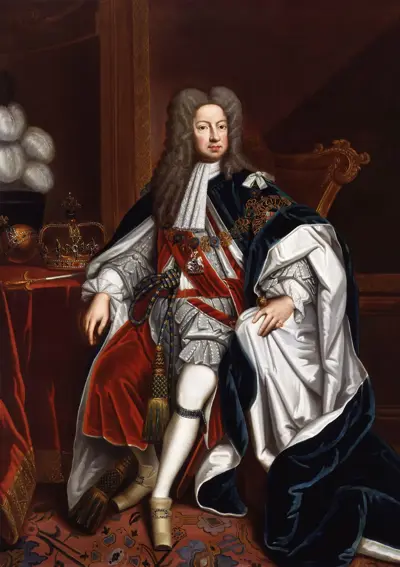
George I was King of Great Britain and Ireland from 1 August 1714 and ruler of the Duchy and Electorate of Brunswick-Lüneburg (Hanover) within the Holy Roman Empire from 23 January 1698 until his death in 1727. He was the first British monarch of the House of Hanover.
