Muhammad Quotes
O believers, take not Jews and Christians as friends; they are friends of each other. Whoso of you makes them his friends is one of them.
Muhammad, 571-632, Prophet and Founder of Islam, Koran, V Tables 55
Sourced by: Eigen's Political and Historical Quotations

The Koran is even more discriminatory regarding Jewish & Christian clerics: {584380}.
This sura illustrates why peace treaties between Islamic and non Islamic countries are difficult to negotiate and enforce. For some fundamentalist Muslims, even making a peace treaty with Israel would constitute a transgression of the word of God. Nonetheless, the first treaty that the United States ever made was with a Muslim nation—Tripoli.
This sura has been in great controversy throughout the Muslim Empires. In part it separates many of the Arab cultures from the Ottomans. The latter had an organized meritocracy whereby Jews, Christians and other “heathens” of exceptional talent were sought out for advisory and leadership positions. In part this was justified as requiring that the Caliph and the Sultans had the power of life and death over their key appointees, hence they had to be slaves and other suras prohibited Muslims holding other Muslims in slavery. Even in modern times some Muslim countries have had key non-Islamic appointees and others would not. In historical practice, the Ottoman Empire utilized far more Christians and Jews that those societies involved Muslims until relatively recent historical times.

His quotations are very important because he wrote many of the Islamic legal opinions that governed Muslim Spain and influenced the Arabs of North Africa. This is yet another example of the classic antipathy that many Muslims have for People of the Book—Christians and Jews.

The Governor had banished John Bowne, the Quaker from the colony. In general, he was opposed to Quakers, Jews and other “non-Christians.”

Anti Hindu prejudice has been a problem for Pakistan from the beginning of its founding.
See {617160} for a similar legal opinion. The concern was that poor Muslims may desert their faith when they see how well-dressed the tolerated people, Christians and Jews, are. They might conclude that Christianity or Judaism is better at making people wealthy than was Islam. See {617162} for a Koranic support of the idea. The Western view of this is generally, that is what the marketplace of ideas is all about. In 21st century America, Jews and Mormons on the average were the wealthiest religious groups. The logic of al-Ramli is that Mormons and Jews—each only 6 percent of the population—should not be allowed to show their wealth, lest Roman Catholics for example—25 percent of the population—will convert from Catholicism to the other two religions. From a democratic point of view, the response should be, we so be it. That is their choice. But America is the living proof that the assumption of conversion and loss of faith is per se wrong. The Mormons and Jews are visibly more successful, yet there are very few Roman Catholics leaving their church and converting to the two wealthier religions. There are some, but not at any greater rate than people convert from “wealthier” religions.


The place of non-Muslims in an Islamic country, if any, has been a point of great anxiety among Christians, Jews, Bhais, and others. These have been persecuted and expelled from numerous Islamic countries while in others such as modern Turkey there is no problem. This particular cleric is seen as more “modern” and “liberal” than most. Even he has little concept of equality and freedom of religion.


Nasr Hamid Abu Zayd, 1943-2010, was an modernistic Egyptian Islamic Scholar and a Professor at the University of Cairo. One of his writings argued that the discriminatory tax that the Koran specified for Christians and Jews in an Islamic nation was not fair or consonant with modern thought regarding freedom of religion and the rights of minorities. Some fundamentalist were outraged and charged him with Apostacy for criticizing a Koranic prescription. He was convicted and lost his professorship. That was the least of his problems. Since he was an apostate, he was not a Muslim the Egyptian Courts ruled, and therefore his wife, a Muslim, could not legally remain married to her. His marriage was legally dissolved and he was threatened with death by fundamentalists forcing him and his wife to go into exile in Holland where he taught at the Utrecht University. He never returned.
See {617157} for a similar legal opinion. The concern was that poor Muslims may desert their faith when they see how well housed the tolerated people, Christians and Jews, are. They might conclude that Christianity or Judaism is better at making people wealthy than was Islam. See {617162} for a Koranic support of the idea. The Western view of this is generally, that is what the marketplace of ideas is all about. In 21st century America, Jews and Mormons on the average were the wealthiest religious groups. The logic of al-Ramli is that Mormons and Jews—each only 6 percent of the population—should not be allowed to show their wealth, lest Roman Catholics for example—25 percent of the population—will convert from Catholicism to the other two religions. From a democratic point of view, the response should be, we so be it. That is their choice. But America is the living proof that the assumption of conversion and loss of faith is per se wrong. The Mormons and Jews are visibly more successful, yet there are very few Roman Catholics leaving their church and converting to the two wealthier religions. There are some, but not at any greater rate than people convert from “wealthier” religions.
At the time, the Muslim discrimination, terrible as it was, was not as bad as Christian discrimination against any non-Christians where death was very common. For many Muslims, the older historical values and practices are desirable if not mandatory today, while many others are modernists like most Christians who reject the Christian practices and morality of the past,
Toleration is a relative term. The Muslim Moors made Christians (and Jews) pay a special tax. At times they were forced to wear special clothing so that they could be readily identified. And they could not build churches larger or taller than the smallest mosque in the community. At times, their occupations were restricted but at other times Christians and Jews were appointed to the highest positions like Vizier. The Inquisition, in contrast, forced all Muslims (and Jews) to leave the country without any of their property or money or be tortured and killed—usually by burning at the stake unless of course that they converted to Christianity.
Many Muslims did not want science and technology to fall into the hands of the heathens. Even today America limits the information and technological products that can be exported to the Islamic nations. At the time it was the case that some Christian and Jewish Scholars translated Islamic scientific treatises and promoted them under their own name, but most of the translations were published and labeled as such .The reason was that at that time Europe was emerging from the Dark Ages and was scientifically relatively ignorant whereas the Muslims had the best scientists and mathematicians in the world. It was more prestigious and credible to attribute science material to Muslims. At the same time, a good bit of the Islamic science texts were translations of the great Greek scientists and some Muslims offered it as their own. Most however translated the Greek works and labeled it as such. Ibn Abdun quotations are very important because he wrote many of the Islamic legal opinions that governed Muslim Spain and influenced the Arabs of North Africa.
Two hundred years earlier, in Spain, the Christians had similar laws discriminating against Jews whose synagogues had to be smaller and shorter than any Christian church.


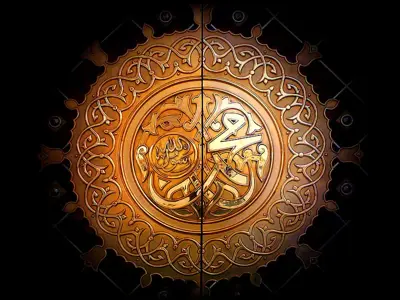
Muhammad was an Arab religious, social, and political leader and the founder of Islam. According to Islamic doctrine, he was a prophet, sent to preach and confirm the monotheistic teachings of Adam, Abraham, Moses, Jesus, and other prophets. He is believed to be the final prophet of God in all the main branches of Islam, though some modern denominations diverge from this belief. Muhammad united Arabia into a single Muslim polity, with the Quran as well as his teachings and practices forming the basis of Islamic religious belief.
