Muhammad Quotes
Take not as advisors, consultants, protectors, helpers, friends, etc. those outside your religion (pagans, Jews, Christians, and hypocrites) since they will not fail to do their best to corrupt you.
This sura has been in great controversy throughout the Muslim Empires. In part it separates many of the Arab cultures from the Ottomans. The latter had an organized meritocracy whereby Jews, Christians and other “heathens” of exceptional talent were sought out for advisory and leadership positions. In part this was justified as requiring that the Caliph and the Sultans had the power of life and death over their key appointees, hence they had to be slaves and other suras prohibited Muslims holding other Muslims in slavery. Even in modern times some Muslim countries have had key non-Islamic appointees and others would not. In historical practice, the Ottoman Empire utilized far more Christians and Jews that those societies involved Muslims until relatively recent historical times.
Muhammad, 571-632, Prophet and Founder of Islam, Koran, Sura 3:118
Sourced by: Eigen's Political and Historical Quotations

Ethnic cleansing was a basic component of early Islam. The contemporary seeming hysteria over American troops in Arab nations, has in addition to the usual problems of soldiers from another land this background. The same is true about the presence of Israel. From some points of view, the presence of Christians and Jew in the Middle East is wrong per se because it undermines the work and intention of the Prophet.

The place of non-Muslims in an Islamic country, if any, has been a point of great anxiety among Christians, Jews, Bhais, and others. These have been persecuted and expelled from numerous Islamic countries while in others such as modern Turkey there is no problem. This particular cleric is seen as more “modern” and “liberal” than most. Even he has little concept of equality and freedom of religion.
This quotation demonstrates that religious persecution of non Muslims was a duty, This has been a characteristic of all religious persecution regardless of religion. The quotation also shows that after 600 years, the original limited tolerance the Prophet had urged for People of the Book (Jews and Christians) was waning. Instead of non-believers being tolerated if they paid the special tax and were second class citizens, leaders were urged to convert or eliminate “infidels.”


The Koran is even more discriminatory regarding Jewish & Christian clerics: {584380}.
At the time, the Muslim discrimination, terrible as it was, was not as bad as Christian discrimination against any non-Christians where death was very common. For many Muslims, the older historical values and practices are desirable if not mandatory today, while many others are modernists like most Christians who reject the Christian practices and morality of the past,
Many Muslims did not want science and technology to fall into the hands of the heathens. Even today America limits the information and technological products that can be exported to the Islamic nations. At the time it was the case that some Christian and Jewish Scholars translated Islamic scientific treatises and promoted them under their own name, but most of the translations were published and labeled as such .The reason was that at that time Europe was emerging from the Dark Ages and was scientifically relatively ignorant whereas the Muslims had the best scientists and mathematicians in the world. It was more prestigious and credible to attribute science material to Muslims. At the same time, a good bit of the Islamic science texts were translations of the great Greek scientists and some Muslims offered it as their own. Most however translated the Greek works and labeled it as such. Ibn Abdun quotations are very important because he wrote many of the Islamic legal opinions that governed Muslim Spain and influenced the Arabs of North Africa.
This sura has unfortunately been used by some Serbians and other Christians to justify ethnic cleansing against Muslims.

Toleration is a relative term. The Muslim Moors made Christians (and Jews) pay a special tax. At times they were forced to wear special clothing so that they could be readily identified. And they could not build churches larger or taller than the smallest mosque in the community. At times, their occupations were restricted but at other times Christians and Jews were appointed to the highest positions like Vizier. The Inquisition, in contrast, forced all Muslims (and Jews) to leave the country without any of their property or money or be tortured and killed—usually by burning at the stake unless of course that they converted to Christianity.

This was early in his career. As he got older, he was very frustrated with the Jews who would not convert to Christianity even after he had “purified” the religion and freed Christians from the “evils” of the Papacy. He became a virulent anti-Semite. See {617773}.


This quotation is an excellent summary of view of most fundamentalist Muslims’ current views towards Christians and Jews. In the Koran, the Prophet made exceptions about required conversions to Islam for Jews, Christians, and Zoroastrians (the pre Islamic Iranian religion). However, although they were to be allowed to maintain their religion. They had to pay a special tax called “Jizya” described in the quotation. Islam interpreted these words of the Prophet very differently in different places and times. Jews and Christians were not only treated very well in Islamic Spain and in Ottoman Turkey when Turkey was the seat of Islamic religion and power in the world, but they achieved some of the most important positions of power in the Empire and in the professions: law, military, teaching, philosophy, science and medicine. However, in other times and places, non Muslims were not allowed to worship in public or hold any position of influence or power and certainly never teach Muslims. So Jews and Christians in this world view will be tolerated but they must exist under a Muslim theocracy. That is the view that most of the ultra fundamentalist Muslims have today, which of course sets up a serious conflict potential.

Nigeria was about equally divided into Muslims who dominated the North and Christians and Animists who dominated the South. The former were intent on making Sharia—Islamic Law—the law of the nation and the latter were equally passionate to avoid it. Muslim protests got very violent including murdering innocent civilians; the Christians threatened to retaliate.


This sura illustrates why peace treaties between Islamic and non Islamic countries are difficult to negotiate and enforce. For some fundamentalist Muslims, even making a peace treaty with Israel would constitute a transgression of the word of God. Nonetheless, the first treaty that the United States ever made was with a Muslim nation—Tripoli.
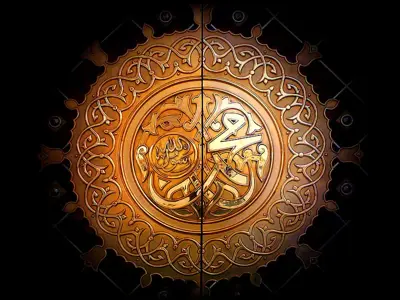
Muhammad was an Arab religious, social, and political leader and the founder of Islam. According to Islamic doctrine, he was a prophet, sent to preach and confirm the monotheistic teachings of Adam, Abraham, Moses, Jesus, and other prophets. He is believed to be the final prophet of God in all the main branches of Islam, though some modern denominations diverge from this belief. Muhammad united Arabia into a single Muslim polity, with the Quran as well as his teachings and practices forming the basis of Islamic religious belief.
