Baha' Ad-Din Al-Amili Quotes
Islamic Holy war against followers of other religions, such as Jews, is required unless they convert to Islam or pay the poll tax.
Baha' ad-Din al-Amili, 1547-1621, Persian Shia Islamic Scholar & Architect, Jami-i-Abbasi: yakdawrah-i fiqh-i Farsi, translation. Baha' al-Din Muhammad ibn Husayn al-Amili
Sourced by: Eigen's Political and Historical Quotations

Damn this world, Damn this time. Damn this fate That uncivilized Arabs have come to make me a Moslem
This is a huge epic poem that he wrote over several years. At the time, the Persians considered themselves far more civilized and sophisticated than the Arabs who were but tribesmen. They really resented the fact that it was the Arabs that brought Islam. And before, most of the Persians worshipped Zoroaster. Although Islam spread faster and further than any religion in history, it was not always easily accepted as this stanza of the poem indicates. There is to this day a superiority that the Iranians perceive over the Arabs. And to this day, many Arabs resent the Iranians for this attitude.

See {586039} for a quotation that goes further and seeks to punish and humiliate the non believers. This sura is often used by those wishing to illustrate the intolerance of Islam—especially of other religions. They fail to put this into the context of the Old Testament which proscribed death for heretics or the history of Christianity regarding the murder of nonbelievers. The difference is however, that a very small proportion of Jews or Christians today believe in following Biblical instructions in this respect while the proportion of Muslims who believe in the literal interpretation of scripture on these points is much larger. However there are Islamic modernists and moderates throughout the world who reject this notion of warring on all other religions and there is a struggle going on within Islam itself.

Nasr Hamid Abu Zayd, 1943-2010, was an modernistic Egyptian Islamic Scholar and a Professor at the University of Cairo. One of his writings argued that the discriminatory tax that the Koran specified for Christians and Jews in an Islamic nation was not fair or consonant with modern thought regarding freedom of religion and the rights of minorities. Some fundamentalist were outraged and charged him with Apostacy for criticizing a Koranic prescription. He was convicted and lost his professorship. That was the least of his problems. Since he was an apostate, he was not a Muslim the Egyptian Courts ruled, and therefore his wife, a Muslim, could not legally remain married to her. His marriage was legally dissolved and he was threatened with death by fundamentalists forcing him and his wife to go into exile in Holland where he taught at the Utrecht University. He never returned.
This quotation demonstrates that religious persecution of non Muslims was a duty, This has been a characteristic of all religious persecution regardless of religion. The quotation also shows that after 600 years, the original limited tolerance the Prophet had urged for People of the Book (Jews and Christians) was waning. Instead of non-believers being tolerated if they paid the special tax and were second class citizens, leaders were urged to convert or eliminate “infidels.”
The “People of the Book” are the Jews and the Christians who believe in the Old Testament book of God which Muslims recognize. Others who would not accept Islam would be killed, but if Jews and Christians are submissive and fell so, they may pay a special additional tax, the Jizyah.

Toleration is a relative term. The Muslim Moors made Christians (and Jews) pay a special tax. At times they were forced to wear special clothing so that they could be readily identified. And they could not build churches larger or taller than the smallest mosque in the community. At times, their occupations were restricted but at other times Christians and Jews were appointed to the highest positions like Vizier. The Inquisition, in contrast, forced all Muslims (and Jews) to leave the country without any of their property or money or be tortured and killed—usually by burning at the stake unless of course that they converted to Christianity.

In September of 2006 Pope Benedict XVI, quoted this statement in a lecture to theological students. There was much distress and protest among Muslim leaders.

He is a Greek Orthodox Christian, and he correctly observes that the Islamic world was considerably more tolerant than the Christian until the 18th century when Islam had become less tolerant in the Middle East while the Christians were modernizing and going through a cultural and intellectual enlightenment and societal modernization while the Muslims, became less tolerant than they were in earlier years leading to the modern situation.

Unlike other conquerors who wanted their wealth, property, animals or women, this was an offer that was almost too good to refuse even if the community were well fortified and had organized soldiers. It is important to note that these options were not available to all people. The Prophet had decided to allow Jews, Christians and Zoroastrians to practice their religion and pay the fizya tax which was not very high. The Persians were Zoroastrians and hence the did not have to convert which most other people did. The Muslim conquest of Persia, therefore, was much easier than most other places.

This sura has been in great controversy throughout the Muslim Empires. In part it separates many of the Arab cultures from the Ottomans. The latter had an organized meritocracy whereby Jews, Christians and other “heathens” of exceptional talent were sought out for advisory and leadership positions. In part this was justified as requiring that the Caliph and the Sultans had the power of life and death over their key appointees, hence they had to be slaves and other suras prohibited Muslims holding other Muslims in slavery. Even in modern times some Muslim countries have had key non-Islamic appointees and others would not. In historical practice, the Ottoman Empire utilized far more Christians and Jews that those societies involved Muslims until relatively recent historical times.

In this extraordinary act, the people who are persecuted are made to pay extra taxes to facilitate their persecution
At the time, the Muslim discrimination, terrible as it was, was not as bad as Christian discrimination against any non-Christians where death was very common. For many Muslims, the older historical values and practices are desirable if not mandatory today, while many others are modernists like most Christians who reject the Christian practices and morality of the past,
In the early stages of Islam, Muhammad had hoped to convert the Jews and others on the Arabian Peninsula. When they refused to be converted, he warred against them usually killing the men, and taking the women and children as slaves. The result was that non-believing tribes were “cleansed” from the Arabian Peninsula. The Muslims at the time preferred children as slaves. For then they could convert the children against their will. Adults in Islam must accept Islam in order to convert. Children are regarded as having no such maturity of decision making and therefore opposition to conversion may be ignored and they may be forced. Critics of Islam and those who argue that Islam is at odds with all other religions point to this quotation. They claim that it is the only religion whose founder and fundamental scriptures demand war against others for no other reason than that they believe in a different religion. The Catholic Church during the Crusades and the Inquisition had a similar philosophy as did Christian missionaries colonizing Africa later. One difference is that most Christians today repudiate the doctrine as against the true spirit and teachings of Christ and view it as historical error, while very few modern Muslims repudiate this quotation of the Prophet.
It is this verse that for some Muslims justifies terrorism against non-Muslims. See {584354} for a specific example. There are similar provisions in the Old Testament which a few extremely conservative Jews and Christians have used to advocate for blasphemy being a capital crime. Note that if an unbeliever repents and becomes a Muslim, he should be spared.
The Jews, Christians and Zoroastrians were allowed to maintain their own religion and live as 2nd class citizens and pay a special tax, but ALL other religions were to be forced to convert.

This sura has unfortunately been used by some Serbians and other Christians to justify ethnic cleansing against Muslims.
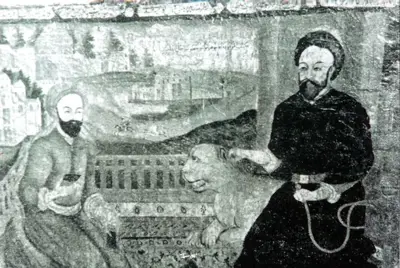
Bahāʾ al‐Dīn Muḥammad ibn Ḥusayn al‐ʿĀmilī (also known as Sheikh Baha'i, Persian: شیخ بهایی) was an Arab Iranian Shia Islamic scholar, philosopher, architect, mathematician, astronomer and poet who lived in the late 16th and early 17th centuries in Safavid Iran. He was born in Baalbek, Ottoman Syria (present-day Lebanon) but immigrated in his childhood to Safavid Iran with the rest of his family. He was one of the earliest astronomers in the Islamic world to suggest the possibility of the Earth's movement prior to the spread of the Copernican theory. He is considered one of the main co-founders of Isfahan School of Islamic Philosophy. In later years he became one of the teachers of Mulla Sadra.
