Muhammad Quotes
Fight those who believe not in Allah nor the Last Day, nor hold that forbidden which hath been forbidden by Allah and His Messenger, nor acknowledge the Religion of truth, from among the People of the Book, until they pay the Jizyah with willing submission, and feel themselves subdued.
The “People of the Book” are the Jews and the Christians who believe in the Old Testament book of God which Muslims recognize. Others who would not accept Islam would be killed, but if Jews and Christians are submissive and fell so, they may pay a special additional tax, the Jizyah.
Muhammad, 571-632, Prophet and Founder of Islam, Koran, Sura 8:60
Sourced by: Eigen's Political and Historical Quotations

Despite the fact that the statues were holy symbols to Buddhists, they were offensive to Muslims who say statues as “graven images” prohibited by the Koran. See Wakil Ahmad Muttawakil {608419} and Jamal’s other quotation {604665}.

He is a Greek Orthodox Christian, and he correctly observes that the Islamic world was considerably more tolerant than the Christian until the 18th century when Islam had become less tolerant in the Middle East while the Christians were modernizing and going through a cultural and intellectual enlightenment and societal modernization while the Muslims, became less tolerant than they were in earlier years leading to the modern situation.


See {586039} for a quotation that goes further and seeks to punish and humiliate the non believers. This sura is often used by those wishing to illustrate the intolerance of Islam—especially of other religions. They fail to put this into the context of the Old Testament which proscribed death for heretics or the history of Christianity regarding the murder of nonbelievers. The difference is however, that a very small proportion of Jews or Christians today believe in following Biblical instructions in this respect while the proportion of Muslims who believe in the literal interpretation of scripture on these points is much larger. However there are Islamic modernists and moderates throughout the world who reject this notion of warring on all other religions and there is a struggle going on within Islam itself.
Ethnic cleansing was a basic component of early Islam. The contemporary seeming hysteria over American troops in Arab nations, has in addition to the usual problems of soldiers from another land this background. The same is true about the presence of Israel. From some points of view, the presence of Christians and Jew in the Middle East is wrong per se because it undermines the work and intention of the Prophet.

There are many different schools of thought about Islamic Law just as there are many opnions on any legal system. However, amongst the otherox Muslims there are 5 major schools of Islamic jurispredence--4 are Sunni and 1 Shiite. These 5 all share an intolerance of other religions. The Prophet allolwed Christians, Jews and Zoroasstrians to worship in their religious manner but they had to pay a discriminatory tax. No such provision was made for other religions and some of the modern Muslims try to force them, under penalty of death, to convert to Islam. After the Iranian Revolution for example, members of the Bahai religion were mordered if they would not convert. Many were hunted down and butchered.
It is this verse that for some Muslims justifies terrorism against non-Muslims. See {584354} for a specific example. There are similar provisions in the Old Testament which a few extremely conservative Jews and Christians have used to advocate for blasphemy being a capital crime. Note that if an unbeliever repents and becomes a Muslim, he should be spared.
The Jews, Christians and Zoroastrians were allowed to maintain their own religion and live as 2nd class citizens and pay a special tax, but ALL other religions were to be forced to convert.
In the early stages of Islam, Muhammad had hoped to convert the Jews and others on the Arabian Peninsula. When they refused to be converted, he warred against them usually killing the men, and taking the women and children as slaves. The result was that non-believing tribes were “cleansed” from the Arabian Peninsula. The Muslims at the time preferred children as slaves. For then they could convert the children against their will. Adults in Islam must accept Islam in order to convert. Children are regarded as having no such maturity of decision making and therefore opposition to conversion may be ignored and they may be forced. Critics of Islam and those who argue that Islam is at odds with all other religions point to this quotation. They claim that it is the only religion whose founder and fundamental scriptures demand war against others for no other reason than that they believe in a different religion. The Catholic Church during the Crusades and the Inquisition had a similar philosophy as did Christian missionaries colonizing Africa later. One difference is that most Christians today repudiate the doctrine as against the true spirit and teachings of Christ and view it as historical error, while very few modern Muslims repudiate this quotation of the Prophet.
This quotation is an excellent summary of view of most fundamentalist Muslims’ current views towards Christians and Jews. In the Koran, the Prophet made exceptions about required conversions to Islam for Jews, Christians, and Zoroastrians (the pre Islamic Iranian religion). However, although they were to be allowed to maintain their religion. They had to pay a special tax called “Jizya” described in the quotation. Islam interpreted these words of the Prophet very differently in different places and times. Jews and Christians were not only treated very well in Islamic Spain and in Ottoman Turkey when Turkey was the seat of Islamic religion and power in the world, but they achieved some of the most important positions of power in the Empire and in the professions: law, military, teaching, philosophy, science and medicine. However, in other times and places, non Muslims were not allowed to worship in public or hold any position of influence or power and certainly never teach Muslims. So Jews and Christians in this world view will be tolerated but they must exist under a Muslim theocracy. That is the view that most of the ultra fundamentalist Muslims have today, which of course sets up a serious conflict potential.
See {617157} for a similar legal opinion. The concern was that poor Muslims may desert their faith when they see how well housed the tolerated people, Christians and Jews, are. They might conclude that Christianity or Judaism is better at making people wealthy than was Islam. See {617162} for a Koranic support of the idea. The Western view of this is generally, that is what the marketplace of ideas is all about. In 21st century America, Jews and Mormons on the average were the wealthiest religious groups. The logic of al-Ramli is that Mormons and Jews—each only 6 percent of the population—should not be allowed to show their wealth, lest Roman Catholics for example—25 percent of the population—will convert from Catholicism to the other two religions. From a democratic point of view, the response should be, we so be it. That is their choice. But America is the living proof that the assumption of conversion and loss of faith is per se wrong. The Mormons and Jews are visibly more successful, yet there are very few Roman Catholics leaving their church and converting to the two wealthier religions. There are some, but not at any greater rate than people convert from “wealthier” religions.

Nasr Hamid Abu Zayd, 1943-2010, was an modernistic Egyptian Islamic Scholar and a Professor at the University of Cairo. One of his writings argued that the discriminatory tax that the Koran specified for Christians and Jews in an Islamic nation was not fair or consonant with modern thought regarding freedom of religion and the rights of minorities. Some fundamentalist were outraged and charged him with Apostacy for criticizing a Koranic prescription. He was convicted and lost his professorship. That was the least of his problems. Since he was an apostate, he was not a Muslim the Egyptian Courts ruled, and therefore his wife, a Muslim, could not legally remain married to her. His marriage was legally dissolved and he was threatened with death by fundamentalists forcing him and his wife to go into exile in Holland where he taught at the Utrecht University. He never returned.

The “People of the Book” were the Jews and Christians who received special status in Muslim lands and societies. Despite the enmity and Muslim fundamentalist terrorism of modern times, Jews have historically lived in relative harmony in Islamic lands, and with the exception of the Christians in the Crusades, Christians were also given a place in Muslim societies. The “Book” refers to the Bible.
Toleration is a relative term. The Muslim Moors made Christians (and Jews) pay a special tax. At times they were forced to wear special clothing so that they could be readily identified. And they could not build churches larger or taller than the smallest mosque in the community. At times, their occupations were restricted but at other times Christians and Jews were appointed to the highest positions like Vizier. The Inquisition, in contrast, forced all Muslims (and Jews) to leave the country without any of their property or money or be tortured and killed—usually by burning at the stake unless of course that they converted to Christianity.

Nigeria was about equally divided into Muslims who dominated the North and Christians and Animists who dominated the South. The former were intent on making Sharia—Islamic Law—the law of the nation and the latter were equally passionate to avoid it. Muslim protests got very violent including murdering innocent civilians; the Christians threatened to retaliate.
This sura has unfortunately been used by some Serbians and other Christians to justify ethnic cleansing against Muslims.
While not in the Koran, this attributed statement is the basis for the ban on non-Muslims going on a Hajj and going to the most holy Muslim places—Mecca, Mina, Muzdalifa, and Arafat as well as the anti-religious hostility to all religions but Islam which is present in some Muslim countries.
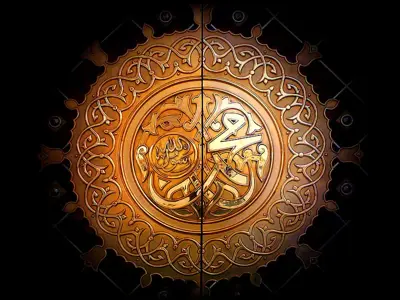
Muhammad was an Arab religious, social, and political leader and the founder of Islam. According to Islamic doctrine, he was a prophet, sent to preach and confirm the monotheistic teachings of Adam, Abraham, Moses, Jesus, and other prophets. He is believed to be the final prophet of God in all the main branches of Islam, though some modern denominations diverge from this belief. Muhammad united Arabia into a single Muslim polity, with the Quran as well as his teachings and practices forming the basis of Islamic religious belief.
