Peter Akinola Quotes
No Christian would pray for violence but it would be utterly naïve to sweep the issue of Islam under the carpet. Let no Muslim think that they have the monopoly on violence.
Nigeria was about equally divided into Muslims who dominated the North and Christians and Animists who dominated the South. The former were intent on making Sharia—Islamic Law—the law of the nation and the latter were equally passionate to avoid it. Muslim protests got very violent including murdering innocent civilians; the Christians threatened to retaliate.
Peter Akinola, Anglican Archbishop of Nigeria, President, Christian Association of Nigeria, Quoted in The Atlantic, March 2008
Sourced by: Eigen's Political and Historical Quotations


Ethnic cleansing was a basic component of early Islam. The contemporary seeming hysteria over American troops in Arab nations, has in addition to the usual problems of soldiers from another land this background. The same is true about the presence of Israel. From some points of view, the presence of Christians and Jew in the Middle East is wrong per se because it undermines the work and intention of the Prophet.
Toleration is a relative term. The Muslim Moors made Christians (and Jews) pay a special tax. At times they were forced to wear special clothing so that they could be readily identified. And they could not build churches larger or taller than the smallest mosque in the community. At times, their occupations were restricted but at other times Christians and Jews were appointed to the highest positions like Vizier. The Inquisition, in contrast, forced all Muslims (and Jews) to leave the country without any of their property or money or be tortured and killed—usually by burning at the stake unless of course that they converted to Christianity.

It is this verse that for some Muslims justifies terrorism against non-Muslims. See {584354} for a specific example. There are similar provisions in the Old Testament which a few extremely conservative Jews and Christians have used to advocate for blasphemy being a capital crime. Note that if an unbeliever repents and becomes a Muslim, he should be spared.

He is a Greek Orthodox Christian, and he correctly observes that the Islamic world was considerably more tolerant than the Christian until the 18th century when Islam had become less tolerant in the Middle East while the Christians were modernizing and going through a cultural and intellectual enlightenment and societal modernization while the Muslims, became less tolerant than they were in earlier years leading to the modern situation.


He was terminated for this and other criticisms of the Islamic fundamentalists. This statement, although very subtle by Western standards, was considered inappropriate since it could be interpreted to criticize some of the clergy.


In the middle of 2010, this organization was running public utility bus ads in major American cities.

Islamic religious extremists do not allow freedom of religion, freedom of speech, freedom of the press, right to life, freedom from torture and mutilation, self-government, gender equality, protection of children or women from violence, sexual freedom, freedom of expression, reproductive rights for women, right work, which are just a few. The modern Islamic extremists allow about the same human rights as did the Christian Kings and the Church of 1000 years ago. Ironically, it is less respect for human rights that many of the great Islamic societies provided 1000 years ago.

Tragically, at the time, reasonable, moderate Muslims who did stand up at that time ran the personal risk of social, religious ostracism to physical attack and killing of them and their families.

He drove a rented SUV into a crowd at a Dining Hall at the University of North Carolina from which he had recently graduated. He was an Iranian-born American citizen who had perceived that American policies and practices abroad led to the death on many Muslims. His interpretation of the Koran agrees with most of the radical, extremist, theologians, but does not comport with the interpretation of moderate Muslim religious thinkers. In 2008, he was convicted and sentenced to 33 years of prison.
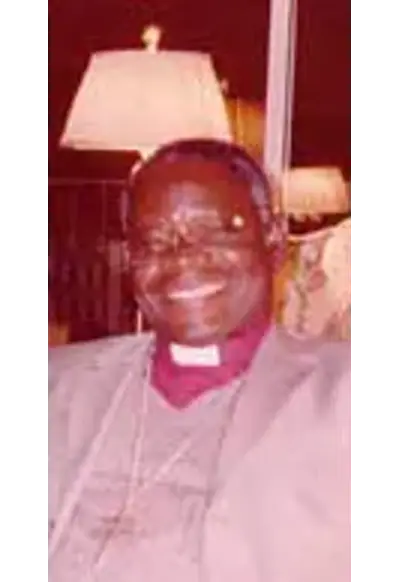
Peter Jasper Akinola is the former Anglican Primate of the Church of Nigeria. He is also the former Bishop of Abuja (Nigeria's capital) and Archbishop of Province III, which covered the northern and central parts of the country. When the division into ecclesiastical provinces was adopted in 2002, he became the first Archbishop of Abuja Province, a position he held until 2010. He is married and a father of six.
