John Esposito Quotes
Islam is not the enemy, religious extremism is.
John Louis Esposito, International Relations Expert, Speech, UN seminar "Confronting Islamophobia: Education for Tolerance and Understanding", December 2004
Sourced by: Eigen's Political and Historical Quotations

Most Americans and Europeans and their governments feel that Muslim leaders and organizations have not done very much in terms of “drawing the line” and publicly condemning terrorism. However many of the critics did not understand the intimidation that exists in most Islamic communities where the fascist fundamentalists target any Muslim public critics as heretics and apostates themselves. Many have been killed or injured in assassination attempts.


She had been covering Muslim nations and leaders for a long time and saw the relationship between the contemporary domination of Islamic fundamentalism and terrorism long before most.


He was one of the few Muslim political leaders who at that time called for reform of any aspect of Islam where reform and change are considered blasphemy and heresy by most Islamic theologians and clerics.


Few Islamic leaders have publicly made such unequivocal statements about the problem of extremism and fanaticism.
A Fatwa is an Islamic theological legal ruling. Islam has no hierarchy. So this Fatwa is not necessarily binding on any Muslims who do not wish to be bound by it. This is one of the relatively few Islamic theological organizations who have taken a public stand against terrorism.

She was originally Egyptian but because of her criticism, her citizenship was actually revoked.


Nigeria was about equally divided into Muslims who dominated the North and Christians and Animists who dominated the South. The former were intent on making Sharia—Islamic Law—the law of the nation and the latter were equally passionate to avoid it. Muslim protests got very violent including murdering innocent civilians; the Christians threatened to retaliate.

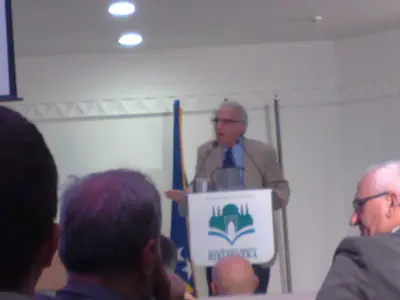
John Louis Esposito is an Italian American professor of Middle Eastern studies, Religious studies, and scholar of Islam, who serves as Professor of Religion & International Affairs and Islamic Studies at Georgetown University in Washington, D.C. He was also the Founding Director of the Prince Alwaleed Center for Muslim–Christian Understanding at Georgetown.
