Muhammad Quotes
Believe no one unless he follows your religion
Muhammad, 571-632, Prophet and Founder of Islam, Koran, Sura 3:73
Sourced by: Eigen's Political and Historical Quotations

The Koran is even more discriminatory regarding Jewish & Christian clerics: {584380}.


This quotation demonstrates that religious persecution of non Muslims was a duty, This has been a characteristic of all religious persecution regardless of religion. The quotation also shows that after 600 years, the original limited tolerance the Prophet had urged for People of the Book (Jews and Christians) was waning. Instead of non-believers being tolerated if they paid the special tax and were second class citizens, leaders were urged to convert or eliminate “infidels.”
In the early stages of Islam, Muhammad had hoped to convert the Jews and others on the Arabian Peninsula. When they refused to be converted, he warred against them usually killing the men, and taking the women and children as slaves. The result was that non-believing tribes were “cleansed” from the Arabian Peninsula. The Muslims at the time preferred children as slaves. For then they could convert the children against their will. Adults in Islam must accept Islam in order to convert. Children are regarded as having no such maturity of decision making and therefore opposition to conversion may be ignored and they may be forced. Critics of Islam and those who argue that Islam is at odds with all other religions point to this quotation. They claim that it is the only religion whose founder and fundamental scriptures demand war against others for no other reason than that they believe in a different religion. The Catholic Church during the Crusades and the Inquisition had a similar philosophy as did Christian missionaries colonizing Africa later. One difference is that most Christians today repudiate the doctrine as against the true spirit and teachings of Christ and view it as historical error, while very few modern Muslims repudiate this quotation of the Prophet.
It is this verse that for some Muslims justifies terrorism against non-Muslims. See {584354} for a specific example. There are similar provisions in the Old Testament which a few extremely conservative Jews and Christians have used to advocate for blasphemy being a capital crime. Note that if an unbeliever repents and becomes a Muslim, he should be spared.
The Islamic Holy Book even recommends against friendships with Christians and Jews. See {584381}.
For many extremists Muslims, this sura calls for the torture or killing of the enemies of Islam. For the more moderate Muslims, the penalty of opposing Islam should be expulsion or banishment. The further modern complication of this sura is the definition of “making war with Allah.” To some extremists, it is writing or publishing anything contrary to their view of Islam; it is occupying any Islamic nation or warring with that nation even though the basis of the war might have nothing to do with religion; it is bringing a Bible into an Islamic nations; it is allowing alcohol to be sold and served; it is opposing their discriminatory customs and laws; it is pressuring them not to stone adulteresses.
This sura has been in great controversy throughout the Muslim Empires. In part it separates many of the Arab cultures from the Ottomans. The latter had an organized meritocracy whereby Jews, Christians and other “heathens” of exceptional talent were sought out for advisory and leadership positions. In part this was justified as requiring that the Caliph and the Sultans had the power of life and death over their key appointees, hence they had to be slaves and other suras prohibited Muslims holding other Muslims in slavery. Even in modern times some Muslim countries have had key non-Islamic appointees and others would not. In historical practice, the Ottoman Empire utilized far more Christians and Jews that those societies involved Muslims until relatively recent historical times.
Toleration is a relative term. The Muslim Moors made Christians (and Jews) pay a special tax. At times they were forced to wear special clothing so that they could be readily identified. And they could not build churches larger or taller than the smallest mosque in the community. At times, their occupations were restricted but at other times Christians and Jews were appointed to the highest positions like Vizier. The Inquisition, in contrast, forced all Muslims (and Jews) to leave the country without any of their property or money or be tortured and killed—usually by burning at the stake unless of course that they converted to Christianity.

Most people are familiar with the people are familiar with the terrible persecution of the Jews in Spain by the Christians. Although there were a few examples of tolerance to Jews by Muslims when they controlled Spain and instances like modern Turkey. Generally however there is and has been Islamic persecution of Jews, Christians, and other non Muslims in almost all nations where Muslims have been in control. Until the Enlightenment, Christian persecution of other religions was just as bad if not worse.
The amazing thing about this quotation of 1913 is that at the end of the 20th century the Christians were again at the Muslims throats and Bosnian Muslims were being murdered and ethnically cleansed by the Roman Catholics of Croatia and the Eastern Orthodox Christians of Serbia. The hatred had persisted—the legacy of 1000 years before.

The report was praised by some of the intellectuals of Pakistan and most of the non-Islamic world. However, Pakistan the discussion of each of the cleavages, instigated the public passion of the cleavage and nothing significant was done.
This sura illustrates why peace treaties between Islamic and non Islamic countries are difficult to negotiate and enforce. For some fundamentalist Muslims, even making a peace treaty with Israel would constitute a transgression of the word of God. Nonetheless, the first treaty that the United States ever made was with a Muslim nation—Tripoli.
While moderate Muslims interpret this sura as meaning that theologically, a belief in the divinity of Christ is inconsistent to Islam, extreme fundamentalists take this to indicate that Christians are heretics and should be executed in accordance with Sharia – Islamic Law.


See {586039} for a quotation that goes further and seeks to punish and humiliate the non believers. This sura is often used by those wishing to illustrate the intolerance of Islam—especially of other religions. They fail to put this into the context of the Old Testament which proscribed death for heretics or the history of Christianity regarding the murder of nonbelievers. The difference is however, that a very small proportion of Jews or Christians today believe in following Biblical instructions in this respect while the proportion of Muslims who believe in the literal interpretation of scripture on these points is much larger. However there are Islamic modernists and moderates throughout the world who reject this notion of warring on all other religions and there is a struggle going on within Islam itself.

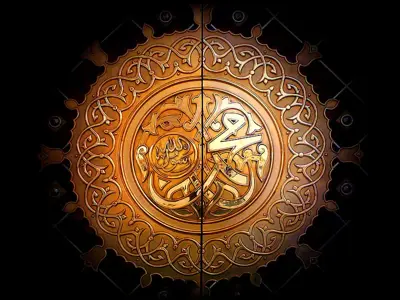
Muhammad was an Arab religious, social, and political leader and the founder of Islam. According to Islamic doctrine, he was a prophet, sent to preach and confirm the monotheistic teachings of Adam, Abraham, Moses, Jesus, and other prophets. He is believed to be the final prophet of God in all the main branches of Islam, though some modern denominations diverge from this belief. Muhammad united Arabia into a single Muslim polity, with the Quran as well as his teachings and practices forming the basis of Islamic religious belief.
