Martin Van Buren Quotes
… a treasonable attempt to overthrow the Federal Government by military force.
He was of course not the President then. But the stands that politicians took with respect to the rebellion of the South often determined their political futures. See {640751} for another future President’s quotation on the subject.
Martin Van Buren, 1782-1862, 8th President of the United States (Democrat), Characterization of the Southern attack on Fort Sumter, 1861
Sourced by: Eigen's Political and Historical Quotations

He was of course not the President then. But the stands that politicians took with respect to the rebellion of the South often determined their political futures. See {640752} for another future President’s quotation on the subject.


Italy was in the midst of civil war with the rebels in Emila wanting its independence from the civil authority of the Pope who then controlled virtually all of Italy. The French emperor, Napoleon BonaparteII, advised that the only way to produce peace was to allow Emila to have its independence. He was the last Pope to hold temporal power. While it should not be surprising, the Pope’s statement is essentially the same position that every autocratic authority has taken when there has been some local success of the rebels.


Lincoln was the first President who had ever been elected who was overtly and publicly opposed to slavery. As a result of that and other positions Lincoln took, there were many who would have liked to see him assassinated and there were others who talked of seizing the government in Washington before the radical new President could be sworn in and inaugurated. The plot was not carried out however.


With martial law came the authority to seize ALL guns in the colony for the emergency. This was not to disarm the general populace. It reflected the fact that there were relatively few colonists who owned guns as they were very expensive. The Governor could take those that existed and use them to defend against the rebels or whatever. There were more gun owners in the Revolution but still a minority. Even after the War of 1812 only 30% of Americans were armed, and that shortly decreased to 10% as there was no real culture of gun ownership in early America. This would come around the Civil War.

In 1956, Democratic presidential candidate, Adlai Stevenson, had suggested a nuclear testing ban. The then Vice President made his extreme accusation. See {619523} for another Nixon smear of Stevenson.

He had just assumed his post 6 days earlier. At this point he did not have enough knowledge to favor or oppose the regime change, but he did realize that the decision was a serious one and there would be no turning back. Diem was a creature of the Central Intelligence Agency. An anti-Communist Christian in a Buddhist county, the CIA engineered his rise to power, created his political party, provided him with cash to bribe other Vietnamese politicians, and paid for all the propaganda so he would “win” the Presidential elections. However, he abused the Buddhists, was thoroughly corrupt and ran a corrupt administration, but worst of all from the American point of view, he was unable to motivate the South Vietnamese population to fight the Communists. He reached the point where he was more of a liability, and the Central Intelligence Agency engineered a coup d’etat to remove him from power and replace him with a President more to our liking. (See {634540}.)

This was one of the several early unofficial Emancipations that was issued in the Civil War.

This was his name for the wealthy slaveowners in Tennessee. He was the military governor of Tennessee when he so labeled the secessionists.


Before the 1968 election, President Johnson, and gotten the North Vietnam Communists to agree to Peace Talks with the U. S. and South Vietnam. Then Candidate Nixon thought that if the peace talks were ongoing and making progress, there would be more support for the Democrats and Nixon's opponent Hubert Humphrey. So Nixon secretly send a secret emissary to South Vietnamese President Nguyen Van Thieu telling him that he would not get a very good deal because President Nixon claimed that President Johnson was too eager to end the Vietnam war. He suggested that if Thieu boycotted the peace talks, then when Nixon was elected, he would guarantee a much better deal for South Vietnam and Thieu personally. President Thieu boycotted the peace talks and there could be no progress. However there is a Federal Law, the Logan Act, that makes it a felony for a private American citizen to conduct or interfere with foreign policy or negotiations with a foreign government. President Johnson found out about Nixon—s sabotage of the Peace Talks, called Nixon and threatened him with prosecution if he interfered further. LBJ had decided that with the left wing at odds with the U. S. Government over the Vietnam War, a prosecution of Nixon would cause the Right Wing to challenge the government also and the country didn—t need further polarization. He would do that only if Nixon did not heed the President—s warning. But when Nixon won the election and became President, he was terribly anxious that his pre-election crimes would be made public, and spent much of his time and staff effort trying to find out who knew about his politically self-serving felony and who might make his crime public. See {583264}.

Under this law Kamal Sayid Qadir who had posted material of the on the internet was accused action “defamatory of government leadership” and given a 30 year jail sentence. See {589505}.

In 1993 Mooshood Abiola was the apparent victor in the Nigerian presidential election, but the election was `nullified' by the previous President and military dictator, General Ibrahim Babangida. Abiola announced he would attempt to form a government anyway.

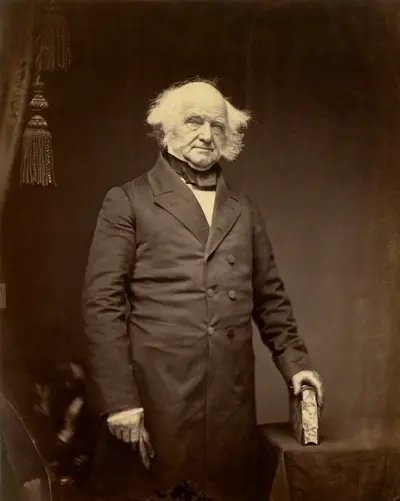
- Born: December 5, 1782
- Died: July 24, 1862
- Nationality: American
- Profession: President
Martin Van Buren was an American lawyer and statesman who served as the eighth president of the United States from 1837 to 1841. A founder of the Democratic Party, he had previously served as the ninth governor of New York, the tenth United States secretary of state, and the seventh vice president of the United States. He won the 1836 presidential election with the endorsement of popular outgoing President Andrew Jackson and the organizational strength of the Democratic Party. He lost his 1840 reelection bid to the Whig nominee, William Henry Harrison, thanks in part to the poor economic conditions surrounding the Panic of 1837. Later in his life, Van Buren emerged as an elder statesman and an important anti-slavery leader who led the Free Soil Party ticket in the 1848 presidential election.
