Elizabeth I Quotes
Was it not you, or such like advisers, that dissuaded her and stirred her up against us and other of the subjects?
Elizabeth I, 1533-1603, Queen of England, Reply to some English bishops who wanted Elizabeth to follow the pro-Catholic policies of her sister Mary, 1559
Sourced by: Eigen's Political and Historical Quotations

In 1956, Democratic presidential candidate, Adlai Stevenson, had suggested a nuclear testing ban. The then Vice President made his extreme accusation. See {619523} for another Nixon smear of Stevenson.


Italy was in the midst of civil war with the rebels in Emila wanting its independence from the civil authority of the Pope who then controlled virtually all of Italy. The French emperor, Napoleon BonaparteII, advised that the only way to produce peace was to allow Emila to have its independence. He was the last Pope to hold temporal power. While it should not be surprising, the Pope’s statement is essentially the same position that every autocratic authority has taken when there has been some local success of the rebels.


He was shot in 1944 for his involvement in an attempt to kill Hitler

Fox hunting was a sport engaged in only by the very wealthy. The House of Lords tends to represent the views and norms of the British upper classes who engage in Fox hunting. Skinner and the House of Commons wanted to ban Fox Hunting because it is a very cruel sport with dozens of dogs chasing a single fox and often tearing him apart before the riders arrive.

He was of course not the President then. But the stands that politicians took with respect to the rebellion of the South often determined their political futures. See {640751} for another future President’s quotation on the subject.


In 1993 Mooshood Abiola was the apparent victor in the Nigerian presidential election, but the election was `nullified' by the previous President and military dictator, General Ibrahim Babangida. Abiola announced he would attempt to form a government anyway.

The confusion of dissent and dissidence and loyalty has plagued many political parties and nations throughout time. The Communists neither originated the concept and certainly were not the last to operate by it, but under Stalin, it took on a virulence that was later emulated by the American McCarthyism.

Referring to Mohandas K. Gandhi, 1869-1948:


Although it seems incredible to us today, thousands of people were arrested and prosecuted under the Espionage Act. The government particularly targeted leftists such as Eugene V. Debs, Bill Haywood, J. Philip Randolph, Victor Berger, John Reed, Max Eastman, and Emma Goldman. Debs was sentenced to 20 years in prison for criticizing the Act itself.


With martial law came the authority to seize ALL guns in the colony for the emergency. This was not to disarm the general populace. It reflected the fact that there were relatively few colonists who owned guns as they were very expensive. The Governor could take those that existed and use them to defend against the rebels or whatever. There were more gun owners in the Revolution but still a minority. Even after the War of 1812 only 30% of Americans were armed, and that shortly decreased to 10% as there was no real culture of gun ownership in early America. This would come around the Civil War.


This quotation shows that the dissent leading to the American Revolution did not emerge suddenly in 1776 after the Battle of Bunker Hill. Dissent, sedition and even violence was documented here in 1774. Salem at the time was the second largest port in the colony and the customs tax collectors—Loyalist Americans—were run out of Salem.

The Roman Catholic Defender Organization had about 300 thousand volunteers, and Belfast was the central location of the Defender leaders.

This was his name for the wealthy slaveowners in Tennessee. He was the military governor of Tennessee when he so labeled the secessionists.


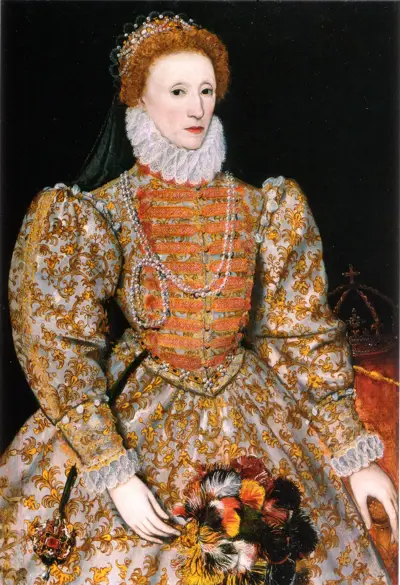
Elizabeth I was Queen of England and Ireland from 17 November 1558 until her death in 1603. Sometimes called the Virgin Queen, Gloriana or Good Queen Bess, Elizabeth was the last of the five monarchs of the House of Tudor.
