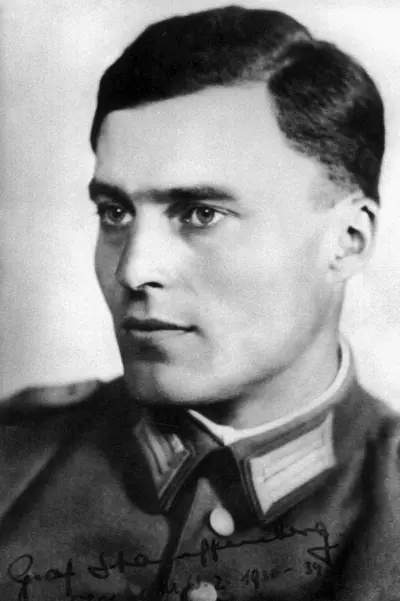
Claus von Stauffenberg Quote

Lyndon B. Johnson

Context: Before the 1968 election, President Johnson, and gotten the North Vietnam Communists to agree to Peace Talks with the U. S. and South Vietnam. Then Candidate Nixon thought that if the peace talks were ongoing and making progress, there would be more support for the Democrats and Nixon's opponent Hubert Humphrey. So Nixon secretly send a secret emissary to South Vietnamese President Nguyen Van Thieu telling him that he would not get a very good deal because President Nixon claimed that President Johnson was too eager to end the Vietnam war. He suggested that if Thieu boycotted the peace talks, then when Nixon was elected, he would guarantee a much better deal for South Vietnam and Thieu personally. President Thieu boycotted the peace talks and there could be no progress. However there is a Federal Law, the Logan Act, that makes it a felony for a private American citizen to conduct or interfere with foreign policy or negotiations with a foreign government. President Johnson found out about Nixon—s sabotage of the Peace Talks, called Nixon and threatened him with prosecution if he interfered further. LBJ had decided that with the left wing at odds with the U. S. Government over the Vietnam War, a prosecution of Nixon would cause the Right Wing to challenge the government also and the country didn—t need further polarization. He would do that only if Nixon did not heed the President—s warning. But when Nixon won the election and became President, he was terribly anxious that his pre-election crimes would be made public, and spent much of his time and staff effort trying to find out who knew about his politically self-serving felony and who might make his crime public. See the linked quotes for additional context.

Earl Browder

Context: When John L. Lewis called for a miners’ strike in 1943, the Communists lashed out at him and accused him of being a Nazi sympathizer. Communist patriotism was not due to fondness for the United States and their military; in fact, before Hitler invaded Russia at the beginning of World War II, communists, for the most part, were outspoken opponents of U.S. militarism.

Max Bedacht

Context: The confusion of dissent and dissidence and loyalty has plagued many political parties and nations throughout time. The Communists neither originated the concept and certainly were not the last to operate by it, but under Stalin, it took on a virulence that was later emulated by the American McCarthyism.

Eddie Cantor

Context: Ford was a great admirer of Adolf Hitler who thought Ford was the greatest of the Americans. He was an inveterate Fascist—racism and all. He vehemently opposed United States entry into WWII against the Nazis. He was awarded a medal by Hitler, and he had no qualms about taking it.

Joseph R. McCarthy

Context: McCarthy was one of the most interesting political phenomena of politics in the 1950s. He was an alcoholic megalomaniac who made wild accusations about communists everywhere and that the Secretary of State and other politicians were communists. He claimed to have a list of thousands of communists in high positions of government. His accusations were so dramatic that most people assumed that there were facts behind them otherwise no rational man would say such things. But it turned out that not a single accusation was ever proven. When McCarthy was esposed, he was censured by the Senate and he lost most of his political credibility and shortly thereafter died as a result of his severe alcoholism.

Portrait of Claus von Stauffenberg
Claus von Stauffenberg
  • Born November 15, 1907
  • Died July 21, 1944
  • Nationality German
  • Profession Soldier

Claus Philipp Maria Justinian Schenk Graf von Stauffenberg was a German army officer best known for his failed attempt on 20 July 1944 to assassinate Adolf Hitler at the Wolf's Lair and remove the Nazi Party from power. Along with Henning von Tresckow and Hans Oster, he was one of the central figures of the German resistance to Nazism within the Wehrmacht. For his involvement in the movement, he was executed by firing squad shortly after Operation Valkyrie.