Andrew Johnson Quotes
… traitorous aristocrats
This was his name for the wealthy slaveowners in Tennessee. He was the military governor of Tennessee when he so labeled the secessionists.
Andrew Johnson Name for the Slave Owning Southern Secessionists ~1861
Sourced by: Eigen's Political and Historical Quotations

In 1956, Democratic presidential candidate, Adlai Stevenson, had suggested a nuclear testing ban. The then Vice President made his extreme accusation. See {619523} for another Nixon smear of Stevenson.

Before the 1968 election, President Johnson, and gotten the North Vietnam Communists to agree to Peace Talks with the U. S. and South Vietnam. Then Candidate Nixon thought that if the peace talks were ongoing and making progress, there would be more support for the Democrats and Nixon's opponent Hubert Humphrey. So Nixon secretly send a secret emissary to South Vietnamese President Nguyen Van Thieu telling him that he would not get a very good deal because President Nixon claimed that President Johnson was too eager to end the Vietnam war. He suggested that if Thieu boycotted the peace talks, then when Nixon was elected, he would guarantee a much better deal for South Vietnam and Thieu personally. President Thieu boycotted the peace talks and there could be no progress. However there is a Federal Law, the Logan Act, that makes it a felony for a private American citizen to conduct or interfere with foreign policy or negotiations with a foreign government. President Johnson found out about Nixon—s sabotage of the Peace Talks, called Nixon and threatened him with prosecution if he interfered further. LBJ had decided that with the left wing at odds with the U. S. Government over the Vietnam War, a prosecution of Nixon would cause the Right Wing to challenge the government also and the country didn—t need further polarization. He would do that only if Nixon did not heed the President—s warning. But when Nixon won the election and became President, he was terribly anxious that his pre-election crimes would be made public, and spent much of his time and staff effort trying to find out who knew about his politically self-serving felony and who might make his crime public. See {583264}.


Italy was in the midst of civil war with the rebels in Emila wanting its independence from the civil authority of the Pope who then controlled virtually all of Italy. The French emperor, Napoleon BonaparteII, advised that the only way to produce peace was to allow Emila to have its independence. He was the last Pope to hold temporal power. While it should not be surprising, the Pope’s statement is essentially the same position that every autocratic authority has taken when there has been some local success of the rebels.

Referring to Mohandas K. Gandhi, 1869-1948:

He was shot in 1944 for his involvement in an attempt to kill Hitler


This poster's distribution before the JFK murder, has fed numerous conspiracy theories that right wing extremists were behind the assassination.

Kahn was killed by an American Drone Strike in Yemen in 2011. Inspire Magazine was an Online Magazine Al Qaeda produced.


Warning to John Calhoun and other South Carolinians about the implications of their nullification of the Tariff Act of 1832:

George W. Bush. The leak was a felony to which the elder Bush was particularly sensitive as he had served as the CIA Director. The younger Bush did not take aggressive measures to find out which of his staff had provided the unauthorized and classified information to the press.

McCarthy was one of the most interesting political phenomena of politics in the 1950s. He was an alcoholic megalomaniac who made wild accusations about communists everywhere and that the Secretary of State and other politicians were communists. He claimed to have a list of thousands of communists in high positions of government. His accusations were so dramatic that most people assumed that there were facts behind them otherwise no rational man would say such things. But it turned out that not a single accusation was ever proven. When McCarthy was esposed, he was censured by the Senate and he lost most of his political credibility and shortly thereafter died as a result of his severe alcoholism.


This was one of the several early unofficial Emancipations that was issued in the Civil War.

Oates was a Confederate Colonel during the Civil War. His statement almost started a brawl as the Memorial Dedication was a joint North-South participation event. Northern politicians, officers and men were outraged and rose to their feet with several mounting the rostrum to refute Oates intemperate remarks. However, like Southern politicians of the 1960s, they produced a lot of redneck support with such extreme statements. The main reason this quotation is important is that most politicians of North and South wanted to get the animosity of the Civil War over with and to do so sponsored these memorial events where both sides could celebrate and remember the bravery of men fighting and dying for their cause. The photographs of former enemies shaking hands which the newspapers ran frequently, would give the impression that by the 1880s the hatred and animosity of the Civil War was behind the nation. However, that was not at all true. Most veterans of both sides maintained their hatreds throughout their entire lives. Even their children carried the hatred into the next generation. Politicians were expected to not open the scabs of the old wounds in public, but many like Oates found political utility in not doing so. The moral outrage of many in the North remained until WWII when regional unity genuinely transcended the Civil War. See {639364} for a Northern example with no political motive but with uncontrollable moral outrage.

He had worked himself into a crescendo of shouting when he delivered this quotation. The main reason this quotation is important is that most politicians of North and South wanted to get the animosity of the Civil War over with and to do so sponsored these memorial events where both sides could celebrate and remember the bravery of men fighting and dying for their cause. The photographs of former enemies shaking hands which the newspapers ran frequently, would give the impression that by the 1880s the hatred and animosity of the Civil War was behind the nation. However, that was not at all true. Most veterans of both sides maintained their hatreds throughout their entire lives. Even their children carried the hatred into the next generation. Politicians were expected to not open the scabs of the old wounds in public, but many like Oates found political utility in not doing so. The moral outrage of many in the North remained until WWII when regional unity genuinely transcended the Civil War.
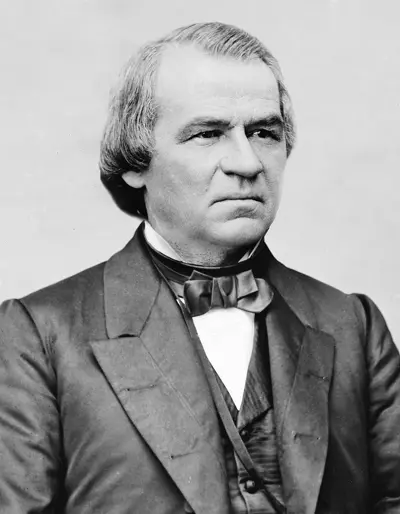
Andrew Johnson was the 17th president of the United States, serving from 1865 to 1869. He assumed the presidency as he was vice president at the time of the assassination of Abraham Lincoln. Johnson was a Democrat who ran with Lincoln on the National Union ticket, coming to office as the Civil War concluded. He favored quick restoration of the seceded states to the Union without protection for the former slaves. This led to conflict with the Republican-dominated Congress, culminating in his impeachment by the House of Representatives in 1868. He was acquitted in the Senate by one vote.
