Andrew Jackson Quotes
Disunion by armed force is treason.
Warning to John Calhoun and other South Carolinians about the implications of their nullification of the Tariff Act of 1832:
Andrew Jackson, 1767-1845, 7th President of the United States (Democrat, TN), Proclamation to the People of South Carolina, December 10, 1832
Sourced by: Eigen's Political and Historical Quotations

In the related quote, Jackson makes the case against the South Carolina argument for nullification. Here he makes his threat which was very successful in ending the notion of “nullification”. The extensive quotation is given as it summarizes the entire issue that was one of the crises of early America.
Jackson makes the case against the South Carolina argument for nullification. In the related quote, he makes his threat which was very successful in ending the notion of “nullification”. The extensive quotation is given as it summarizes the entire issue that was one of the crises of early America.


Lincoln was the first President who had ever been elected who was overtly and publicly opposed to slavery. As a result of that and other positions Lincoln took, there were many who would have liked to see him assassinated and there were others who talked of seizing the government in Washington before the radical new President could be sworn in and inaugurated. The plot was not carried out however.
It would be almost 30 years until Jackson would have been proved correct and the Civil War had begun.


He was shot in 1944 for his involvement in an attempt to kill Hitler

This quotation shows that the dissent leading to the American Revolution did not emerge suddenly in 1776 after the Battle of Bunker Hill. Dissent, sedition and even violence was documented here in 1774. Salem at the time was the second largest port in the colony and the customs tax collectors—Loyalist Americans—were run out of Salem.

This was one of the several early unofficial Emancipations that was issued in the Civil War.

This was his name for the wealthy slaveowners in Tennessee. He was the military governor of Tennessee when he so labeled the secessionists.


This is a wonderful quotation which illustrates the polarization which had taken place in America as a result of the slavery issue. Lincoln’s address—which history and most people have adjudged to be such a moderate attempt to find common ground, and which offended many of his constituents because he was compromising and temporizing on the slavery issue—was seen as the radical attacks of a “fanatic”. There is probably no policy that Lincoln or any other President could have followed that would be even marginally acceptable to the slave owners and their economies and the abolitionists and their economies. In the final analysis, slavery was the kind of issue that is not susceptible to compromise. No nation can exist half slave and half free. The Civil War was inevitable unless the South would give up slavery or the North would accept it.

Many Southern Rebels saw themselves as patriots and secession as akin to the Boston Tea Party—the start of a revolution.

While Douglas and Lincoln were political opponents with little love lost between them, both were patriots. Douglas’s position were much more popular in the South, and the moment he realized that Lincoln would win the Presidency, he headed South where he was very persuasive in trying to hold the Union together, but he could not see all the potential rebels and was only effective with some. South Carolina not only seceded, but in order to prevent any changing of minds, some the worst of the South Carolinians, attacked Fort Sumter firing on the American Flag and attacking and capturing the Union troops who were totally outnumbered. The Civil War was then inevitable.

The Latin phrase is the motto of the State of Virginia.


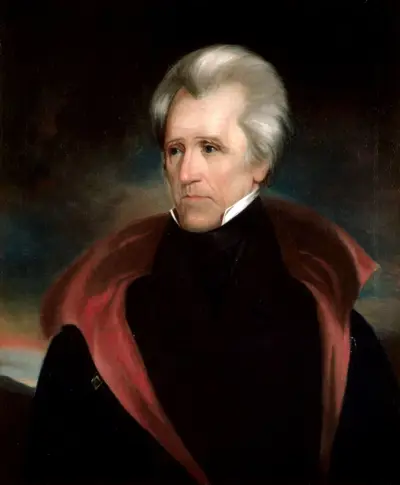
Andrew Jackson was an American lawyer, soldier, and statesman who served as the seventh president of the United States from 1829 to 1837. Before being elected to the presidency, Jackson gained fame as a general in the United States Army and served in both houses of the U.S. Congress. An expansionist president, Jackson sought to advance the rights of the "common man" against a "corrupt aristocracy" and to preserve the Union.
